 HYGO News
 Q: Why false hope (for vote)? Biden: Republicans snatched away the hope of (free money)
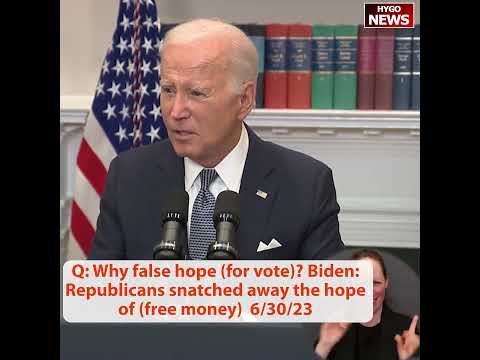
Reporter Asks Biden Why He Gave Borrowers “False Hope” — Biden Blames Republicans
On June 30, 2023, moments after the Supreme Court struck down his $400 billion student loan forgiveness program, President Biden was confronted by a reporter with a pointed question: “Mr. President, why did you give millions of borrowers false hope? You’ve doubted your own authority here in the past.” Biden rejected the premise entirely and instead blamed Republicans for the outcome, claiming they had “snatched away the hope” that borrowers were given. The exchange laid bare a central tension in the administration’s approach: Biden had promised relief he may never have had the legal authority to deliver, and when confronted with the consequences, he refused to accept any responsibility.
”I Didn’t Give Any False Hope”
The reporter’s question cut to the heart of the controversy. Biden had announced the student loan forgiveness program in August 2022, promising up to $10,000 in debt cancellation for borrowers earning under $125,000 and up to $20,000 for Pell Grant recipients. The announcement had generated enormous expectations among the roughly 43 million Americans who held federal student loans. But from the outset, legal experts, Republican officials, and even some Democrats had questioned whether the President possessed the constitutional authority to cancel such a vast sum through executive action alone.
Biden’s response was defiant: “I didn’t give any false hope. The question was whether or not I would do even more than was requested. What I did, I thought was appropriate and was able to be done and would get done. I didn’t give borrowers false hope.”
The claim that he had not given false hope was difficult to square with the timeline. Biden had made the promise, millions of borrowers had applied for and been approved for forgiveness, and then the program had been struck down by the nation’s highest court. For the borrowers who had been counting on that relief, the outcome was indistinguishable from having been given false hope, regardless of Biden’s intentions.
Blaming Republicans
Rather than acknowledging that his own legal strategy had failed or that his administration had pursued a constitutionally questionable path, Biden pivoted to blaming Republicans: “But the Republicans snatched away the hope that they were given. And it’s real — real hope.”
The framing was notable for several reasons. First, it was not Republicans who struck down the program but the Supreme Court, applying the separation of powers principles embedded in the Constitution. Six Republican state attorneys general had brought the legal challenge in Biden v. Nebraska, but the decision was rendered by a court that Biden himself had called upon to uphold the program. Characterizing the outcome as Republicans “snatching away” hope rather than the Court finding the program unlawful was a reframing of the legal reality.
Second, Biden’s assertion that the hope was “real” contradicted the Court’s finding. The 6-3 ruling determined that the program had been unlawful from its inception, meaning the hope Biden had extended to borrowers was built on an authority he did not legally possess. If the program was unconstitutional, then the promise of relief had always been contingent on a legal theory that the Court ultimately rejected.
The Reporter’s Key Point: Biden “Doubted His Own Authority”
The reporter’s reference to Biden having “doubted his own authority in the past” was a significant detail. Prior to announcing the forgiveness program, Biden had expressed uncertainty about whether he could cancel student debt through executive action. More prominently, former House Speaker Nancy Pelosi had stated in July 2021 that the President did not have the power to forgive student debt, declaring: “He does not. He can postpone. He can delay. But he does not have that power. That has to be an act of Congress.”
Biden’s decision to proceed despite these doubts, and despite Pelosi’s explicit legal assessment, was what made the reporter’s question so pointed. Biden had not merely been overruled by the Court; he had been overruled after members of his own party had warned him that he was on uncertain legal ground. The false hope, if it existed, was not created by Republicans but by an administration that pushed forward with a program whose legality was always in question.
The Legal Background
The Supreme Court’s 6-3 ruling in Biden v. Nebraska found that Biden had overstepped his authority under the HEROES Act of 2003. The administration had argued that the COVID-19 pandemic constituted a national emergency justifying broad debt cancellation, but the Court held that the HEROES Act’s authorization to “waive or modify” student loan provisions did not extend to a $400 billion blanket cancellation.
Six Republican state attorneys general had filed suit arguing the program violated the separation of powers. Separately, two borrowers who did not qualify for forgiveness under Biden’s plan brought their own challenge in Department of Education v. Brown. The 8th U.S. Circuit Court of Appeals had blocked the program in November 2022, and the Department of Justice’s request to the Supreme Court to lift that block was denied. The final 6-3 ruling confirmed that Biden had exceeded his constitutional authority.
A Political Promise Without Legal Foundation
Biden had announced the student loan forgiveness in August 2022, a move widely interpreted as an effort to energize Gen Z and Millennial voters ahead of the November midterm elections. The program would have canceled over $400 billion in student loans, up to $10,000 for borrowers earning $125,000 or less and up to $20,000 for Pell Grant recipients.
The political calculation was clear: student debt was a significant burden for younger voters, and offering relief could drive turnout among a demographic that traditionally voted Democratic. But by choosing executive action over legislation, the administration accepted the risk that the program could be struck down in court. When that risk materialized, the borrowers who had been promised relief were left with nothing, and the administration’s response was to blame the opposition rather than acknowledge the strategic failure.
The exchange captured in this video became emblematic of the broader student loan debate. Biden’s refusal to accept that he had raised expectations he could not legally fulfill, combined with his decision to blame Republicans for the Court’s ruling, illustrated the gap between political promises and constitutional reality.
Key Takeaways
- A reporter asked Biden directly why he had given millions of borrowers “false hope” on student loan forgiveness, noting that he had previously doubted his own authority to cancel debt.
- Biden denied giving false hope and blamed Republicans, saying they “snatched away the hope” that borrowers were given, rather than acknowledging the Supreme Court’s constitutional finding.
- The 6-3 ruling in Biden v. Nebraska found the $400 billion forgiveness program exceeded presidential authority under the HEROES Act.
- Biden had announced the forgiveness in August 2022, widely viewed as a political strategy to energize younger voters ahead of the midterms.
- The exchange highlighted the central tension of the student loan saga: Biden had promised relief on legally uncertain ground, and when the program was struck down, the administration refused to accept responsibility.