 HYGO News
 Zelensky: 'I Will Wear a Suit After This War'; The Moment Before the Oval Office Confrontation Erupted
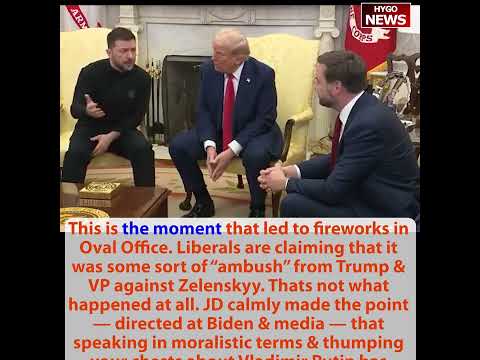
Zelensky: “I Will Wear a Suit After This War”; The Moment Before the Oval Office Confrontation Erupted
This footage captured the moments before and during the escalation that led to the explosive Trump-Zelensky confrontation on February 28, 2025. The meeting began with a lighthearted exchange when a reporter asked Zelensky why he refused to wear a suit to the Oval Office — “I will wear costume after this war will finish.” Trump praised Ukrainian fighters and said “we want to get it over with — it’s enough.” VP Vance then made the remarks that shifted Zelensky’s mood, arguing that “thumping our chest” about Putin under Biden “destroyed a significant chunk of the country” while Trump’s diplomacy offered a real path to peace. Zelensky pushed back by recounting his own diplomatic history with Putin, and the exchange escalated into the confrontation that ended with his expulsion.
The Suit Question
A reporter directed an unexpected question at Zelensky: “Why don’t you wear a suit? You’re the highest level in this country’s office and you refuse to wear a suit. Just want to see if you do own a suit.”
Zelensky handled the question with humor. “Yeah, yeah. Problems Americans have — problems with you, not — I don’t have such,” he said. “I will wear costume after this war will finish.”
He then engaged in lighthearted banter, looking at Trump’s suit. “Yes, maybe. Maybe something like yours,” Zelensky said. “Maybe something better, I don’t know. We will see. Maybe something cheaper.”
The exchange drew laughter and gave no indication of the confrontation that would follow. Zelensky’s wartime fatigues had become his signature — a visual reminder that Ukraine was at war and its president was a wartime leader. The promise to wear a suit “after this war will finish” was both a fashion statement and a political one: the fatigues would come off when peace was achieved, not before.
Trump: “We Want to Get It Over With — It’s Enough”
Trump’s initial remarks were warm but carried the message that would eventually provoke the confrontation.
“Very tough fighting, great fighters, and you have to be very proud of them,” Trump said of Ukrainian soldiers. “That’s their problem. But now we want to get it over with. It’s enough, right? We want to get it over with.”
He set a positive tone for the scheduled events: “It’s an honor to have you here. We’re going to sign the agreement at the conference in the East Room in a little while, right after lunch. And we’ll be having lunch together.”
Trump described the moment as significant: “It’s a somewhat exciting moment — get this thing done.”
He then offered Zelensky a choice about how the relationship would proceed. “You want me to be tough? I could be tougher than any human being you’ve ever seen. I’d be so tough,” Trump said. “But you’re never going to get a deal that way. So that’s the way it goes.”
The statement was simultaneously an offer of partnership and a warning. Trump was saying he could be an ally or an adversary — Zelensky’s choice would determine which.
Vance: “Thumping Our Chest” Failed
Vance then delivered the remarks that shifted the room’s dynamics. A reporter’s question about diplomacy gave Vance the opening to make a broader point about the failure of Biden-era Ukraine policy.
“For four years in the United States of America, we had a president who stood up at press conferences and talked tough about Vladimir Putin,” Vance said. “And then Putin invaded Ukraine and destroyed a significant chunk of the country.”
He drew the lesson: “The path to peace and the path to prosperity is maybe engaging in diplomacy.”
Vance named the failed approach directly: “We tried the pathway of Joe Biden — of thumping our chest and pretending that the President of the United States’s words mattered more than the President of the United States’s actions.”
He concluded: “What makes America a good country is America engaging in diplomacy. That’s what President Trump is doing.”
The argument was clear and devastating: Biden’s tough rhetoric had not deterred Putin. It had not prevented the invasion, stopped the destruction, or brought the war closer to resolution. Three years of verbal condemnation and weapons shipments had produced a stalemate with hundreds of thousands dead. Trump’s approach — direct engagement with Putin, honest conversations with Zelensky, and a willingness to impose terms — represented a fundamentally different path.
Zelensky’s Diplomatic History
Zelensky responded to Vance by recounting his own experience with Russian diplomacy, which he presented as evidence that negotiation with Putin was futile.
“He occupied big parts of Ukraine, parts of the East and Crimea — so he occupied it in 2014,” Zelensky said. “During a lot of years, I’m not speaking about just Biden, but those times was Obama, then President Trump, then President Biden, now President Trump.”
Zelensky described his own efforts: “I signed with him the deal. I signed with him, Macron, and Merkel — we signed ceasefire,” he said. “All of them told me that he will never go. We signed him gas contract.”
He then described the outcome: “But after that, he broke the ceasefire. He killed our people, and he didn’t exchange prisoners.”
Zelensky’s point was that he had tried diplomacy — he had personally negotiated with Putin, signed ceasefires with the endorsement of major European leaders, and watched Putin violate every agreement. The implication was that Trump’s faith in a negotiated settlement was naive because Zelensky had already walked that path and found it led nowhere.
It was this exchange — Zelensky essentially telling the American president and vice president that their diplomatic approach was doomed to fail based on his personal experience — that shifted the dynamic from diplomatic discussion to confrontation. Vance and Trump interpreted the pushback not as a legitimate policy disagreement but as an ungrateful ally lecturing the leaders of the country that was keeping him in power.
The Mood Shift
Observers in the room noted that Zelensky’s body language changed after Trump told him directly that the war needed to end. The shift from the jovial suit-question exchange to the increasingly tense back-and-forth was visible in the footage: Zelensky’s posture stiffened, his tone became more assertive, and the diplomatic courtesy that had characterized the opening minutes dissolved.
The footage revealed that the confrontation was not a sudden explosion but a gradual escalation. Each exchange pushed both sides further from the middle ground. Vance’s critique of Biden’s approach was interpreted by Zelensky as dismissive of Ukraine’s sacrifice. Zelensky’s recitation of failed ceasefires was interpreted by Trump and Vance as resistance to the peace process. Both interpretations were partially correct, and both contributed to the breakdown that followed.
Key Takeaways
- Zelensky told a reporter he would “wear a suit after this war will finish,” maintaining his wartime fatigues as both a fashion choice and a political statement.
- Trump praised Ukrainian fighters but said “we want to get it over with — it’s enough” and warned: “I could be tougher than any human being. But you’re never going to get a deal that way.”
- Vance said Biden’s approach of “thumping our chest” about Putin led to an invasion that “destroyed a significant chunk of the country,” while Trump’s diplomacy offered a real path.
- Zelensky recounted signing ceasefires with Putin alongside Macron and Merkel, only for Putin to “break the ceasefire” and “kill our people,” arguing negotiation had already failed.
- The footage showed the gradual mood shift — from suit jokes to historical debate to the confrontation that ended with Zelensky’s expulsion.