 HYGO News
 Q: why are others all wrong? White House: the President very clear: no recession
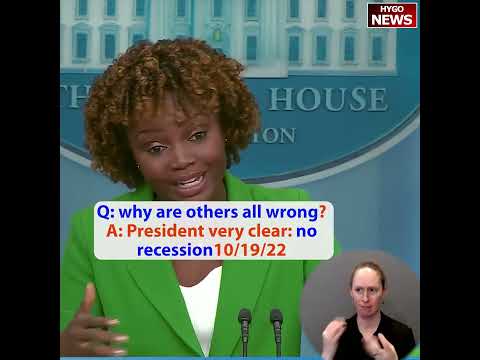
Reporter Lists Bezos, Dimon, Goldman Sachs CEO Warning of Recession — Asks “Why Are They Wrong?” KJP: “The President Was Very Clear: No Recession”
On 10/19/2022, a reporter confronted White House Press Secretary Karine Jean-Pierre with a growing roster of business leaders warning of recession: Jeff Bezos, Jamie Dimon, and Goldman Sachs’s CEO had all expressed serious concern about the economic outlook. “Why are they wrong then?” the reporter asked. KJP responded that the economy was “resilient” and that the U.S. was “in a better place to deal with these global challenges than any other global major company — I’m sorry — major country in the world.” She concluded by insisting “the president was very clear: he doesn’t anticipate there being a recession” — positioning Biden’s opinion against the collective judgment of America’s most prominent business leaders.
”Why Are They Wrong?”
The reporter’s framing was deliberately cumulative. “We’ve heard you say that the President believes there’s not going to be a recession or could not — might not happen,” the reporter said. “But a growing number of business folks who are outside this building — Jeff Bezos, yesterday, joining Jamie Dimon, Goldman Sachs’s CEO — why are they wrong then?”
The list was deliberately curated to represent the broadest possible business credibility. Jeff Bezos had founded and built Amazon into the world’s most valuable company. Jamie Dimon led JPMorgan Chase, the largest bank in the United States. Goldman Sachs was the most prestigious investment bank on Wall Street. These were not partisan commentators or cable news pundits — they were leaders who collectively managed trillions of dollars and whose businesses depended on accurate economic forecasting.
Their recession warnings were not casual observations. Dimon had warned in September 2022 that the U.S. could be in a recession “in six to nine months.” Bezos had urged consumers and businesses to “batten down the hatches.” Goldman Sachs economists had raised their recession probability estimates multiple times throughout 2022.
By asking “why are they wrong,” the reporter forced KJP to either defer to the collective wisdom of America’s business elite or dismiss it — effectively claiming that the White House’s political appointees had better economic insight than the people who ran the largest companies in the world.
”Global Major Company — I’m Sorry — Major Country”
KJP’s response began with an inadvertent substitution that became one of her more memorable stumbles. “What he wants the American people to know is, because of the resilience of the economy and because of our economic plan, we are in a better place to deal with these global challenges, to deal with global inflation, than any other global major company — I’m sorry — major country in the world,” KJP said.
The slip from “company” to “country” was a minor verbal error that became a recurring example of KJP’s difficulties at the podium. But the substance of the claim was more problematic than the delivery. The assertion that the U.S. was in “a better place” than any other major country to handle global challenges was a comparative argument that avoided the absolute question: was the U.S. heading toward a recession? Being in a “better place” than, say, the UK or Germany — both of which were experiencing their own severe inflation and energy crises — didn’t mean the U.S. economy was strong in any objective sense.
”Jobs Are — Jobs Are — Jobs Are Up”
KJP cited the administration’s standard defense. “We see jobs — jobs are — jobs are up. We created 10 million jobs,” KJP said.
The 10-million-jobs claim, used by Biden and his press team in virtually every economic briefing, required significant context. The vast majority of those jobs were recoveries from the pandemic-era collapse — workers returning to positions that had existed before COVID lockdowns eliminated them. The economy had lost 22 million jobs in March and April 2020; most of the “10 million jobs created” under Biden represented the natural rebound as restrictions lifted, vaccines became available, and economic activity resumed.
By October 2022, total employment had only recently surpassed its pre-pandemic level from February 2020. Claiming credit for “creating” jobs that were, in reality, restored positions was like a store claiming it had “built” revenue after reopening from a forced closure.
Moreover, the strong jobs data — while genuinely impressive in certain sectors — was itself contributing to the inflation the White House was simultaneously trying to combat. Tight labor markets drove wages up, which pushed business costs higher, which translated to higher consumer prices. The Federal Reserve’s aggressive rate hikes were explicitly designed to cool the job market. The White House was celebrating the very metric that its own central bank was trying to suppress.
”He Doesn’t Anticipate”
KJP’s closing line was the most revealing. “And so, look, again, the president was very clear: he doesn’t anticipate there being a recession because of those data points that I just laid out,” KJP said.
The phrase “he doesn’t anticipate” positioned Biden’s personal belief as the relevant economic forecast, overriding the analysis of Bezos, Dimon, Goldman Sachs, Bloomberg Economics (which had forecast a 100% recession probability), and a growing consensus of professional economists. The president’s anticipation was treated as dispositive — he had spoken, the matter was settled.
This was not economic analysis; it was political messaging masquerading as economic confidence. Biden had no special insight into economic conditions that America’s leading business executives lacked. If anything, the people running the nation’s largest companies and banks had better real-time data about consumer behavior, credit conditions, supply chains, and business investment than any political appointee in the White House.
The Recession Definition Debate
The White House’s “no recession” position in October 2022 had already been tested by reality. GDP had contracted in both Q1 and Q2 of 2022 — the traditional textbook definition of a recession (two consecutive quarters of negative GDP growth). The administration had responded by insisting that the National Bureau of Economic Research (NBER), not the textbook definition, was the authoritative determinant of recessions, and that the NBER had not declared a recession.
The semantic argument — technically correct but politically transparent — allowed the White House to maintain its “no recession” line while GDP data suggested otherwise. It was the economic equivalent of claiming it wasn’t raining because the weather service hadn’t issued a formal rain advisory, despite visible precipitation.
The Business Leader Divide
The reporter’s question highlighted an unusual dynamic: the private sector was collectively warning of danger while the government insisted everything was fine. This represented a reversal of the typical pattern, where governments were more cautious and businesses more optimistic. In 2022, businesses with actual money at stake were battening down, while the White House — whose political fortunes depended on optimism — maintained its rosy outlook.
The business community’s warnings proved more accurate than the White House’s assurances. While the NBER never officially declared a 2022-2023 recession, the economic conditions that prompted the warnings — aggressive Fed tightening, housing market slowdown, consumer spending pullback, corporate layoffs — all materialized. The White House’s confidence was proven premature even if the worst-case recession scenario was ultimately avoided.
Key Takeaways
- A reporter listed Bezos, Dimon, and Goldman Sachs’s CEO all warning of recession and asked “why are they wrong”; KJP insisted Biden “doesn’t anticipate there being a recession.”
- KJP accidentally called the U.S. a “global major company” before correcting to “country” — one of her more memorable verbal stumbles.
- She cited “10 million jobs created” — mostly pandemic recovery — as evidence against recession while the Fed was actively trying to cool the labor market.
- The White House maintained its “no recession” position despite two quarters of GDP contraction, relying on the NBER’s lack of an official declaration.
- Biden’s personal anticipation was positioned as more authoritative than the collective judgment of America’s most prominent business leaders.
Transcript Highlights
The following is transcribed from the video audio (unverified — AI-generated from audio).
- The President believes there’s not going to be a recession. But Jeff Bezos, Jamie Dimon, Goldman Sachs CEO — why are they wrong then?
- Because of the resilience of the economy and our economic plan, we are in a better place than any other global major company — I’m sorry — major country in the world.
- We are in a stronger position to navigate through these global challenges.
- We see jobs — jobs are up. We created 10 million jobs.
- The president was very clear: he doesn’t anticipate there being a recession.
- Because of those data points that I just laid out.
Full transcript: 154 words transcribed via Whisper AI.