 HYGO News
 Q: When Biden Will Hold Another Press Conference? A: Laughs, Everyday! Everyday!
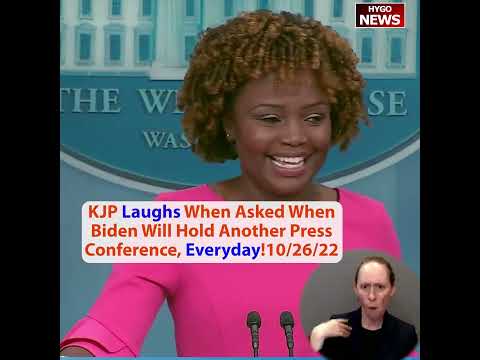
Reporter Begs KJP to Get Biden Into the Briefing Room — “It’s Been Since January”; KJP Laughs and Says He Takes Questions “Almost Every Day”
On 10/26/2022, a reporter pressed White House Press Secretary Karine Jean-Pierre on President Biden’s absence from the White House briefing room. “It’s been since January since the President has held a press conference here at the White House,” the reporter said, asking whether the “scarcity of press conferences” had contributed to public misinformation and concluding with a direct plea: “Can we please get him in here?” KJP laughed, said “duly noted” twice, and insisted Biden “takes questions from all of you almost every day” — conflating shouted questions over helicopter noise with the sustained, multi-topic questioning that a formal press conference provides.
”Can We Please Get Him in Here?”
The reporter’s question combined a factual observation with an unusual personal appeal. “I’d like to follow up on something you were asked Monday about presidential press conferences,” the reporter said. “It’s been since January since the President has held a press conference here at the White House.”
The nine-month gap between formal press conferences was historically unusual. Previous presidents had held press conferences more frequently, particularly during periods of significant public concern. Biden’s avoidance of the format had been a running source of frustration for the White House press corps, which relied on extended press conferences to pursue follow-up questions and pin down presidential positions on complex issues.
“Is this administration at all concerned that the scarcity of press conferences by this President has in any way led to some of the misinformation that has been out in the public?” the reporter asked — a diplomatically phrased suggestion that Biden’s absence from sustained questioning was allowing false narratives to flourish.
The reporter then dropped the diplomatic framing entirely. “Can we please get him in here?” the reporter asked — a rare moment of direct, almost personal pleading from a White House correspondent to the press secretary.
”Duly Noted”
KJP’s response began with her standard acknowledgment-without-commitment. “I mean, look, I understand the question. You guys have to ask the question about press conferences. Duly noted,” KJP said.
“Duly noted” was KJP’s way of acknowledging a request she had no intention of fulfilling — the verbal equivalent of putting a memo in a filing cabinet that would never be opened. The phrase appeared in KJP’s responses to press conference questions with such regularity that it had become a running joke among White House correspondents.
“And so, we, again, appreciate the question,” KJP added — another formula that conveyed politeness without substance. Appreciating the question is not the same as answering it.
”He Takes Questions Almost Every Day”
KJP then deployed her standard defense: Biden answered questions frequently, just not in formal press conferences. “He certainly takes questions from all of you. And he does it often,” KJP said.
“This is a President who has not shied away from taking questions from all of you,” KJP continued. “And so, I think he’ll continue to do that. Almost every day, he’ll continue to make sure that — I’m sure, on his own, will continue to take your questions.”
The distinction between “taking questions” and “holding a press conference” was critical, and KJP’s conflation of the two was deliberate. Biden’s question-taking typically occurred in one of several controlled formats:
Shouted questions after events: Reporters yelled questions as Biden walked away from a podium or toward Marine One. Biden selectively chose which to answer — usually one or two — and often couldn’t hear or pretended not to hear inconvenient questions over helicopter noise.
Pre-selected reporters: At some events, Biden called on reporters from a pre-approved list, limiting questions to friendly or anticipated topics. “I’m told there will be four questioners,” Biden had said at one such event — revealing that his staff predetermined the format.
Brief pool sprays: A small group of reporters was allowed into the Oval Office or Cabinet Room for brief remarks, sometimes shouting a question or two before being ushered out by staff.
None of these formats provided the sustained, multi-topic, follow-up-enabled questioning that a formal press conference allowed. A press conference typically lasted 30-60 minutes, covered a dozen or more topics, and permitted reporters to challenge the president’s initial answers with follow-up questions. Biden’s “takes questions almost every day” consisted of brief, controlled encounters where he maintained complete discretion over which questions to acknowledge.
”A More Robust Discussion”
The reporter attempted to articulate the difference KJP was obscuring. “I understand of having a more, you know — more —” KJP stumbled, unable to complete the sentence.
“A more robust discussion,” the reporter supplied.
The reporter’s phrase — “robust discussion” — captured precisely what was missing. Biden’s drive-by question sessions were the opposite of robust — they were fleeting, selective, and easily terminated by aides or by Biden himself walking away. The formal press conference format forced the president to stand at a podium and engage with the press for an extended period, making it much harder to avoid difficult topics or cut off follow-up questions.
The Press Conference Gap
Biden’s avoidance of formal press conferences was documented and quantified by press freedom organizations. By October 2022, Biden had held fewer solo press conferences than any modern president at the same point in their term. The comparison was particularly unfavorable when measured against Trump, who held combative but frequent press conferences and briefings, and Obama, who maintained a regular press conference schedule throughout his presidency.
The scarcity was widely interpreted as a strategic decision by Biden’s staff to minimize unscripted exposure. Press conferences were the format most likely to produce the extended verbal stumbles, confused statements, and off-message remarks that generated negative headlines. By limiting Biden to brief, controlled interactions, the communications team could reduce the risk of gaffes while still claiming the president was “accessible.”
The strategy had a cost: it reduced public accountability. A president who never faced sustained questioning on his policies, decisions, and statements was a president who was never forced to defend them in real time. The briefing room — with its tradition of adversarial but substantive questioning — existed precisely to provide this accountability function.
”Let Him Know We’d Love to See Him”
The reporter concluded with a final appeal. “Well, just let him know we’d love to see him in here someday,” the reporter said.
KJP laughed. “Okay. But, again, I’m not going to get ahead of him, of where we are with the process,” KJP said.
The laugh was revealing — it acknowledged the absurdity of the situation without committing to change it. The “process” KJP referenced was never explained: what process determined when the president of the United States would face questions from the press in his own building? The answer, clearly, was a political calculation about risk and reward — and the calculation consistently concluded that the risk of Biden’s unscripted performance outweighed the reward of demonstrating presidential accessibility.
The Transparency Contradiction
The exchange highlighted a fundamental contradiction in the Biden administration’s self-presentation. Biden had entered office promising “the most transparent administration in history.” He had criticized Trump’s combative relationship with the press and pledged to restore traditional norms of presidential communication.
Yet by October 2022, Biden had held fewer press conferences than any modern predecessor, his press secretary regularly dismissed reporter questions as “bizarre” or “ridiculous,” classified documents were being handled outside proper channels, and the White House had established a pattern of releasing unfavorable information on Friday evenings to avoid coverage.
The gap between promised transparency and actual practice was one of the defining contradictions of the Biden presidency — and the reporter’s plaintive “can we please get him in here” captured the press corps’ frustration with it.
Key Takeaways
- It had been nine months since Biden held a formal press conference at the White House — fewer than any modern president at the same point in their term.
- A reporter asked if the “scarcity of press conferences” contributed to misinformation and pleaded “can we please get him in here?”
- KJP said “duly noted” twice, laughed, and insisted Biden “takes questions almost every day” — conflating brief shouted exchanges with formal press conferences.
- Biden’s question-taking occurred in controlled formats: shouted questions over helicopter noise, pre-selected reporters, and brief pool sprays — none providing sustained follow-up.
- The press conference avoidance was widely interpreted as a strategic decision to minimize unscripted exposure that could produce damaging verbal stumbles.
Transcript Highlights
The following is transcribed from the video audio (unverified — AI-generated from audio).
- It’s been since January since the President has held a press conference here at the White House.
- Is this administration concerned that the scarcity of press conferences has led to some of the misinformation out in the public? Can we please get him in here?
- You guys have to ask the question about press conferences. Duly noted.
- He certainly takes questions from all of you. He does it often.
- This is a President who has not shied away from taking questions. Almost every day.
- Just let him know we’d love to see him in here someday. — (Laughs.) Okay. I’m not going to get ahead of him.
Full transcript: 238 words transcribed via Whisper AI.