 HYGO News
 Q: What you say to Zelensky? Trump: How ya doing? Regime change takes chaos; calm down, ridiculous
Q: What you say to Zelensky? Trump: How ya doing? Regime change takes chaos; calm down, ridiculous
Trump’s departure for the NATO summit in the Netherlands produced a wide-ranging press stakeout in which the president addressed his planned meeting with Ukrainian President Zelensky, framed his position on Iranian regime change, criticized Israel for striking Iran after the ceasefire deal was finalized, and delivered one of the sharpest rebukes of American cable news outlets in recent memory. He praised the American B-2 pilots in extraordinary terms — “magnificent hit in the dark of night with no moon, no light, no nothing” — and called CNN “disrespectful” for questioning the completeness of the damage. He walked through his own reasoning on NATO Article 5, noting that he is committed to friends without necessarily endorsing the traditional reading of the collective defense commitment. The press stakeout was vintage Trump: blunt, discursive, and unconcerned with diplomatic niceties.
”How Ya Doing?”
The reporter asked about the upcoming Zelensky meeting. “Do you think you’ll meet with Zelensky when you’re there?”
Trump: “Yeah, probably I’ll see him.”
“What would you say to him?”
Trump: “Say, how you doing? He’s in a tough situation. Should have never been there.”
The “how you doing” response is classic Trump informality. Presidents typically speak of meetings with foreign leaders in formal diplomatic language. Trump’s shorthand — that he’ll ask Zelensky how he’s doing — reduces a high-stakes meeting to the tone of a chance encounter between acquaintances.
“He’s in a tough situation. Should have never been there.” The “should have never been there” framing is Trump’s ongoing characterization that the Russia-Ukraine war is the result of decisions that should not have been made. In Trump’s telling, if different policy choices had been made during the Biden administration, the war would not have occurred.
”Regime Change Takes Chaos”
The reporter then pivoted to Iran. “Do you want to see regime change in Iran?”
Trump: “No. If there was, there was. But no, I don’t want to. I’d like to see everything calm down as quickly as possible. Regime change takes chaos. Ideally, we don’t want to see so much chaos.”
The “regime change takes chaos” observation is one of the clearest articulations of the administration’s restraint on the regime question. Trump is not opposed to regime change as a principle — he is opposed to it as a practical matter in this specific context.
Why? Because regime change involves chaos — the period of transition when the old order collapses but the new order has not yet consolidated. In chaos, civil war becomes possible. Power vacuums attract competing factions. The humanitarian cost can be enormous. The strategic cost can include terror groups taking control of weapons and infrastructure that the prior regime controlled but did not deploy.
Iran with an Iranian regime that has accepted denuclearization is, in Trump’s reading, more stable than Iran in a chaotic transition period. The administration’s preference for a settled outcome is therefore the preference for avoiding the chaos that regime change would bring.
”Very Good Traders”
Trump offered a characterization of the Iranian people that is worth noting. “You know, the Iranians are very good traders. They’re very good business people. And they got a lot of oil. They should be fine. They should be able to rebuild and do a good job.”
The characterization of Iranians as “very good traders” and “very good business people” is sympathetic. Trump is not demonizing the Iranian people. He is noting their commercial capability and suggesting that Iran can rebuild. The implicit framework is that the problem with Iran has been the regime’s policy choices, not the capacities of the Iranian population.
”They’re Never Going To Have Nuclear”
Trump’s restatement of the core outcome was direct. “They’re never going to have nuclear. But other than that, they should do a great job.”
“Never going to have nuclear” is the administration’s firm commitment. The strikes destroyed the existing program. The administration will prevent reconstitution. Iran’s future can include prosperity and integration into international commerce. Iran’s future cannot include nuclear weapons.
“Other than that, they should do a great job” is the offer. Iran can be a successful regional economic power if it makes the right strategic choices.
”I’m Not Happy That Israel Is Going Out Now”
Trump then addressed the overnight situation. Israel had conducted strikes in response to what it characterized as an Iranian rocket that was fired after the ceasefire began. Trump was unhappy about both the Iranian rocket and the Israeli response.
“Are you far away from the Israeli clashes? I don’t think so, but I’m not happy that Israel is going out now. There was one rocket that I guess was fired overboard. It was after the time limit and it missed its target. And now Israel is going out. These guys got to calm down. They’re killing us.”
“These guys got to calm down” is Trump expressing frustration with both sides. One Iranian rocket that missed its target is not the kind of violation that should trigger Israeli retaliation after a ceasefire. Israeli retaliation for a missed strike then threatens to unravel the ceasefire the administration spent days negotiating.
”Plenty Of Things I Didn’t Like”
Trump continued. “I didn’t like plenty of things I saw yesterday. I didn’t like the fact that Israel unloaded right after we made the deal. They didn’t have to unload. I didn’t like the fact that the retaliation was very strong.”
The specificity is unusual. Presidents generally do not publicly criticize Israel with this level of directness. Trump is willing to. He is saying that Israel’s last-minute strikes after the deal was finalized were unnecessary and that the scale of the strikes was excessive.
The diplomatic consequence is meaningful. Netanyahu and the Israeli security establishment will receive this public criticism through every diplomatic channel. The administration is signaling that even close allies cannot assume automatic American support for every escalatory choice.
”But In All Fairness, Israel Unloaded A Lot”
Trump then offered the balanced framing. “But in all fairness, Israel unloaded a lot. And now I hear Israel just went out because they felt it was violated by one rocket that didn’t land anywhere. That’s not what we want.”
The observation that Israel “unloaded a lot” during the 12-day war is factually accurate. Israeli strikes against Iranian targets — nuclear facilities, missile sites, IRGC leadership — were extensive and effective. Israeli forces did most of the kinetic work in the campaign. But Trump is arguing that having done that much, Israel should stop rather than continue after the ceasefire.
”I’m Not Happy About That Israel Either”
Trump’s combined verdict. “I’ll tell you, and I’m telling you, I’m not happy about that Israel either. All I do is play both sides.”
“Play both sides” is a revealing framing. Trump is positioning himself as the mediator who criticizes both Iran and Israel when they contribute to instability. The posture is neither pro-Iran nor pro-Israel in this specific moment. It is pro-stability.
”The Last Thing On Iran’s Mind”
A reporter asked about nuclear enrichment commitments. “Your President did remind me of any commitments yesterday about uranium enrichment. What? About uranium enrichment.”
Trump: “They’re not going to have enrichment and they’re not going to have a nuclear weapon. And they know that they’re going to get on to being a great trading nation. You know they’re very good traders. And they’re going to be a great trading nation and they have a lot of oil. They’re going to do well. They’re not going to have a nuclear weapon.”
The reporter pressed. “So did they promise?”
Trump: “The last thing on Iran’s mind right now is nuclear weapons.”
The characterization — “the last thing on Iran’s mind right now” — is realistic. A country that has just seen its nuclear program destroyed, its conventional missile capability degraded, and its proxy networks collapsed is not, in the immediate aftermath, thinking about how to rebuild the destroyed capability. It is thinking about survival, stabilization, and the path forward. Trump’s observation captures the psychological reality of post-defeat decision-making.
The B-2 Pilots Praise
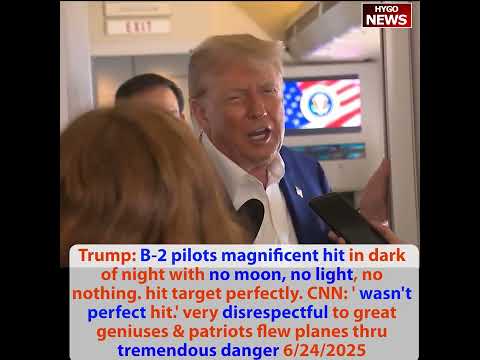
Trump then pivoted to the B-2 operation. “Our B-2 pilots made this all possible. They had a magnificent hit in the dark of night with no moon, no light, no nothing. They hit the target perfectly, wiped it out.”
The “no moon, no light, no nothing” detail is operationally specific. Nighttime strikes on defended targets depend on darkness as a protective cover. The pilots flew into a defended target in conditions designed to minimize any visual cue that would aid detection. The mission succeeded in those conditions.
“They hit the target perfectly, wiped it out” is the administration’s continued characterization of the damage. The claim that the target was “wiped out” is stronger than “disabled” or “damaged.” It is the assertion that the Iranian capability has been removed, not just reduced.
CNN’s “Disrespectful” Coverage
Trump then turned on CNN specifically. “The press is very disrespectful. I saw CNN fake news going, well, maybe it wasn’t a perfect hit, it was perfect. They said, maybe it did destroy it. We agree it did destroy it, but maybe it could have destroyed it more. No, no, it couldn’t have destroyed it more. Everyone hit.”
The characterization of CNN as “fake news” is familiar. What is less familiar is the specific nature of Trump’s critique — that CNN is questioning the completeness of the damage. The administration’s framing is that the strikes destroyed the program. CNN’s framing, in Trump’s telling, is that the strikes might have been slightly less than fully effective.
The substantive difference is small. The rhetorical difference matters. “Destroyed” validates the operation. “Maybe didn’t fully destroy” hedges it. The administration wants the unhedged framing to dominate.
”Disrespectful To Those Great Geniuses And Patriots”
Trump’s strongest critique was of the political cost to the pilots. “It’s very disrespectful to those great geniuses and patriots that flew those planes through tremendous dangers.”
The framing converts CNN’s coverage into an insult to American servicemembers. The pilots risked their lives. They executed perfectly. Questioning the completeness of their success is, in Trump’s framing, questioning their competence. And questioning their competence is disrespecting them.
Whether CNN’s coverage can fairly be characterized as disrespectful to the pilots is a judgment call. What is clear is that Trump wants the coverage so characterized. The political cost of being perceived as disrespectful to American pilots is high enough that CNN may adjust its framing.
”CNN And MSDNC Are Disgrace”
Trump’s breadth of target. “So CNN and MS-DNC are disgrace. And so are the others. I mean, they’re pretty much all in disgrace.”
“MS-DNC” is Trump’s recurring nickname for MSNBC, pairing the network’s initials with the Democratic National Committee to suggest partisan alignment. The “pretty much all in disgrace” generalization extends the critique to the media landscape broadly.
NATO Article 5
The reporter asked about NATO. “Are you supplementing to Article 5 of NATO?”
Trump: “It depends on your definition. There’s numerous definitions of Article 5, you know that, right? But I’m committed to being their friends. You know, I’ve become friends with many of those leaders, and I’m committed to helping them.”
Article 5 is the collective defense commitment — an attack on one NATO member is treated as an attack on all. Trump’s framing — “numerous definitions” — is not the conventional diplomatic framing. Article 5 has one textual definition. Different NATO members may interpret its implementation differently, but the text is singular.
Trump’s reframing — that the real commitment is to “being their friends” and “helping them” rather than to any specific treaty text — suggests a preference for personal-relationship-based security guarantees over institutional-text-based ones. The implication for European defense planning is significant. If Trump’s commitment is relationship-based, the relationship has to be continuously maintained. If it is text-based, the text is enduring regardless of relationships.
”European Roads And Bridges”
Trump offered an observation on European defense investment. “We should pay what everyone else, you know, they’re in Europe, we’re not. You know, a lot of that money goes through rebuilding their bridges, their roads, so it can take heavy equipment. We don’t have any roads in Europe. We don’t have any bridges in Europe.”
The observation is the administration’s justification for asking European members to pay more. American defense spending supports American forces. European defense spending often funds infrastructure that benefits European allies directly — transportation networks that would carry American and European forces to defend Europe in a crisis. The infrastructure benefits the host countries. Those countries, in Trump’s framing, should fund it.
”A Unified System”
Trump closed on NATO. “By having a unified system, I think we’re going to have a stronger peace, a better peace. And I think we have that.”
The “unified system” framing is the administration’s preferred way to describe the current NATO posture. With every member paying more, with clearer allocation of responsibilities, the alliance can produce “stronger peace” through more credible deterrence.
Whether the new posture actually produces stronger peace is a question that will be tested by the next major crisis in the NATO area of responsibility. For now, Trump is making the claim.
Key Takeaways
- Trump on meeting Zelensky: “I’ll say, ‘How ya doing?’ He’s in a tough situation. Should have never been there.”
- On Iran regime change: “Regime change takes chaos. Ideally, we don’t want to see so much chaos.”
- On Israel: “These guys got to calm down. They’re killing us…I’m not happy about that Israel either. All I do is play both sides.”
- On the B-2 pilots: “Magnificent hit in the dark of night with no moon, no light, no nothing…CNN fake news” is “disrespectful to those great geniuses and patriots that flew those planes through tremendous dangers.”
- On NATO Article 5: “It depends on your definition. There’s numerous definitions of Article 5…But I’m committed to being their friends.”