 HYGO News
 Q: what would you point us to that would demonstrate that seriousness? A: really refer you to White
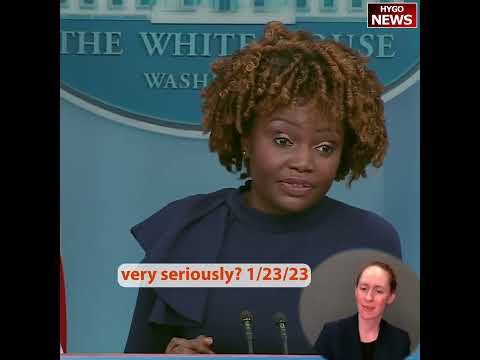
Reporter Asks KJP to Demonstrate Biden’s “Seriousness” — She Refers Them to Counsel Instead
In January 2023, a reporter asked White House Press Secretary Karine Jean-Pierre to demonstrate the “seriousness” with which President Biden was said to take classified documents. “When you and the White House and the President all say that the President takes these classified documents very seriously, without commenting on the ongoing legal issue, what would you point us to that would demonstrate that seriousness?” the reporter asked. KJP’s response was predictable deflection: “I’m going to really refer you to the White House Counsel’s office.” When the reporter pressed back — “The President continues to say he takes this seriously and you can’t demonstrate how he takes it seriously?” — KJP doubled down: “Let me just finish my answer. I’m going to refer you to the White House Counsel’s office and I’m going to refer you to the statements that you’ve received from his personal lawyer.” The exchange exposed the empty nature of the “takes seriously” claim — no evidence or actions could be pointed to from the briefing podium.
The Reporter’s Clever Framing
The reporter’s question was strategically framed:
“Without commenting on ongoing legal issue” — Preemptive scope limit.
“What would you point us to” — Concrete evidence sought.
“Demonstrate that seriousness” — Evidence of action.
Template challenged — Directly.
Evidence standard — Implied.
By asking for demonstration rather than assertion of seriousness, the reporter was challenging the empty nature of the template claim. The framing worked around the typical “ongoing investigation” deflection.
The “Takes Seriously” Template
The “takes seriously” line had become template:
Deployed repeatedly — Across briefings.
Generic content — No specifics.
Character claim — Rather than action.
Without evidence — Typically.
Empty signifier — Increasingly.
Each time the template was used, its emptiness was exposed. Saying someone takes something seriously is easy. Demonstrating it with actions is harder. The reporter was asking for the harder demonstration.
”I’m Going to Really Refer You”
KJP’s response deflected. “I’m going to really refer you to the White House Counsel’s office. I am. I am,” KJP said.
The response:
“Really refer you” — Emphasis.
“I am. I am.” — Double confirmation.
Counsel referral — Again.
Immediate deflection — No attempt at answer.
Pattern maintained — Consistent.
The immediate deflection to Counsel was revealing. The reporter had specifically excluded “ongoing legal issue” from the question, but KJP still referred to Counsel. This showed that Counsel referral wasn’t really about legal sensitivity — it was universal topic avoidance.
The Reporter’s Sharp Follow-Up
The reporter pushed back effectively. “So the President continues to say he takes this seriously and you can’t demonstrate how he takes it seriously?” the reporter asked.
The follow-up:
Characterization sharp — Can’t demonstrate.
Tension highlighted — Between claim and evidence.
Template emptiness — Exposed.
Accountability demand — Implicit.
Pattern challenge — Direct.
This was effective journalism. By framing KJP’s deflection as inability to demonstrate the claim, the reporter was putting pressure on the messaging template itself. The claim without evidence was being exposed.
”Let Me Just Finish My Answer”
KJP tried to regroup. “Let me just finish my answer,” KJP said.
The request:
Interruption stopped — By KJP.
Answer continuation — Sought.
Process management — By spokesperson.
Standard practice — For briefings.
Pressure handling — Through procedure.
By asking to finish her answer, KJP was using procedure to manage pressure. Reporters interrupting spokespeople was common but could be politely stopped. This was routine briefing procedure.
The Triple Referral
KJP attempted triple referral. “I’m going to refer you to the White House Counsel’s office and I’m going to refer you to the statements that you’ve received from his personal lawyer. I’m going to refer you to the…,” KJP said, before trailing off.
The triple referral:
Counsel’s office — First.
Personal lawyer statements — Second.
Third referral — Unspecified.
Information outside briefing — Theme.
No direct demonstration — Offered.
KJP was essentially saying: look elsewhere for evidence. Counsel’s office, personal lawyer statements, third unspecified source. None of these was available in the briefing for reporter examination. The referrals were information avoidance mechanisms.
The Counsel’s Office Reality
White House Counsel’s office:
Legal advisor — To president.
Not briefing — Press.
No public statements — Regular.
Confidentiality — Professional.
Inaccessible to reporters — In practice.
Referring reporters to Counsel’s office was essentially deadending information requests. Counsel didn’t brief press. There was no way to actually get answers through that referral. It was deflection dressed as redirection.
The Personal Lawyer Statements
Bob Bauer’s public statements:
Brief — Each.
Limited scope — By design.
Pre-written — Released as needed.
Not interactive — No follow-up.
Incomplete — By nature.
Personal lawyer statements had been issued at various points. They provided some information but were carefully crafted. They weren’t substitute for spokesperson engagement, they were supplement. Treating them as substitute was evasion.
The Seriousness Evidence Question
What would demonstrate seriousness:
Policy changes — From incident.
Staff training — Enhanced.
Procedural improvements — Documented.
Biden engagement — Personal.
Transparency — About findings.
None of these were being described in briefings. The “takes seriously” claim was essentially unsupported. This was the emptiness the reporter was exposing.
The Template Breakdown
The exchange showed template breaking down:
Reporters — Smarter at questions.
Template deployment — Obviously empty.
Administrative challenges — Growing.
Pattern exposure — Increasing.
Adjustment needed — Eventually.
As reporters asked more pointed questions, the template wore thin. Simply saying “takes seriously” without evidence was becoming harder to maintain as effective messaging.
The Communication Strategy Limits
The administration’s strategy had limits:
Template responses — Exhaustible.
Deflection patterns — Obvious.
Reporter adaptation — Occurring.
Coverage patterns — Shifting.
Political cost — Accumulating.
As the briefings became more obviously evasive, coverage was shifting from substance to evasion itself. The news became “White House won’t demonstrate seriousness” rather than administration messaging.
The Public Trust Dimension
Public trust implications:
Unsubstantiated claims — Erode trust.
Evasion patterns — Noticed.
Empty messaging — Recognized.
Transparency expectations — Not met.
Credibility — Declining.
When administration couldn’t support its own claims, public trust suffered. The “takes seriously” claim became cynical political talking point rather than truthful characterization. This had long-term credibility costs.
The Journalistic Achievement
The reporter’s exchange was journalistic achievement:
Template exposed — Effectively.
Evasion documented — Clearly.
Professional engagement — Skilled.
Accountability attempt — Worthy.
Coverage generated — Productive.
Even though substantive information wasn’t extracted, the journalistic value was real. Exposing administration patterns through skilled questioning was legitimate journalism. The exchange would generate coverage of the evasion itself.
The Briefing’s Diminishing Returns
The briefings were producing diminishing substantive returns:
Questions asked — Consistently.
Answers given — Repetitively.
Substance exchanged — Minimal.
Performance — Increasing.
Function — Changing.
The press briefing was becoming performative rather than informative. Reporters asked questions knowing the answers. KJP gave template responses knowing reporters wouldn’t be satisfied. Both participated in ritual that had lost informational purpose.
The Historical Context
The template approach had history:
Prior administrations — Had templates too.
But specific content — Usually varied.
KJP approach — More rigid.
Template empire — Built.
Comparison unfavorable — To predecessors.
While all press secretaries used talking points, KJP’s approach was notably template-heavy. Jen Psaki had used talking points but varied content more. The contrast was being noticed in coverage.
The 2024 Messaging Concerns
As 2024 approached, messaging effectiveness mattered:
Campaign communication — Essential.
Messaging discipline — Needed.
Effective responses — Required.
Public engagement — Expected.
Administration credibility — Campaign asset.
The briefing pattern was affecting broader administration credibility. For 2024 campaign success, improved messaging would be needed. The current approach was generating ongoing criticism.
The Press Corps Reaction
The press corps was increasingly frustrated:
Same questions — Repeated.
Same answers — Given.
Limited progress — In understanding.
Coverage shifting — To evasion.
Professional relationship — Strained.
Individual reporters had different styles, but collective frustration was growing. The press corps was adapting by asking more pointed questions. Administration was responding with deeper template deployment.
The Executive Privilege Question
Some deflection referenced executive privilege implicitly:
Confidential communications — Protected.
Counsel advice — Privileged.
Investigation privacy — Implied.
Deliberative process — Protected.
Legal constraints — Real.
Some limits on administration candor were legitimate. Legal proceedings deserved some protection. Counsel advice was privileged. But these limits shouldn’t prevent demonstrating simple administrative responses to incidents.
The “Seriousness” Paradox
The administration faced paradox:
Claimed seriousness — Repeatedly.
Couldn’t demonstrate — From briefings.
Contradicted by — Biden’s “no regrets.”
Inconsistent messaging — Resulting.
Template wearing — Thin.
Biden saying “no regrets” while administration claimed seriousness was contradiction. If truly serious, regret would be natural. The template was in tension with actual presidential statements, making both hollow.
Key Takeaways
- A reporter asked KJP to demonstrate Biden’s “seriousness” about classified documents beyond the template claim.
- The reporter preemptively excluded ongoing legal issues: “Without commenting on the ongoing legal issue, what would you point us to that would demonstrate that seriousness?”
- KJP deflected: “I’m going to really refer you to the White House Counsel’s office. I am. I am.”
- The reporter pushed back sharply: “The President continues to say he takes this seriously and you can’t demonstrate how he takes it seriously?”
- KJP attempted triple referral to Counsel, personal lawyer statements, and unspecified third source.
- The exchange exposed the empty nature of the repeated “takes seriously” template — no actions or evidence could be pointed to demonstrating the claim.
Transcript Highlights
The following is transcribed from the video audio (unverified — AI-generated from audio).
- When you and the White House and the President all say that the President takes these classified documents very seriously, without commenting on the ongoing legal issue, what would you point us to that would demonstrate that seriousness?
- I’m going to really refer you to the White House Counsel’s office. I am. I am.
- So the President continues to say he takes this seriously and you can’t demonstrate how he takes it seriously?
- Let me just finish my answer.
- I’m going to refer you to the White House Counsel’s office and I’m going to refer you to the statements that you’ve received from his personal lawyer.
- I’m going to refer you to the…
Full transcript: 113 words transcribed via Whisper AI.