 HYGO News
 Q: what in the book says that he can't look at this? A: process they reached out to the Archive
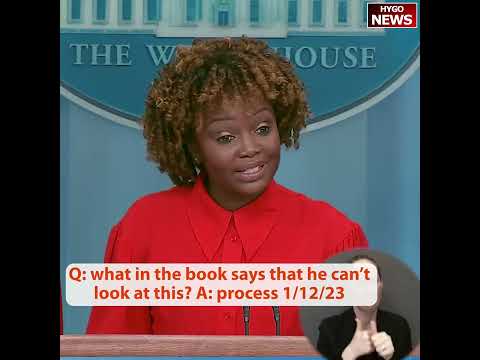
Reporter: Why Are Biden’s Lawyers Advising He Not Look at His Own Classified Documents? KJP: “Doing This by the Book”
On 1/13/2023, a reporter pressed White House Press Secretary Karine Jean-Pierre on a puzzling claim from Biden himself. “The President has said that his lawyers have advised him not to ask what was in these classified documents. I don’t understand the purpose of that. He’s the President of the United States,” the reporter said. KJP deflected: “Because we’re trying to do this by the book. We’re trying to do this in the appropriate way.” The reporter pressed for specifics: “What in the book says that he can’t look at this? What would compel him or push him in that direction?… What are his lawyers looking at that says, yeah, don’t look at this classified information that was found here?” KJP deflected again: “Again, there’s a process here. The process is that when the lawyers found that these documents existed, they reached out to the archive.”
The Odd Biden Claim
Biden had publicly said:
Lawyers advised him — Not to review documents.
Didn’t know contents — Of classified materials.
Separated from investigation — Legally.
“By the book” — Framing.
Unusual claim — For sitting president.
The claim’s strangeness:
President has top clearance — Obviously.
Could review any documents — With clearance.
Biden was VP — When documents created.
Already reviewed — At creation.
Lawyer advice — Peculiar.
”I Don’t Understand the Purpose”
The reporter’s substantive framing:
Legitimate confusion — About legal advice.
Factual basis questioned — For claim.
Public accountability — For peculiar statement.
Substantive inquiry — Appropriate.
Professional framing — Non-confrontational.
The reporter’s approach:
Acknowledged confusion — Diplomatically.
Requested explanation — Substantively.
Biden’s own claim — Referenced.
Legal basis sought — For advice.
Standard inquiry — Appropriate.
The “President of the United States” Reference
The reporter noted. “He’s the President of the United States,” the reporter said.
The presidential status:
Top security clearance — By position.
Constitutional authority — Over classified.
Declassification power — Personal.
Access to anything — Essentially.
Commander-in-Chief — Full access.
The logic:
President has all access — Normally.
Why not to these documents? — Question.
Legal theory unclear — For advice.
Unusual legal posture — Concerning.
Substantive question — Legitimate.
”By the Book”
KJP’s framing. “Because we’re trying to do this by the book. We’re trying to do this in the appropriate way,” KJP said.
“By the book”:
Legal compliance framing — Emphasized.
Proper procedure — Claimed.
Standard legal language — Used.
Administrative virtue — Implied.
Political positioning — Over legal specifics.
The “by the book” framing:
Didn’t answer question — About what book.
Generic legal language — Without specifics.
Administrative framing — Over substantive.
Political messaging — Rather than legal analysis.
Standard deflection — Technique.
”Appropriate Way”
KJP’s additional framing:
“Appropriate way” — Subjective characterization.
Process over substance — Again.
Administrative virtue — Claimed.
Political messaging — Continued.
Substantive avoidance — Through generic.
The “appropriate way”:
Self-defined standard — By administration.
Not externally validated — Obviously.
Subjective characterization — Throughout.
Political positioning — Standard.
Accountability avoidance — Through language.
”His Team Has Been Complying, Right, Cooperating”
KJP repeated framing. “We have, we have, his team has been complying, right, cooperating with the Department of Justice,” KJP said.
The repeated compliance language:
“Complying” — Legal framing.
“Cooperating” — Political framing.
“Right” — Validation-seeking.
Team-focused — Rather than Biden.
Administrative response — Standard.
The “right” insertion:
Verbal tic — KJP’s pattern.
Validation-seeking — From reporter.
Uncertainty indicator — Possibly.
Standard briefing pattern — Of language.
Not argumentative substance — Actually.
”I’ll Leave It There”
KJP attempted closure. “And I will leave it there. I’m not going to go beyond,” KJP said.
“Leave it there”:
Closure attempt — Of topic.
Substantive avoidance — Maintained.
Briefing flow management — Attempted.
Standard technique — For difficult.
Pattern recognized — By observers.
The “not going beyond”:
Bounded engagement — Explicitly.
Refuses further inquiry — Directly.
Administrative limit — Set.
Substantive question — Avoided.
Accountability limited — Through technique.
The Reporter’s Persistence
The reporter continued. “The book says that he can’t look at this. What would compel him or push him in that direction? Because you’ve said it repeatedly,” the reporter said.
The continued questioning:
Used KJP’s language — “The book.”
Asked for specifics — About reference.
Professional persistence — Maintained.
Substantive focus — Continued.
Accountability demand — For clarity.
“You’ve said it repeatedly”:
Across briefings — Same framing.
Without specifics — Throughout.
Pattern noted — By reporter.
Professional observation — Of repetition.
Substantive engagement needed — Obvious.
”What Are His Lawyers Looking At?”
The substantive specific question:
Legal basis sought — For advice.
Specific authority — About advice.
“Don’t look at this” — Strange advice.
Classification basis — Questioned.
Legal framework — Demanded.
The question:
Directly substantive — About legal theory.
Not hypothetical — About reality.
Specific to Biden situation — Current.
Required substantive answer — Ideally.
Professional inquiry — Persistent.
The “Process” Deflection
KJP returned to process. “Again, there’s a process here. The process is that when the lawyers found that these documents existed, they reached out to the archive,” KJP said.
“There’s a process”:
Standard deflection — To process.
Avoid legal specifics — Consistently.
Administrative response — Rather than legal.
Substantive avoidance — Through procedure.
Pattern recognized — By observers.
The “process”:
Generic framing — Not specific.
Archives contact — Mentioned.
Legal actions taken — Administrative.
Not the question — Asked though.
Deflection complete — Substantively.
The Question Unanswered
The substantive question remained:
Why lawyers advised Biden — Not to review.
What legal basis exists — For advice.
What “book” says this — Specifically.
Why president can’t review — His own documents.
Legal theory — Unexplained.
KJP’s responses:
Generic process language — Throughout.
Archives contact — Referenced.
No legal theory — Articulated.
Substantive avoidance — Complete.
Standard deflection — Pattern.
The Possible Legal Theories
Possible reasons for advice:
Evidence preservation — In investigation.
Chain of custody — Considerations.
Investigation integrity — Maintained.
Conflict avoidance — Between president and investigation.
Legal strategy — Protection.
But:
Administration didn’t explain — Theory.
Deflected repeatedly — To process.
Substantive engagement — Avoided.
Legal framework — Not clarified.
Credibility gap — Remained.
The Political Optics
The “lawyers said don’t look” framing:
Created distance — Between Biden and documents.
Legal protection — For Biden.
Plausible deniability — Implied.
Political positioning — Strategic.
Substantive reality — Different.
The distance:
Suggested innocence — About contents.
Legal strategy apparent — Obviously.
Politically useful — For Biden.
Substantively questionable — As claim.
Trump contrast sought — Probably.
The Trump Comparison
The Biden approach:
Contrast with Trump — Apparently.
Who retained documents — Intentionally allegedly.
Who engaged with contents — Reportedly.
Who resisted return — Allegedly.
Biden different framing — Attempted.
But:
Documents still mishandled — In Biden case.
Multiple years — Of retention.
Various locations — Unsecured.
Similar pattern — Technically.
Legal framework similar — Though advice different.
The Legal Separation Strategy
The Biden legal strategy:
Separate Biden — From documents.
Through lawyer advice — Not to review.
Claim ignorance — Of contents.
Build legal defense — On this.
Political positioning — Strategic.
The strategy:
Required maintaining — Biden claims.
Supporting evidence needed — For credibility.
Administrative messaging — Coordinated.
Standard legal approach — For such cases.
Long-term viability — Questionable.
The Hur Report Implications
The eventual Hur report:
Examined this strategy — In detail.
Biden interview — Revealing.
Memory issues prominent — Throughout.
Willful retention finding — Though no charges.
Political implications — Major.
The report:
Found mishandling — Confirmed.
Documented memory issues — Extensively.
Avoided criminal charges — Technically.
Characterized memorably — Damagingly.
“Elderly man, poor memory” — Key phrase.
The “Don’t Look” Advice’s Effect
The advice served:
Legal protection — For Biden.
Political distance — From documents.
Investigation cooperation framing — Maintained.
Public accountability avoidance — Through separation.
Strategic positioning — For legal defense.
But:
Made Biden look uninformed — About his own materials.
Raised competence questions — Indirectly.
Supported memory concerns — Later.
Created additional issues — Nonetheless.
Short-term benefit, long-term cost — Pattern.
The Administration’s Difficult Position
The administration:
Had to maintain Biden claims — Consistently.
Couldn’t explain substance — Of legal advice.
Legal strategy limits — Public engagement.
Political pressure — For explanation.
Deflection standard — Technique.
The position:
Substantively difficult — To defend.
Required coordination — Administrative.
Limited transparent — Engagement.
Political positioning — Maintained.
Credibility costs — Accumulating.
The “By the Book” Problem
KJP’s “by the book” framing:
Generic standard — Language.
Without specifics — Of book.
Not substantive — Response.
Political messaging — Standard.
Vulnerable to testing — By reporters.
“By the book” required:
Specific book — To reference.
Legal authority — Cited.
Substantive explanation — Offered.
Administrative basis — Articulated.
None of which — Provided.
The Pattern of Administrative Language
Administration language patterns:
“By the book” — Generic compliance.
“Appropriate way” — Subjective standard.
“Process” — Deflection to procedure.
“Cooperating fully” — Administrative.
“Right thing” — Moral framing.
Each phrase:
Lacks specificity — Deliberately.
Serves messaging — Rather than information.
Substantive substitute — For analysis.
Political cover — Through language.
Standard technique — Recognized.
The Investigation Period Constraints
During active investigation:
Administration caution — Appropriate.
Legal constraints — Real.
Evidence protection — Needed.
Professional limits — On commentary.
Standard practice — For such cases.
But:
Transparency promise — Conflicts.
Public accountability — Required.
Media legitimate — Questions.
Political implications — Unavoidable.
Balance difficult — Always.
The Hur Report Eventual Findings
The February 2024 findings:
Biden knew about documents — Some evidence.
Shared classified info — With ghostwriter.
Willfully retained — Finding.
Memory issues — Documented.
No charges — Recommended.
Specific findings:
Knowledge acknowledged — In interviews.
Sharing with ghostwriter — Documented.
Classification violations — Confirmed.
Willful retention — Technical finding.
Criminal intent — Not provable beyond doubt.
The “Don’t Look” Eventually Tested
Through investigation:
Biden’s claim of ignorance — Tested.
Hur interview revealing — Eventually.
Memory issues — Major theme.
Contents knowledge — Some evidence.
Strategic framing — Partially collapsed.
The Biden defense:
Worked legally — No charges.
Damaged politically — Significantly.
Memory issues prominent — Through report.
“Elderly man” framing — From Hur.
Age concerns amplified — Substantially.
The Standard Administrative Difficulty
Administrations facing investigations:
Balance transparency — With legal needs.
Political messaging — With legal strategy.
Press engagement — With confidentiality.
Investigation progress — With public accountability.
Complex navigation — Required.
Biden administration:
Chose protection — Over transparency.
Generic language — Over specifics.
Process deflection — Over substance.
Standard technique — Deployed.
Political costs — Accumulated.
The Reporter’s Professional Service
The reporter’s role:
Asked substantive questions — Professional.
Pressed for specifics — Persistently.
Exposed deflection patterns — Through questioning.
Built public record — Of responses.
Served democratic function — Essentially.
The service:
Essential for democracy — Accountability role.
Particularly valuable — For transparency issues.
Professional standard — Maintained.
Pattern documentation — Continuing.
Historical record — Built.
The Key Takeaways
- A reporter questioned why Biden’s lawyers advised him not to review the classified documents found in his possession.
- The reporter noted: “He’s the President of the United States” — implying he could review anything.
- KJP deflected: “We’re trying to do this by the book” without specifying which book.
- The reporter pressed: “What in the book says that he can’t look at this?”
- KJP returned to generic process framing: “When the lawyers found that these documents existed, they reached out to the archive.”
- The “don’t look” advice served Biden’s legal strategy but created political optics issues.
- The Hur investigation would eventually test Biden’s claims of ignorance through his October 2023 interview.
- The Hur report in February 2024 documented Biden’s actual knowledge and memory issues extensively.
Transcript Highlights
The following is transcribed from the video audio (unverified — AI-generated from audio).
- The President has said that his lawyers have advised him not to ask what was in these classified documents.
- I don’t understand the purpose of that. He’s the President of the United States.
- Because we’re trying to do this by the book. We’re trying to do this in the appropriate way.
- The book says that he can’t look at this. What would compel him or push him in that direction?
- What are his lawyers looking at that says, yeah, don’t look at this classified information that was found here?
- Again, there’s a process here. The process is that when the lawyers found that these documents existed, they reached out to the archive.
Full transcript: 176 words transcribed via Whisper AI.