 HYGO News
 Q: "What do you intend to do differently to change opinion?' A: "Nothing, we have more money"
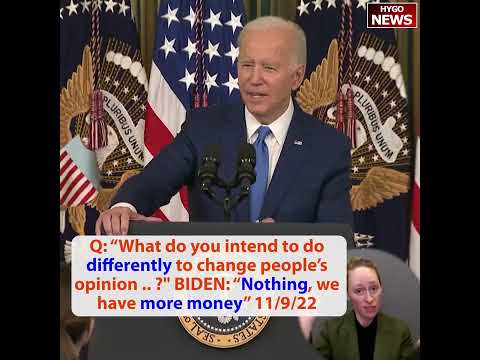
Reporter: With 75% of Voters Saying Country Is Heading Wrong Direction, What Will You Do Differently? Biden: “Nothing”
On 11/9/2022, at his first White House press conference in 10 months, President Biden was asked a devastating question: “You mentioned that Americans are frustrated and in fact 75% of voters say the country is heading in the wrong direction. Despite the results of last night, what in the next two years do you intend to do differently to change people’s opinion of the direction of the country, particularly as you contemplate a run for president in 2024?” Biden’s one-word answer was remarkable for its bluntness: “Nothing.” He then explained: “Because they’re just finding out what we’re doing. The more they know about what we’re doing, the more support there is.” He attributed the disconnect to voters not understanding his accomplishments rather than to any problem with his policies.
”Nothing”
Biden’s single-word response — “Nothing” — was extraordinary candor. Presidents asked whether they would change course after negative voter sentiment typically offer some version of pivoting, listening, or adjusting. Even presidents who have no intention of changing usually soften the message with language about “hearing voters” or “continuing to explain.”
Biden went straight to the blunt truth: he would do nothing differently. The voters who thought the country was heading in the wrong direction — 75% of them — would not see any policy changes, communication adjustments, or strategic shifts from the Biden administration. The president believed his existing approach was correct, and no amount of voter disapproval would change it.
The candor was refreshing in a way. Biden was being honest about his intentions rather than pretending to listen to voter concerns he planned to ignore. But the honesty also revealed a fundamental disconnect: three-quarters of the country thought the country was headed the wrong way, and the president’s response was “nothing needs to change."
"They’re Just Finding Out What We’re Doing”
Biden’s explanation for the “nothing” answer was equally revealing. “Because they’re just finding out what we’re doing. The more they know about what we’re doing, the more support there is,” Biden said.
The argument rested on a specific theory: voters disapproved because they didn’t understand Biden’s accomplishments. If they just knew more about the Inflation Reduction Act, the infrastructure bill, the student loan forgiveness program, and the CHIPS Act, they would approve of Biden’s presidency. The problem was one of communication and awareness, not substance or results.
This theory had been the Democratic Party’s dominant explanation for Biden’s poor approval ratings throughout 2022. It attributed low approval to an information deficit: voters were simply uninformed about the good things the administration was doing. If the White House could just “tell the story” more effectively, voter sentiment would align with the actual record.
The theory had problems. First, it assumed voters were passively uninformed rather than actively informed and disapproving. Most voters had considerable information about the administration’s major policies — the IRA, student loans, and inflation were heavily covered by media across the political spectrum. The problem wasn’t that voters didn’t know what Biden was doing; it was that they knew and rejected it.
Second, the theory ignored the lived experience of inflation, which required no media coverage to recognize. Families experienced 8.2% inflation every time they bought groceries, filled a gas tank, or paid rent. No amount of White House messaging could convince someone who had just paid $150 for a grocery run that cost $100 the year before that the economy was working for them.
Third, the “more they know, the more support” claim was empirically false. Biden’s approval had been declining throughout 2022 despite constant White House efforts to explain his accomplishments. If increased awareness led to increased support, the pattern should have been the opposite — but more information correlated with less support, not more.
”Already Out There We’ve Voted For”
Biden pivoted to a specific example. “We have more money in the pot now, already out there we’ve voted for, than the entire money we spend on Amtrak to begin with,” Biden said.
The Amtrak comparison was characteristic of Biden, who had a decades-long personal relationship with the Amtrak commuter train system from his Senate years traveling between Delaware and Washington. “Amtrak Joe” was one of his nicknames, and he referenced Amtrak in a remarkable number of unrelated speeches.
But the comparison was analytically meaningless. Biden was claiming that legislation had allocated more money than Amtrak’s total budget — which could have been true of many spending bills without telling voters anything about whether the money was well-spent or was helping their lives.
The reference to money “we’ve voted for” also missed the reporter’s point. The question wasn’t whether Biden had passed legislation with large dollar figures. The question was what he would do to change voter opinion about the country’s direction. Pointing to dollar amounts of legislation already passed didn’t address future strategy.
The 75% Wrong Direction Number
The reporter’s framing — “75% of voters say the country is heading in the wrong direction” — captured a dire political reality for Biden. The “right direction/wrong direction” polling question is one of the most basic measures of political sentiment, and 75% wrong direction was historically high. Most presidents facing those numbers would have acknowledged the seriousness of the sentiment and articulated some response.
Biden’s “nothing” answer treated the 75% figure as something like static noise — background unhappiness that would resolve itself once voters understood his achievements. The response suggested the president either didn’t believe the number reflected genuine policy disagreement or had decided the disagreement was irrelevant to his plans.
Either interpretation raised questions about the administration’s responsiveness to democratic sentiment. A president who received a mandate from voters in 2020 to govern in a particular way might reasonably defend that mandate against shifting sentiment. But a president whose mandate had been substantially eroded — with 75% saying the country was heading wrong — typically acknowledged at least the need to explain the gap between his sense of success and voters’ sense of decline.
The Post-Midterm Context
The exchange occurred the day after the midterm elections, where Democrats had performed better than historical patterns predicted. Biden was in a moment of unexpected political strength — Democrats had held the Senate and limited House losses. This gave Biden some basis for claiming vindication.
But the strong Democratic midterm performance had been driven primarily by abortion (Dobbs backlash), concerns about Trump-backed candidates and democracy, and weak Republican candidates in key races — not by voter approval of Biden’s economic record. Exit polls showed that voters who cited the economy as their top issue broke heavily Republican. The “nothing will change” response suggested Biden was interpreting the midterm result as an endorsement of his approach when the result was actually a rejection of the Republican alternative.
This misreading of the mandate would have consequences. By concluding that voters were just beginning to learn about his accomplishments, Biden committed the administration to a communications strategy rather than a policy adjustment. The next two years of his term would bring more explanation, more talking points, and more “telling the story” — and no fundamental change in the approach voters had rejected.
Key Takeaways
- A reporter asked what Biden would do differently given 75% of voters said the country was heading in the wrong direction; Biden said “Nothing.”
- Biden argued voters just didn’t understand his accomplishments: “The more they know about what we’re doing, the more support there is.”
- The theory attributed low approval to an information deficit rather than to policy disagreement or lived experience with inflation.
- Biden pivoted to an Amtrak budget comparison that didn’t address the reporter’s question about future strategy.
- The response suggested Biden interpreted better-than-expected midterm results as endorsement of his approach rather than rejection of Republicans.
Transcript Highlights
The following is transcribed from the video audio (unverified — AI-generated from audio).
- 75% of voters say the country is heading in the wrong direction.
- What in the next two years do you intend to do differently to change people’s opinion of the direction of the country?
- Nothing.
- Because they’re just finding out what we’re doing.
- The more they know about what we’re doing, the more support there is.
- We have more money in the pot now, already out there we’ve voted for, than the entire money we spend on Amtrak to begin with.
Full transcript: 107 words transcribed via Whisper AI.