 HYGO News
 Q: what classified documents process in general? A: It’s been asked to me many different ways
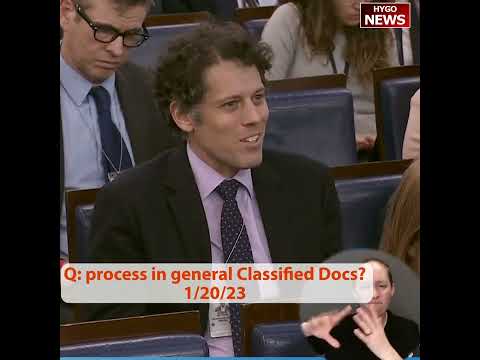
Reporter Asks KJP to Explain General Classified Document Process — “I Hear the Question… Asked Many Different Ways” — Still Refers to Counsel
In January 2023, a reporter tried a new approach with White House Press Secretary Karine Jean-Pierre — asking about the general process for handling improperly found classified documents, explicitly divorced from the Biden specific case. “Without speaking about the investigation or the special counsel specifically, if you could walk us through a little bit of what the process in general is supposed to be when classified documents are improperly found. And if the White House has any role in those circumstances, if they refer anything to the Office of Director of National Intelligence, or sort of what that process should be — again, sort of not necessarily referencing the current situation, but just in general,” the reporter asked. KJP acknowledged the effort but refused again: “I hear the question. It’s been asked to me many different ways, many different times. I’m trying yet to know. And I appreciate the effort. Again, I am going to refer you on the particulars of the process and how it goes down and how it works. I’m going to refer you to the White House counsel.”
The Strategic Reframing
The reporter’s approach was thoughtful:
Generic process — Not specific case.
ODNI reference — Specific institutional role.
Historical pattern — How it normally works.
Educational framing — Not investigative.
Deflection anticipation — Working around.
The question was designed to work around KJP’s deflection pattern. By asking about generic process rather than the Biden situation, the reporter was removing the usual deflection rationale. There was no DOJ investigation of the general question.
”Without Speaking About the Investigation”
The reporter preemptively excluded deflection. “Without speaking about the investigation or the special counsel specifically,” the reporter said.
The exclusion:
Explicit scope limit — Not about case.
Investigation excluded — From question.
Special counsel excluded — From scope.
Generic focus — Confirmed.
KJP deflection preempted — Logically.
By explicitly excluding the investigation, the reporter eliminated the stated reason for KJP’s deflections. Questions about the investigation could be referred to DOJ; questions about process generally couldn’t reasonably be referred the same way.
”What the Process in General Is Supposed to Be”
The reporter sought process information. “If you could walk us through a little bit of what the process in general is supposed to be when classified documents are improperly found,” the reporter asked.
The information sought:
Process walk-through — Step by step.
Generic context — Not Biden-specific.
Standard handling — When issues arise.
Educational content — Rather than operational.
Reference information — For public understanding.
This was the kind of information government officials routinely provide. Process descriptions don’t depend on specific cases. Explaining generally how things work is basic civic education.
The ODNI Reference
The reporter mentioned specific institutions. “If the White House has any role in those circumstances, if they refer anything to the Office of Director of National Intelligence, or sort of what that process should be,” the reporter said.
The ODNI reference:
Specific institution — Named.
Intelligence oversight — Role.
Damage assessment — Function.
National security — Scope.
Process component — Identified.
The ODNI did have role in classified document incidents — conducting damage assessments of potential intelligence harm. The reporter’s reference showed informed question framing. This wasn’t fishing question but well-informed inquiry.
”Sort of Not Necessarily Referencing the Current Situation”
The reporter restated the scope. “Again, sort of not necessarily referencing the current situation, but just in general,” the reporter said.
The restatement:
Emphasis on generic — Doubled.
Current situation excluded — Again.
Just in general — Scope confirmed.
Deflection prevention — Attempt.
Clear framing — For record.
The repeated emphasis was tactical. If KJP still refused to answer general questions about process, it would be clearly documented that she was refusing something that wasn’t even about the Biden case. This would highlight the unreasonableness of the deflection.
”I Hear the Question”
KJP acknowledged hearing. “I hear the question,” KJP said.
The acknowledgment:
Listening signaled — Not automatic rejection.
Question understood — Framework accepted.
Engagement pretense — At least.
Different response pending — Maybe.
Possibly genuine engagement — Forthcoming.
“I hear the question” signaled that KJP was acknowledging the thoughtful framing of the reporter’s inquiry. This was different from automatic dismissal. The question had registered.
”Asked to Me Many Different Ways, Many Different Times”
KJP acknowledged the pattern. “It’s been asked to me many different ways, many different times,” KJP said.
The acknowledgment:
Multiple askings — Confirmed.
Different approaches — Recognized.
Persistent reporter effort — Acknowledged.
Pattern awareness — Displayed.
Deflection history — Tacit admission.
KJP was acknowledging that reporters had been trying various approaches to get process information. This was implicit admission that the same question in different forms had been asked repeatedly. It was honest about the pattern.
”I’m Trying Yet to Know”
KJP’s phrasing was unclear. “I’m trying yet to know,” KJP said.
The phrase:
Possibly mistranscribed — Unclear.
“Trying” — KJP making effort?
“Yet to know” — Uncertain meaning.
Verbal difficulty — Characteristic.
Meaning obscure — From text.
The phrase was puzzling. It might have been something like “I’m trying, you know” or “I’m trying, I get it.” The exact meaning was unclear from transcript. KJP’s verbal patterns frequently produced such ambiguous moments.
”I Appreciate the Effort”
KJP acknowledged the reporter. “And I appreciate the effort,” KJP said.
The acknowledgment:
Reporter effort — Noticed.
Strategic framing — Recognized.
Professional respect — Conveyed.
Deflection anyway — Coming.
Relationship preservation — With press.
“I appreciate the effort” was gracious. It recognized that the reporter had tried to construct a question that worked around the deflection pattern. But appreciation wasn’t engagement — KJP was still about to deflect.
”Refer You to the White House Counsel”
KJP deflected despite framing. “Again, I am going to refer you on the particulars of the process and how it goes down and how it works. I’m going to refer you to the White House counsel,” KJP said.
The deflection:
Counsel referral — Again.
“The particulars” — Scope.
Process specifics — Deflected.
“Goes down and works” — Colloquial.
Standard pattern — Maintained.
Despite the reporter’s careful framing to avoid investigation-specific questions, KJP still referred to Counsel. This exposed that Counsel referral wasn’t really about legal sensitivity — it was comprehensive topic avoidance.
The Deflection Logic Failure
The Counsel referral for generic process questions had logical problems:
Counsel handles this case — Specific.
Not generic process expertise — Necessarily.
Public educational function — Not counsel role.
Standard practice — Publicly available.
Political deflection — Not legal.
Referring generic process questions to Counsel made little sense. Counsel’s job was to advise on specific legal matters, not to provide public education about classified document handling. The referral exposed the broader deflection pattern’s unreasonableness.
The Publicly Available Information
The answers were actually publicly available:
Executive orders — On classified information.
ODNI guidelines — On classification.
Standard practices — Documented.
GAO reports — On handling.
Academic analyses — Available.
Anyone researching classified document handling could find the information. KJP could have summarized standard practice in two sentences. The refusal to even describe what was publicly known was notable — the blackout extended even to matters already in the public domain.
The Intentional Ignorance Framing
By not describing standard process, the administration was:
Playing ignorant — Of generic matters.
Avoiding comparison — With Biden situation.
Preventing context — For accountability.
Controlled narrative — Without standards.
Evaluation difficult — Without framework.
If the public didn’t know what was normal classified document handling, they couldn’t easily evaluate whether Biden’s situation had deviated. Keeping the standards opaque protected the administration from comparison.
The Reporter’s Acknowledgment
“I appreciate the effort” was interesting communication:
Collegiality — With reporter.
Recognition — Of thoughtful approach.
Softening — Of deflection.
Relationship — Preserved.
Professional respect — Maintained.
Despite the policy of deflection, KJP and reporters maintained working relationships. The professional acknowledgment of reporter effort showed that personal relations could coexist with substantive disagreement on engagement levels.
The Broader Blackout Completeness
After this exchange, the blackout scope was clearer:
Specific case questions — Deflected.
Procedural questions — Deflected.
Generic process questions — Deflected.
National security questions — Deflected.
Personal questions — Deflected.
Travel questions — Deflected.
Every angle on classified documents faced the same treatment. The Counsel referral was the catch-all for any topic that touched on the broader classified documents matter. Nothing substantive could be addressed.
The Journalistic Function Question
The exchange raised journalistic function question:
Getting information — From government.
Holding accountable — Through questions.
Educating public — Via briefings.
Press secretary role — In democracy.
Limits of deflection — When reached.
When generic educational questions couldn’t be answered, something fundamental about the press briefing function was breaking down. This wasn’t about investigation secrecy; it was about the administration not engaging with basic informational requests.
The Comparative Framework Absence
Without process explanation, comparison was difficult:
Biden’s approach — Not compared.
Standard practice — Unknown.
Best practices — Unstated.
Evaluation impossible — By public.
Judgment avoided — About adequacy.
The administration’s refusal to discuss generic process prevented meaningful public evaluation of Biden’s specific situation. Without knowing how classified documents were supposed to be handled, voters couldn’t judge whether Biden had handled them appropriately.
The Trump Comparison Implications
The process question had Trump comparison dimension:
Trump documents case — Different.
Trump process violations — Alleged.
Biden documents case — Ongoing.
Comparative evaluation — Political.
Process standards — Would affect.
If KJP explained standard process, observers could compare Trump and Biden handling. Each had potentially deviated in different ways. Keeping the standards hidden prevented specific comparative judgments. This was politically protective for Biden but also for Trump in the comparison.
The Long-Term Implications
Extended opacity about process had implications:
Accountability erosion — Continuing.
Press function limitation — Accepted.
Information flow — Restricted.
Democratic norms — Affected.
Precedent establishment — For future.
Each day of the blackout established precedent that could affect future administrations. Expecting spokesperson to explain process could become less normalized. The current administration’s choice affected long-term norms around transparency.
Key Takeaways
- A reporter tried a new approach — asking about the general process for handling improperly found classified documents, explicitly excluding the Biden case.
- The reporter specifically referenced ODNI involvement and asked about “what that process should be… just in general.”
- KJP acknowledged the strategic framing: “I hear the question. It’s been asked to me many different ways, many different times.”
- She said “I appreciate the effort” — recognizing the reporter’s work to construct a deflection-resistant question.
- Despite the generic framing, KJP still deflected: “I am going to refer you on the particulars of the process and how it goes down and how it works. I’m going to refer you to the White House counsel.”
- The Counsel referral for generic process questions exposed that the deflection was comprehensive topic avoidance rather than legitimate legal sensitivity.
Transcript Highlights
The following is transcribed from the video audio (unverified — AI-generated from audio).
- Without speaking about the investigation or the special counsel specifically, if you could walk us through a little bit of what the process in general is supposed to be when classified documents are improperly found.
- If the White House has any role in those circumstances, if they refer anything to the Office of Director of National Intelligence, or sort of what that process should be.
- Again, sort of not necessarily referencing the current situation, but just in general.
- I hear the question. It’s been asked to me many different ways, many different times.
- I’m trying yet to know. And I appreciate the effort.
- Again, I am going to refer you on the particulars of the process and how it goes down and how it works. I’m going to refer you to the White House counsel.
Full transcript: 136 words transcribed via Whisper AI.