 HYGO News
 Q: What Biden “No Regrets” Hiding Classified Docs? A: Shows How Seriously He Takes Classified Docs
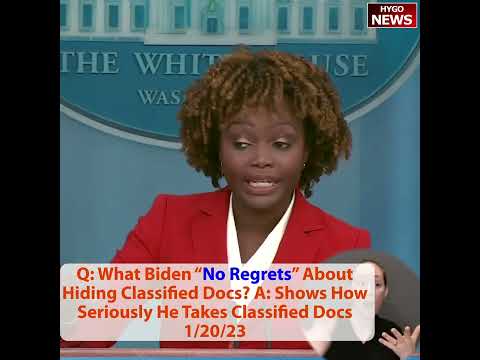
Reporters Press KJP on Biden’s “No Regrets” — What Does He Mean? KJP: “Not Going to Comment Further”
In January 2023, reporters pressed White House Press Secretary Karine Jean-Pierre to clarify what President Biden meant when he said he had “no regrets” about the classified documents situation, given his simultaneous statements that he took classified documents seriously. “What does the president mean when he said no regrets? Because he’s also said he takes very seriously the handling of classified documents. So I’m unclear what he means about no regrets,” one reporter (CBS’s Kelly O’Donnell) asked. KJP declined to clarify: “So I’m not going to comment further from what the president has said yesterday… I’m not going to get into specifics or I’m not going to go beyond what the president has said.” She repeated the “takes seriously” line. A follow-up reporter probed further: “Was he referring to sort of the rollout of the information or about the timeline? Or I’m just unclear about what he’s not regretting.” KJP acknowledged the confusion: “Kelli-O, I totally understand the question. I totally understand why you made…”
The “No Regrets” Comment
Biden had said “no regrets” in a recent interaction:
Recent statement — Day before.
Unscripted comment — Reportedly.
Apparent confidence — About handling.
Contrast with seriousness — Claims.
Communication problem — Created.
The “no regrets” comment had been surprising given the situation. Documents had been found at multiple locations. Special Counsel had been appointed. The White House had been consistently apologetic. And then Biden said “no regrets” — seemingly contradicting the careful positioning.
The Apparent Contradiction
The reporter identified the contradiction. “Because he’s also said he takes very seriously the handling of classified documents. So I’m unclear what he means about no regrets,” the reporter said.
The contradiction was clear:
Takes classified docs seriously — Current position.
No regrets about situation — Newly stated.
Both claims by Biden — In recent days.
Logically in tension — Seemingly.
Public clarification needed — From spokesperson.
If Biden took classified documents seriously, having been found to have mishandled them would seemingly generate regret. Having no regrets while also taking seriously suggested either he didn’t actually take seriously or he didn’t think he had mishandled. Either interpretation was problematic.
The Spokesperson Function
Clarifying presidential statements is spokesperson core function:
Interpreting unclear comments — Job role.
Resolving apparent contradictions — Expected.
Explaining context — Standard practice.
Correcting misperceptions — Regular.
Adding clarity — Central purpose.
Reporters asking for clarification of confusing presidential statements is routine. The spokesperson normally provides context, explains meaning, resolves ambiguity. This is basic job function.
”Not Going to Comment Further”
KJP declined the basic function. “So I’m not going to comment further from what the president has said yesterday. I think he laid out his thoughts,” KJP said.
The refusal:
Explicit non-commitment — To clarification.
Prior Biden statement invoked — As sufficient.
“Laid out his thoughts” — Characterization.
No new information — Added.
Function abdication — Of spokesperson role.
Declining to comment further was declining to do the clarifying job. If Biden had laid out his thoughts clearly, reporters wouldn’t be confused. The confusion was evidence that clarification was needed.
”Whatever Question He Was Asked”
KJP’s phrasing was notable. “He was asked about it. He laid out his thoughts of whatever question he was asked,” KJP said.
The “whatever question”:
Vagueness about actual question — Acknowledged.
Biden’s response — As response to question.
Context dependent — On specific question.
Not universal statement — Implied.
Distance from statement — Created.
This phrasing slightly minimized the “no regrets” statement. By emphasizing it was response to a specific question in specific context, KJP was suggesting it shouldn’t be taken as comprehensive statement of Biden’s position.
”Not Going to Get Into Specifics”
KJP explicitly limited response. “I’m not going to get into specifics or I’m not going to go beyond what the president has said,” KJP said.
The limitation:
Specifics off-limits — Detail.
Boundary setting — About response scope.
Biden statement as ceiling — For spokesperson.
Minimal engagement — Choice.
Clarity refused — Explicitly.
Spokespeople often decline to “go beyond” what principals have said. But this usually applies to major policy positions, not to clarifying apparently contradictory statements. The refusal to clarify was unusual in scope.
The “Takes Classified Documents Seriously” Repetition
KJP returned to the template. “He does indeed take classified information. And seriously, he does indeed take classified documents. Seriously, I’m just not going to go beyond that,” KJP said.
The verbal pattern:
Comma placement unclear — “Seriously” attribution.
Double repetition — “Classified information” and “classified documents.”
Template deployment — Standard line.
Without resolving — The actual question.
Character claim — Without evidence.
The awkward construction was characteristic. “Seriously” appeared oddly in the sentence. The repeated “takes seriously” was essentially same content repeated. None of this addressed the “no regrets” question.
The Follow-Up Question
A follow-up pressed further. “Was he referring to sort of the rollout of the information or about the timeline? Or I’m just unclear about what he’s not regretting,” the reporter said.
The follow-up offered interpretations:
Rollout of information — Timing of disclosure.
Timeline — When documents found.
Specific aspect — Rather than overall.
Interpretation attempt — By reporter.
Engagement invitation — For KJP.
The reporter was trying to help KJP explain by offering possible interpretations. Maybe Biden didn’t regret the rollout approach. Maybe he didn’t regret the timeline. These were narrower possible meanings that could be reconciled with taking seriously.
”Kelli-O, I Totally Understand”
KJP acknowledged the reporter. “Kelli-O, I totally understand the question. I totally understand why you made…” KJP said, before the transcript cut off.
The acknowledgment:
Personal address — Kelli-O (Kelly O’Donnell).
Understanding claimed — Of question logic.
Relationship note — Rapport.
Possible clarification coming — Or not.
Transcript end — At crucial moment.
The transcript ending at “I totally understand why you made…” was frustrating. Whether KJP went on to actually clarify or to repeat deflection is unclear. The acknowledgment of the question’s logic was positive sign but no actual answer appeared.
The Biden Statement Confusion
Biden’s “no regrets” was genuinely puzzling:
Documents were found — At multiple locations.
Special Counsel appointed — Serious step.
Ongoing investigation — By DOJ.
Administration concerns — Visible.
Potential charges — Possible.
In this context, “no regrets” was tone-deaf at best. Biden seemed either oblivious to the gravity of the situation or confident that there was nothing worth regretting. Both interpretations were politically problematic.
The Possible Meanings
Various interpretations were possible:
No regrets about documents — Not his fault documents were there.
No regrets about disclosure — Handled properly once found.
No regrets about response — Cooperating with investigation.
No regrets generally — Broader claim.
Political defiance — Not showing weakness.
Any of these could be meant. Without clarification, voters and observers could choose their own interpretation. Administration silence on meaning was effectively letting each interpretation exist.
The Biden Communication Style
Biden’s unscripted comments had often generated clarification needs:
Various gaffes — Over time.
Unclear references — Regularly.
Off-script moments — Frequent.
Subsequent clarifications — Often needed.
Administrative management — Of comments.
The “no regrets” comment fit pattern of Biden unscripted moments that required administrative clarification. Usually clarification came quickly. Here it was notable for its absence — administration apparently had decided not to walk back or explain the comment.
The Political Calculation
The decision to not clarify likely reflected:
Walking back shows weakness — Political concern.
Explaining might complicate — Narrative.
Silence preferable — To correction.
Biden’s defiance acceptable — To base.
Critics won’t be convinced — Either way.
Administration might have concluded that explaining would only create more content for critics to attack. Silence let the “no regrets” become part of Biden’s record without further definition.
The Accountability Gap
The exchange showed accountability gap:
Biden said confusing thing — Publicly.
Reporters sought clarification — Professionally.
Spokesperson refused — To clarify.
Meaning unresolved — Publicly.
Accountability function failed — For spokesperson.
The basic function of explaining what the president meant was declined. This was significant — reporters couldn’t get clarity about confusing presidential statements through normal briefing process. The channel of accountability was partially closed.
The Legal Process Context
Some of KJP’s restraint reflected ongoing legal process:
DOJ investigation — Active.
Special Counsel — Robert Hur.
Potential testimony — By Biden.
Statements on record — Legal implications.
Restraint appropriate — Legally.
Any administrative statement could be relevant to the investigation. Elaborating on Biden’s “no regrets” could create material that investigators might examine. Legal caution was legitimate reason for not elaborating.
But the refusal to explain what “no regrets” meant went beyond legal necessity. Clarifying whether Biden meant the rollout, the timeline, or something else wouldn’t affect the investigation. The refusal was broader than legal need required.
The Media Coverage Impact
The exchange generated its own coverage:
“No regrets” comment — Highlighted.
Clarification refused — Noted.
Administration dysfunction — Implied.
Press secretary challenges — Discussed.
Narrative building — Around response.
The administration’s refusal to clarify became part of the coverage. Reporters writing about the exchange could frame it as administration stonewalling. This added to the accumulating narrative about White House communication challenges on classified documents.
The Communication Strategy Limits
The administration’s communication strategy showed limits:
Template responses — Breaking down.
Reporter frustration — Growing.
Genuine questions — Not answered.
Narrative control — Limited.
Accumulating challenges — Daily.
Each day’s briefing added to the accumulation of unanswered questions. The “takes seriously” template was becoming threadbare. Reporters were increasingly skilled at exposing the limits of deflection. The strategy was showing strain.
Key Takeaways
- Reporters pressed KJP to clarify Biden’s “no regrets” comment about the classified documents, given his simultaneous claims that he took the documents seriously.
- KJP declined to clarify: “I’m not going to comment further from what the president has said yesterday.”
- She repeated the standard template: “He does indeed take classified information. And seriously, he does indeed take classified documents. Seriously.”
- A follow-up reporter offered possible interpretations — rollout, timeline — trying to help KJP explain; KJP acknowledged the question but still didn’t clarify.
- The exchange showed the administration refusing basic spokesperson function of explaining apparently contradictory presidential statements.
- Biden’s “no regrets” comment remained unexplained, leaving observers to choose their own interpretation.
Transcript Highlights
The following is transcribed from the video audio (unverified — AI-generated from audio).
- What does the president mean when he said no regrets? Because he’s also said he takes very seriously the handling of classified documents.
- So I’m unclear what he means about no regrets.
- So I’m not going to comment further from what the president has said yesterday. I think he laid out his thoughts.
- I’m not going to get into specifics or I’m not going to go beyond what the president has said.
- He does indeed take classified information. And seriously, he does indeed take classified documents. Seriously, I’m just not going to go beyond that.
- Was he referring to sort of the rollout of the information or about the timeline? Or I’m just unclear about what he’s not regretting.
Full transcript: 169 words transcribed via Whisper AI.