 HYGO News
 Bessent: Tariff Revenue Will Fund 'No Tax on Tips, Social Security, and Overtime' -- 'A Combination of Both' Revenue and Deals
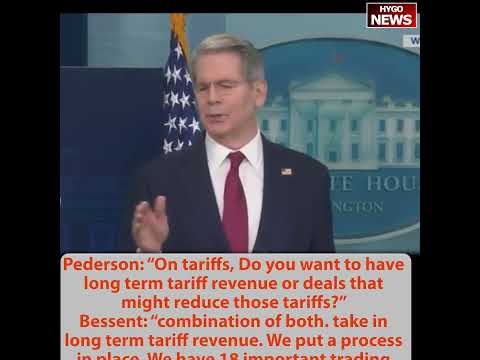
Bessent: Tariff Revenue Will Fund “No Tax on Tips, Social Security, and Overtime” — “A Combination of Both” Revenue and Deals
Treasury Secretary Scott Bessent explained the administration’s tariff strategy at an April 2025 White House briefing, answering the central question: revenue or deals? “I think it’s a combination of both,” Bessent said. “We’re going to take in long-term tariff revenue. We have 18 important trading relationships. We will be speaking to all of those partners over the next few weeks.” He connected tariffs directly to tax relief: “What President Trump is referring to is the ability for tariff revenue to give income tax relief. The president campaigned on no tax on tips, no tax on Social Security, no tax on overtime, and restoring interest deductibility for American-made autos. So tariff income could be used for tax relief on all those immediately.” The question came from Punchbowl News, seated in the administration’s “new media seat."
"A Combination of Both”
Punchbowl News reporter Brendan Pederson asked the question that had defined the tariff debate.
“The president said over the weekend that we are hoping that maybe tariff revenues could replace income tax,” Pederson said. “But we also keep hearing about the deals that the administration is pursuing. So my question is, what is the White House’s ultimate objective here? Do you want to have long-term tariff revenue, or deals that might reduce those tariffs?”
Bessent’s answer resolved the apparent contradiction: “I think it’s a combination of both.”
He explained the revenue side: “We’re going to take in long-term tariff revenue.”
He described the deal-making side: “We put a process in place. We have 18 important trading relationships. We will be speaking to all of those partners, or at least 17 of them, over the next few weeks. Many of them have already come to Washington.”
The “combination of both” formulation was the most precise articulation of the administration’s tariff strategy to date. Critics had argued that the administration couldn’t simultaneously use tariffs as revenue and negotiate them away through trade deals. Bessent explained that both could coexist: some tariffs would remain as permanent revenue sources, while others would be negotiated down in exchange for concessions from trading partners.
The 18 trading relationships Bessent referenced — the “Big 18” that included Japan, the EU, South Korea, India, China, and others — represented the countries whose trade volumes were large enough to generate significant tariff revenue and whose cooperation was important enough to warrant negotiated reductions. For smaller trading partners, the baseline 10% tariff would remain as a permanent revenue source.
Tariff Revenue as Tax Relief
Bessent connected the tariff strategy directly to Trump’s campaign promises.
“What President Trump is referring to is the ability for tariff revenue to give income tax relief,” Bessent said.
He listed the specific promises: “The president campaigned on no tax on tips, no tax on Social Security, no tax on overtime, and restoring interest deductibility for American-made autos.”
He stated the mechanism: “So tariff income could be used for tax relief on all those immediately.”
The connection between tariff revenue and tax relief was the economic innovation at the heart of the Trump trade agenda. Rather than viewing tariffs in isolation — as a trade policy with costs and benefits — the administration was presenting them as one side of a fiscal equation. Tariffs on foreign goods generated revenue that could offset lost revenue from eliminating taxes on American workers’ income.
The specific tax relief items Bessent listed had been among Trump’s most popular campaign promises. No tax on tips directly benefited the millions of service workers — waiters, bartenders, hotel staff, hairstylists — who depended on gratuities for their income. No tax on Social Security relieved seniors living on fixed incomes. No tax on overtime rewarded workers who put in extra hours. Restored auto interest deductibility made car ownership more affordable.
Each of these tax cuts shifted the tax burden from American workers to foreign producers. Instead of waitresses paying income tax on their tips, Chinese manufacturers paid tariffs on their exports. Instead of retirees paying tax on Social Security, European exporters paid tariffs on goods entering the American market. The trade was explicit and politically powerful: tax foreign goods, untax American workers.
The Revenue Mathematics
The fiscal case for tariff-funded tax relief was grounded in arithmetic. At a 10% baseline tariff on approximately $3.3 trillion in annual imports, the tariff revenue approached $330 billion per year. Higher rates on specific countries and products — 25% on autos, steel, and aluminum, higher rates on Chinese goods — pushed the total considerably higher.
The revenue from eliminating tax on tips was estimated at approximately $30-50 billion per year in foregone income tax. Social Security tax exemption was larger but could be structured to affect only retirees below a certain income threshold. Overtime tax elimination was similarly quantifiable. Auto interest deductibility restoration had a more limited revenue impact.
The math worked: tariff revenue could fund all four campaign promises with revenue to spare. The surplus could be directed toward deficit reduction, infrastructure, or additional tax relief — creating a fiscal framework in which foreign trade supported American prosperity rather than depleting it.
The New Media Seat
The briefing opened with Leavitt highlighting the administration’s continuing media access expansion.
“In our new media seat, we have Brendan Pederson, the financial services reporter for Punchbowl News,” Leavitt said.
She described the outlet: “Punchbowl News covers power, people and politics, based in Washington, D.C. Laser focus on Capitol Hill, the politics of legislating, founded in 2021.”
She praised its reach: “And it is the first newsletter that Capitol Hill and the White House reads every morning, in the middle of the day, and throughout the evening.”
The Punchbowl News seat demonstrated the administration’s media strategy in action. Rather than giving the first question to AP or a broadcast network, Leavitt gave it to a digital-native outlet with deep Capitol Hill expertise. The question that resulted — a specific, substantive inquiry about the fiscal logic of tariff policy — was more informative than the typical hostile gotcha questions from legacy outlets.
The 18 Trading Relationships
Bessent’s reference to “18 important trading relationships” and “at least 17 of them” over the next few weeks confirmed that the tariff negotiation process was entering its intensive phase. The one conspicuous omission from the 17 — presumably China — suggested that the China relationship was being handled on a separate, higher-level track.
For the 17 non-China partners, the negotiation framework was straightforward: come to Washington, present proposals, negotiate terms, and reach agreements that reduced tariffs in exchange for concessions on market access, trade practices, or investment commitments. Many had “already come to Washington,” confirming that the tariff pressure was generating exactly the engagement the administration had intended.
The pace — 17 negotiations in “the next few weeks” — was extraordinary by diplomatic standards. Traditional trade negotiations took years. The administration was compressing the process into weeks, using tariff pressure as the accelerant that made speed possible.
Key Takeaways
- Bessent on tariffs vs. deals: “It’s a combination of both. We’re going to take in long-term tariff revenue” while negotiating with 18 key trading partners.
- Tariff revenue will fund campaign promises: “No tax on tips, no tax on Social Security, no tax on overtime, and restoring auto interest deductibility.”
- Bessent: “Tariff income could be used for tax relief on all those immediately” through the upcoming reconciliation bill.
- 17 of 18 major trading partners will be engaged “over the next few weeks” — many have “already come to Washington.”
- Punchbowl News occupied the “new media seat,” continuing the administration’s expansion of briefing room access beyond legacy outlets.