 HYGO News
 Q: Vogue private wedding? A: no reason to mince the words, There was no press access to the wedding
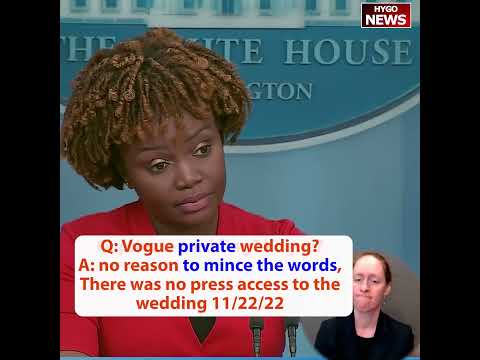
Reporter: “Dressing Up in a Wedding Dress, Having a Photo Shoot, Talking About the Wedding Is Coverage of the Wedding” — KJP Insists There Was “No Press Access”
On 11/22/2022, a reporter continued pressing White House Press Secretary Karine Jean-Pierre on the Vogue wedding coverage contradiction. When KJP again asserted the wedding was “private” with “no press access,” the reporter pushed back directly: “I think those of us might think that dressing up in a wedding dress, having a photo shoot, talking about the wedding is coverage of the wedding.” KJP rejected the characterization: “The wedding was private. It was a private family affair. There was no press access to the wedding. We were very clear about that. There’s no reason to mince our words here.” The exchange captured the fundamental disagreement between common-sense understanding of “press coverage of a wedding” and the White House’s narrow, technical definition that required a journalist to be physically present during the ceremony itself.
”Dressing Up in a Wedding Dress”
The reporter offered the common-sense definition. “I think those of us might think that dressing up in a wedding dress, having a photo shoot, talking about the wedding is coverage of the wedding,” the reporter said.
The reporter’s formulation captured what normal people would understand “press coverage of a wedding” to mean. If a magazine photographs the bride in her wedding dress, if the magazine describes the preparations, if the magazine publishes an extensive written feature about the event and the couple — that’s press coverage of a wedding. The fact that the photographer wasn’t physically present during the five minutes of vows didn’t change what the coverage was.
Vogue had photographed Naomi Biden in her wedding dress. Vogue had published extensive written coverage about the wedding. Vogue had presented the story as exclusive access to the Biden family wedding. By any ordinary reader’s understanding, Vogue had covered the wedding.
The White House’s denial rested on a technicality — that no Vogue photographer had been in the ceremony itself. This was true but beside the point. The coverage existed. Vogue had exclusive access to produce it. Other press did not have the same access. The White House was trying to pretend that these facts didn’t mean what they clearly meant.
”It Is Inaccurate, Completely Wrong”
KJP’s response was emphatic. “It is inaccurate, completely wrong. It is not right to say that it was open to suggest that a Vogue cover was open to the press. It was not. And so just want to be very, very clear. What you’re reading right now is not accurate,” KJP said.
The “completely wrong” and “not right” and “not accurate” formulations were attempts to shut down the line of questioning through emphatic denial. If KJP said the characterization was wrong enough times, maybe the reporter would move on.
But the emphatic denial made no sense in the context of the actual question. The reporter hadn’t said “Vogue was open to the press.” The reporter had said the photo shoot, the dress coverage, and the wedding feature collectively constituted coverage of the wedding. KJP was denying something that hadn’t been asserted.
This technique — denying a strawman version of the reporter’s question rather than the actual question — was common in KJP’s briefings. By restating the question in a form she could easily deny, she could produce emphatic denials without actually addressing what had been asked.
The Reporter’s Clarification
The reporter had to clarify the intent of the question. “Yeah, I wasn’t suggesting that. No, that’s what you just said. No, my question was — you said it was going to be a private wedding. It was,” the reporter said.
The clarification captured the frustration of being misinterpreted. The reporter wasn’t suggesting that Vogue had been formally invited as press — she was pointing out that Vogue’s coverage effectively included the wedding regardless of the formal access arrangement. The distinction KJP was drawing was technical and unconvincing.
“I think, I mean, it seems as if you were saying it would be the media would not be allowed access on the wedding day. But I think those of us might think that dressing up in a wedding dress, having a photo shoot, talking about the wedding is coverage of the wedding,” the reporter continued.
The reporter was essentially offering KJP a chance to explain the distinction without the technical dodging. Why was a photo shoot of the bride in her wedding dress not considered coverage of the wedding? What definition of “coverage” was being used?
”There’s No Reason to Mince Our Words”
KJP refused to engage with the reporter’s point. “The wedding was private. It was a private family affair. There was no press access to the wedding. We were very clear about that. There’s no reason to mince our words here. The family and friends were invited to this wedding. It was a private event,” KJP said.
The “no reason to mince our words” phrase was particularly ironic. KJP was using maximally precise technical language — “at the wedding,” “on the wedding day,” “press access to the wedding” — specifically to create a distinction that ordinary language obscured. Mincing words was exactly what she was doing.
The formulation also revealed what KJP considered the defensible position. She kept returning to the narrow claim that “there was no press access to the wedding” — meaning no press at the ceremony itself. She wouldn’t extend to broader claims like “Vogue had no special access to the wedding story” or “Vogue had no access beyond what other press had.” Those broader claims would have been false, and she knew it.
The Technicality vs. the Reality
The exchange highlighted a fundamental tension between technical accuracy and communicative honesty. KJP’s narrow claim — that no press attended the wedding ceremony — was technically accurate. But the overall impression her statements created — that the wedding was a private event inaccessible to press — was false. Vogue had substantial access and produced substantial coverage.
Communicative honesty requires not just avoiding literal falsehoods but also avoiding creating false impressions through selective emphasis or technical distinctions. KJP’s statements failed the communicative honesty test even if they passed the literal accuracy test. Readers and viewers who absorbed her statements would have believed the wedding was a private event with no press involvement, which was not the case.
The White House communications team had clearly discussed how to handle the Vogue situation. The “did not attend the wedding” formulation was too specific to be accidental. It was crafted to preserve a technical denial while allowing the substantive preferential access. KJP was executing a prepared communications strategy, not struggling to explain an accidental situation.
The Broader Access Question
The Vogue arrangement raised a broader question about White House press access decisions. If the White House could choose which publications to grant access to specific events — giving Vogue the wedding while denying everyone else — what prevented them from applying similar selectivity to other events?
The principle of equal press access had been a foundation of White House communications for decades. The White House press corps operated on the assumption that access was granted based on credentials and rotation, not on editorial preferences. The Vogue arrangement violated this principle by making access contingent on what the White House wanted in coverage terms.
Key Takeaways
- A reporter pushed back on KJP’s wedding denials with a common-sense definition: “dressing up in a wedding dress, having a photo shoot, talking about the wedding is coverage of the wedding.”
- KJP emphatically denied this characterization: “inaccurate, completely wrong, not right” and “not accurate.”
- KJP’s narrow denial — “no press access to the wedding” — was technically accurate but substantively misleading, as Vogue had exclusive access that no other press had.
- The phrase “no reason to mince our words” was itself ironic — KJP was using maximally precise technical language to create distinctions ordinary language obscured.
- The exchange highlighted the difference between literal accuracy (which KJP’s statements achieved) and communicative honesty (which they did not).
Transcript Highlights
The following is transcribed from the video audio (unverified — AI-generated from audio).
- It is inaccurate, completely wrong. It is not right to say that it was open.
- No, my question was you said it was going to be a private wedding. It was.
- Those of us might think that dressing up in a wedding dress, having a photo shoot, talking about the wedding is coverage of the wedding.
- The wedding was private. It was a private family affair.
- There’s no reason to mince our words here.
- The family and friends were invited to this wedding. It was a private event.
Full transcript: 172 words transcribed via Whisper AI.