 HYGO News
 Q: Viktor Bout still security threat? A: not lightly, to make that very clear
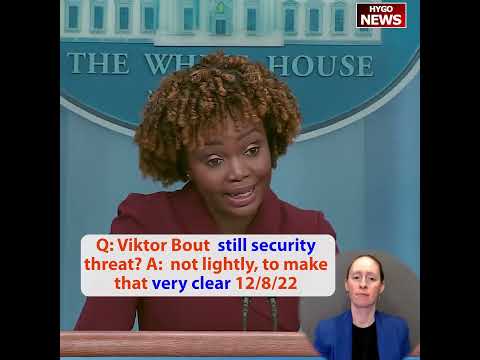
Reporter Presses KJP on Viktor Bout Threat Assessment: “You Still Have Security Concerns?” KJP: “I’m Not the Intelligence Committee”
On 12/9/2022, a reporter pressed White House Press Secretary Karine Jean-Pierre on whether the Biden administration still considered Viktor Bout a security threat after trading him for Brittney Griner. “You were asked previously about the security assessment regarding Victor Boot and you said that the United States would stay vigilant. It sounds like the administration still sees him as a security threat, no?” the reporter asked. KJP offered a convoluted response that emphasized Biden hadn’t made the decision lightly but didn’t directly address whether Bout remained a security concern. When the reporter pressed directly with “So you still have security concerns?”, KJP deflected: “I’m not the intelligence committee here, so I’m not going to get into any intelligence.” The exchange captured the administration’s difficulty reconciling its defense of the trade with acknowledgment that it had released someone it still considered dangerous.
The Prior “Stay Vigilant” Statement
The reporter referenced a previous KJP statement. “You were asked previously about the security assessment regarding Victor Boot and you said that the United States would stay vigilant,” the reporter said.
“Victor Boot” was the common pronunciation of Viktor Bout’s name — the reporter was using the phonetic form. The reference to “staying vigilant” was to prior administration statements that Bout would be monitored after his release.
The “stay vigilant” language was telling. It implied that Bout:
Remained a threat — Otherwise, vigilance wouldn’t be needed.
Might resume criminal activity — Which was what vigilance was defending against.
Could cause future harm — Consistent with his criminal history.
Required ongoing attention — Not a closed case after release.
These implications fit the widely-held view of Bout as a continuing threat. He was 55 years old in 2022 — fully capable of returning to international arms dealing. His release freed him to potentially resume criminal operations. Monitoring made sense precisely because his threat profile remained active.
The Logical Implication
The reporter’s follow-up was a logical implication of the administration’s own statements. “It sounds like the administration still sees him as a security threat, no?” the reporter asked.
The question was a simple logical connection:
- Administration said it would stay vigilant
- Vigilance is directed at threats
- Therefore, administration sees Bout as a threat
This was straightforward reasoning. If KJP had said vigilance wouldn’t be needed because Bout was no longer a threat, the question wouldn’t have arisen. Her earlier statement had effectively acknowledged the continuing threat.
The question was also a test of administration coherence. If the administration simultaneously:
- Traded Bout (implying the trade was acceptable)
- Called him a continuing security threat (implying releasing him was problematic)
…then the two positions were in tension. The reporter was asking the administration to address the tension.
The Convoluted Response
KJP’s response was difficult to parse. “We’re saying the question is, and the question has been placed to us is do we have security concerns, right? And what we have said is that the President did not make this decision lightly. He just wanted to make that very clear, but he believed this was the right thing to do to secure Brittany’s release,” KJP said.
Let me parse this:
“The question is…” — KJP was restating what the question was.
“Do we have security concerns” — She identified this as the core question.
“The President did not make this decision lightly” — Asserted the decision was considered.
“He wanted to make that very clear” — Emphasized the seriousness of the decision.
“He believed this was the right thing to do” — Claimed Biden’s belief in the decision.
“To secure Brittany’s release” — Identified the justification.
Notably absent from this response: any direct answer to whether the administration still had security concerns about Bout. KJP had identified the question but hadn’t answered it. Her response was about the decision-making process, not about the substantive security assessment.
”Not Lightly”
KJP’s emphasis on “did not make this decision lightly” was revealing. The framing implied that the decision had weighed significant concerns — including, implicitly, security concerns about Bout. If there had been no security concerns, the decision wouldn’t have required serious weighing. The “not lightly” framing was essentially an acknowledgment that security concerns existed without directly admitting them.
The “wanted to make that very clear” repetition suggested defensiveness. The administration wanted to be on record as having taken the decision seriously. But the question wasn’t whether the decision had been taken seriously — the question was whether Bout remained a security threat. The repeated emphasis on seriousness was responding to a different question than what had been asked.
The Direct Challenge
The reporter pressed directly. “So you still have security concerns?” the reporter asked.
This was the binary question:
- Yes or no
- About Bout specifically
- About security concerns specifically
- Current (not historical) assessment
KJP’s earlier response had described process; the reporter was asking for substance. Did the administration currently assess Bout as a security threat?
”I’m Not the Intelligence Committee”
KJP deflected by citing role limitations. “I’m not going to, I’m not the intelligence committee here, so I’m not going to get into any intelligence,” KJP said.
The “intelligence committee” reference was probably intended to mean “intelligence community” — the collection of U.S. intelligence agencies (CIA, NSA, FBI, etc.). The statement that KJP wasn’t the intelligence committee/community was technically true but analytically weak.
The White House Press Secretary regularly commented on intelligence-related matters in ways that didn’t require her to be an intelligence officer:
Administration positions on threats — Can be stated without revealing intelligence.
Public assessments — Officials regularly share unclassified assessments.
Policy implications — Security concerns inform policy, which is within press secretary purview.
Consistency with prior statements — Reconciling previous “stay vigilant” statement.
The “not the intelligence committee” framing prevented KJP from addressing the question but didn’t logically require silence. She could have said:
- “Yes, we continue to view Bout as a security threat, which is why we’re staying vigilant”
- “Our concerns about Bout are why we’ll monitor him after release”
- “We wouldn’t stay vigilant if we thought he was no longer a threat”
Any of these responses would have been consistent with administration positioning and wouldn’t have required intelligence disclosure. The refusal to say them was a choice, not a necessity.
The Political Tension
KJP’s difficulty reflected a genuine political tension in the administration’s defense of the trade. The administration needed to simultaneously:
Defend releasing Bout — As necessary for Griner’s release.
Acknowledge Bout remained dangerous — To avoid seeming naive.
Maintain deterrent messaging — That trades weren’t reward for bad behavior.
Preserve future options — For similar trades if needed.
These positions created tension. If Bout was dangerous, releasing him was costly. If Bout wasn’t dangerous, the trade was easy but the monitoring was unnecessary. The administration wanted to claim both — that the trade was acceptable despite Bout’s continuing threat.
The “not the intelligence committee” deflection was a way to avoid having to resolve the tension publicly. By refusing to engage with the intelligence-related question, KJP could leave the tension unresolved rather than having to explicitly defend the seemingly-contradictory position.
The Subsequent Evidence
Following Bout’s release, various observers tracked his post-release activities. Reports suggested that:
He returned to Russia — And was welcomed by the Russian government.
He entered politics — Running for office and being elected to a regional parliament.
He resumed public profile — Giving interviews and making public statements.
He maintained Kremlin ties — Working within the Russian government apparatus.
Whether Bout resumed arms trafficking was harder to document. Intelligence assessments of his post-release activities weren’t publicly released. Various analysts expressed concern that he might resume criminal activities or share expertise with others.
The continued monitoring that KJP had referenced as “staying vigilant” was presumably tracking these post-release activities. But the administration didn’t publicly address whether the monitoring had confirmed continued threat behavior or had found him to be less dangerous than feared.
The Accountability Gap
The exchange exemplified an accountability gap in how the administration discussed the trade. Critical questions — about threat assessment, about precedent, about alternative deals — consistently received deflection rather than engagement.
Over time, this gap had cumulative effects:
Public perception — That the administration couldn’t defend its decisions analytically.
Press relations — With reporters increasingly frustrated with deflection.
Political positioning — Leaving the administration’s messaging incoherent.
Policy precedent — Without public analysis, precedent concerns persisted.
The administration’s preferred framing — bringing Americans home is always good — was rhetorically effective but analytically limited. When reporters pushed on the trade-offs, the administration couldn’t offer the sophisticated analysis that the decision required. The “not the intelligence committee” deflection was one example among many of this pattern.
The Bout Legacy
Bout’s release became one of the more controversial foreign policy decisions of the Biden administration. Critics continued to reference it as evidence of poor negotiation or misguided priorities. Supporters continued to defend it as the right choice under the circumstances.
The debate was structurally difficult to resolve because the counterfactual — what would have happened if the trade hadn’t occurred — was unknowable. Griner might have been released eventually at a lower price. Or she might have spent years in Russian detention. Bout might have resumed his criminal activities. Or he might have stayed out of action by choice.
What was knowable was the specific trade that had been made and its specific costs. A convicted would-be killer of Americans had been freed. A man serving a 25-year sentence had been released after 11. The message sent to future hostage-takers was at best ambiguous. These specific costs were real and fixed, regardless of what happened afterward.
Key Takeaways
- A reporter referenced KJP’s prior statement that the U.S. would “stay vigilant” regarding Viktor Bout — implying the administration still viewed him as a security threat.
- When asked directly whether the administration saw Bout as a security threat, KJP pivoted to discussing that Biden “did not make this decision lightly.”
- The reporter pressed again: “So you still have security concerns?”
- KJP deflected to intelligence confidentiality: “I’m not the intelligence committee here, so I’m not going to get into any intelligence.”
- The exchange illustrated the tension in the administration’s defense — needing to simultaneously justify releasing Bout and acknowledge his continuing threat level.
Transcript Highlights
The following is transcribed from the video audio (unverified — AI-generated from audio).
- You were asked previously about the security assessment regarding Victor Boot and you said that the United States would stay vigilant.
- It sounds like the administration still sees him as a security threat, no?
- We’re saying the question is, and the question has been placed to us is do we have security concerns, right?
- The President did not make this decision lightly. He just wanted to make that very clear.
- He believed this was the right thing to do to secure Brittany’s release.
- So you still have security concerns? — I’m not the intelligence committee here, so I’m not going to get into any intelligence.
Full transcript: 116 words transcribed via Whisper AI.