 HYGO News
 Trump on Ukraine Territory: 'Crimea Was Handed Over by Barack Hussein Obama -- Nothing to Do with Me'; Bessent: South Korea Deal 'Next Week'
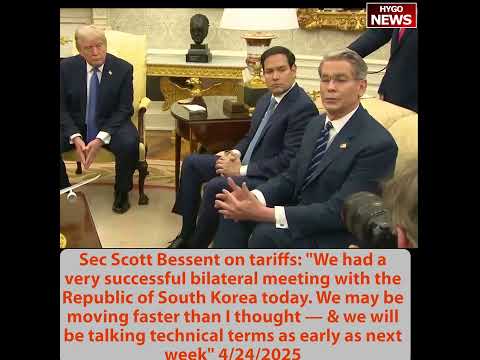
Trump on Ukraine Territory: “Crimea Was Handed Over by Barack Hussein Obama — Nothing to Do with Me”; Bessent: South Korea Deal “Next Week”
President Trump addressed the territorial dimension of Ukraine peace talks in April 2025, telling reporters: “When you say Crimea, that was handed over during a president named Barack Hussein Obama. That had nothing to do with me. There wasn’t a bullet fired, no fighting, no anything. They just handed it over.” He acknowledged the difficulty: “They say, can you get it back? I think that’s going to be a very difficult thing to do.” Treasury Secretary Bessent announced a breakthrough with South Korea: “We had a very successful bilateral meeting. We may be moving faster than I thought — we will be talking technical terms as early as next week.” Trump praised the Norway relationship, joking: “You don’t need snow, you don’t need skis, you don’t need ski champions either."
"Crimea Was Barack Hussein Obama”
A reporter posed the question directly: “Do you still agree that Ukraine has to give some territory away to win peace?”
Trump’s answer was characteristically layered: “Well, it depends what territory. They’ve been fighting, they’ve lost a lot of territory.”
He committed to effort: “We’ll do the best we can. Working with Ukraine, we’ll do the best we can.”
He acknowledged reality: “But they lost a lot of territory.”
Then he reframed the Crimea question entirely: “When you say Crimea, that was handed over during a president named Barack Hussein Obama. That had nothing to do with me, Crimea. That was 11 years ago with Obama.”
He described what happened: “They made a decision. There wasn’t a bullet fired, there was no fighting, there was no anything. They just handed it over.”
He assessed the prospect of recovery: “Now they say, can you get it back? I think that’s going to be a very difficult thing to do.”
He placed responsibility: “That was given by Barack Obama when he was president, not by Donald Trump.”
The Crimea distinction was the most important piece of the territorial puzzle. Russia had annexed Crimea in 2014 — during Obama’s presidency — without military resistance from Ukraine or the West. Obama’s response had been limited to sanctions and diplomatic protests, neither of which reversed the annexation. By framing Crimea as “Obama’s loss,” Trump was accomplishing two things.
First, he was separating Crimea from the broader territorial dispute. The territory Russia had seized during the 2022 invasion — portions of Donetsk, Luhansk, Zaporizhzhia, and Kherson — was a different category from Crimea, which had been under Russian control for over a decade. Any realistic peace deal would need to address these differently.
Second, he was deflecting responsibility for accepting Crimea’s status. If Crimea was lost under Obama, demanding its return was asking Trump to reverse another president’s failure. The “nothing to do with me” formulation was both historically accurate and politically useful — it lowered expectations for Crimea’s recovery while maintaining pressure on Russia regarding more recently seized territory.
South Korea: “Faster Than I Thought”
Bessent delivered a trade breakthrough that signaled the tariff strategy’s accelerating momentum.
“We had a very successful bilateral meeting with the Republic of South Korea today,” Bessent said.
He expressed surprise at the pace: “We may be moving faster than I thought.”
He set the timeline: “And we will be talking technical terms as early as next week, as we reach an agreement on understanding as soon as next week.”
He praised the Koreans: “South Koreans came early, they came with their A-game, and we will see if they follow through on that.”
The South Korea development was significant on multiple levels. South Korea was America’s sixth-largest trading partner and a major exporter of automobiles, electronics, and semiconductors to the United States. A trade agreement with Seoul would be one of the most consequential deals of the tariff era.
Bessent’s “faster than I thought” comment was the most optimistic assessment any administration official had offered about the pace of trade negotiations. When the Treasury Secretary — the official responsible for the economic side of trade policy — expressed pleasant surprise at the speed of progress, markets took notice.
The “A-game” characterization suggested that South Korea had come prepared with serious concessions — not token gestures but substantive offers that addressed the trade imbalances the administration was targeting. The willingness to discuss “technical terms” next week meant the negotiations had moved from broad principles to specific details — the stage at which deals actually got done.
Norway: “You Don’t Need Snow”
Trump’s exchange with Norwegian media produced one of the lighter moments of the day.
“What do you want Norway to buy more of from the U.S.?” a reporter asked.
Trump’s answer was playful: “Well, you don’t need snow. You don’t need skis. You don’t need ski champions either, right?”
He assessed the relationship: “We just want to keep the relationship the way it is. We’ve had a great relationship — I think now maybe closer than ever, but we’ve had a great relationship with Norway.”
He concluded generously: “You can’t do better.”
When told Norway wanted to offer additional concessions, Trump was magnanimous: “That’s okay. You can’t do much better.”
The Norway exchange revealed a dimension of Trump’s trade strategy that critics missed: not every relationship needed to be renegotiated. Norway was a NATO ally, a reliable partner, and a country with which the United States had a balanced economic relationship. Trump’s instinct was to preserve good relationships while demanding change from exploitative ones.
The War Update
Trump provided his assessment of the peace process with Store beside him.
“We’ve had talks on the war with Ukraine-Russia and trade,” Trump said. “We’re doing very well, I think, on both. We’ve had some pretty good movement in every respect.”
He reiterated the human cost: “I used to say 2,500 people a week dying — young people, mostly soldiers from Russia and Ukraine. And we want to end that war. We want to end it quickly.”
He expressed cautious optimism: “I think we’ve made a lot of progress, and we’ll see what happens. This next few days is going to be very important.”
He set the standard for the future: “I think the Prime Minister knows that over the years the United States has been very good to a lot of people. And it’s time for us to benefit also.”
He welcomed Store: “Mr. Prime Minister, it’s an honor to have you at the White House.”
The “next few days is going to be very important” statement aligned with the deadline framework that Rubio and Vance had established. The administration was converging on a moment of decision — a period within which both Russia and Ukraine would either accept the proposed framework or face the consequences of American disengagement.
Key Takeaways
- Trump on Crimea: “That was handed over during Barack Hussein Obama. There wasn’t a bullet fired. Nothing to do with me.”
- On recovering Crimea: “They say can you get it back? I think that’s going to be very difficult.”
- Bessent on South Korea: “Very successful bilateral meeting. We may be moving faster than I thought — technical terms as early as next week.”
- Trump to Norway: “You don’t need snow, skis, or ski champions. We just want to keep the relationship as it is. You can’t do better.”
- Peace process: “Pretty good movement in every respect. The next few days is going to be very important.”