 HYGO News
 Q: tripped up Biden policies A: weigh new doctrine new Higher Education Act pathway
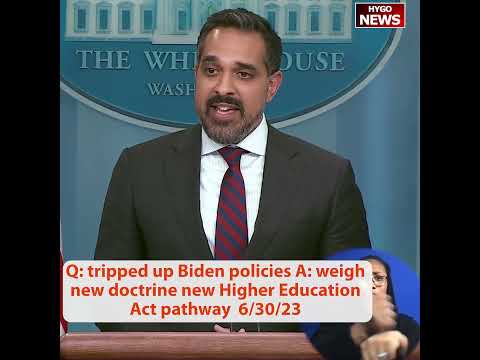
Major Questions Doctrine Has “Tripped Up” Biden Policies — White House Plans Higher Education Act Pathway
On June 30, 2023, a reporter pressed the White House on a problem that extended far beyond student loans: the Supreme Court’s major questions doctrine had now derailed multiple Biden administration policies, and the student loan ruling appeared to strengthen that legal constraint even further. The exchange between the reporter and Deputy NEC Director Bharat Ramamurti revealed both the administration’s frustration with the doctrine and its strategy for navigating around it by shifting from the HEROES Act to the Higher Education Act as the legal foundation for future student loan reforms.
The Major Questions Doctrine as a Pattern
The reporter’s question identified something the White House was reluctant to discuss openly: the student loan ruling was not an isolated setback but part of a pattern in which the Supreme Court used the major questions doctrine to block ambitious executive actions that lacked explicit congressional authorization.
The reporter asked: “The opinion touches on the President’s authority to act without specific permissions on Congress and cites several opinions that I know have tripped up Biden administration policies over the last couple of years. Can you talk about how you see this opinion moving forward applying in other areas of policymaking that you do?”
The reference to previous cases was pointed. The major questions doctrine had been invoked by the Court to strike down the CDC’s eviction moratorium during the pandemic, the OSHA vaccine-or-test mandate for large employers, and the EPA’s broad authority to regulate power plant emissions. In each case, the Court held that the executive branch was attempting to use existing statutory authority to accomplish something far more sweeping than Congress had intended.
The student loan ruling added another landmark application of the doctrine. The Court found that using the HEROES Act’s authority to “waive or modify” student loan provisions during an emergency did not extend to canceling $400 billion in debt. The doctrine’s core principle — that agencies must have clear congressional authorization before taking actions of vast economic or political significance — was becoming the primary judicial check on executive power.
Ramamurti’s Defense: “In the Eye of the Beholder”
Ramamurti pushed back on the premise that the doctrine necessarily constrained the administration’s policymaking.
“Well, look, I — I think that it’s kind of in the eye of the beholder. Right? When — when the HEROES Act says that the Secretary can waive or modify a provision, it seems to me that that is very clear about what the Secretary’s authorities are. It is a broad grant of authority,” he said.
The response was notable for its defiance in the face of a decisive 6-3 loss. Ramamurti was effectively saying that the administration still believed its original legal theory was correct, even though the Supreme Court had just rejected it. The “eye of the beholder” framing suggested that the administration viewed the major questions doctrine not as a settled legal principle but as a tool the conservative majority wielded selectively.
This interpretation had some support in legal scholarship. Critics of the major questions doctrine argued that it lacked a principled basis for determining when a question was “major” enough to trigger the heightened requirement for clear congressional authorization. The threshold appeared to depend on the political significance of the issue and the economic impact of the regulation, which gave the Court considerable discretion to apply it when it wanted to block executive action and ignore it when it did not.
The Pivot to the Higher Education Act
When the reporter pressed more directly on whether the doctrine would continue to obstruct the administration’s agenda, Ramamurti acknowledged the constraint while pointing to a workaround.
“We’ll have to weigh how it would stand up against that new doctrine that the Supreme Court has issued. But again, we think that the pathway that we’re choosing here, the Higher Education Act, is available even with this doctrine in place,” he said.
This was the most strategically significant statement in the exchange. The administration was signaling that its future student loan reforms would be grounded in the Higher Education Act rather than the HEROES Act. The distinction mattered because the Higher Education Act provides explicit statutory authority for the Secretary of Education to create and modify income-driven repayment plans. Unlike the HEROES Act’s broad emergency powers, which the Court found insufficient for mass debt cancellation, the Higher Education Act’s provisions were specifically designed for the purpose the administration now intended to use them.
The calculation was that even the major questions doctrine could not block regulatory action when Congress had specifically authorized the agency to take that kind of action. Creating or modifying an income-driven repayment plan under a statute that explicitly authorized income-driven repayment plans was categorically different from canceling $400 billion in debt under a statute that authorized “waivers and modifications” during emergencies.
The Broader Implications for Executive Power
The exchange illuminated a larger shift in the balance of power between the executive and judicial branches. The major questions doctrine represented the Court’s most powerful tool for limiting agency action, and its application was expanding. Each successful invocation of the doctrine — the eviction moratorium, the vaccine mandate, the EPA regulations, and now student loans — established new precedent that emboldened future challenges.
For the Biden administration, the practical effect was a narrowing of what could be accomplished through executive action alone. Policies that might have survived legal challenge a decade earlier now faced a judicial framework that required explicit congressional authorization for any action the Court deemed sufficiently significant. In a Congress where partisan gridlock made major legislation difficult to pass, this constraint effectively limited the executive branch to incremental regulatory changes rather than transformative policy shifts.
Ramamurti’s pivot to the Higher Education Act reflected this new reality. Rather than fighting the major questions doctrine head-on, the administration was adapting to it by choosing legal foundations that could satisfy the doctrine’s requirements. The strategy traded ambition for durability — the SAVE plan was far less generous than the original forgiveness program, but it stood a better chance of surviving judicial review.
The Legal Context: Biden v. Nebraska
The reporter’s question came in the immediate aftermath of the Supreme Court’s 6-3 decision in Biden v. Nebraska. The ruling invalidated the administration’s plan to cancel up to $10,000 in student debt for borrowers earning under $125,000 and up to $20,000 for Pell Grant recipients, a program estimated to cost over $400 billion. Six Republican attorneys general challenged the program on separation of powers grounds, and the Court agreed that the HEROES Act did not provide the necessary authorization for action of such sweeping economic significance.
The ruling joined a growing line of cases applying the major questions doctrine to curtail executive authority, establishing the doctrine as perhaps the most consequential legal development of the Roberts Court era.
Key Takeaways
- A reporter noted that the major questions doctrine had “tripped up” multiple Biden administration policies and asked how the student loan ruling would affect future policymaking across government.
- Ramamurti called the doctrine’s application “in the eye of the beholder” and maintained that the HEROES Act’s authority to “waive or modify” student loan provisions was clear, even though the Court had just ruled otherwise.
- The administration signaled a strategic pivot to the Higher Education Act as the legal foundation for future student loan reforms, arguing this pathway could survive the major questions doctrine because Congress specifically authorized income-driven repayment programs.
- The exchange revealed the narrowing of executive power under the major questions doctrine, with each new application establishing precedent that emboldened future legal challenges to agency action.
- The administration’s shift from transformative debt cancellation to incremental repayment reform reflected the practical constraints imposed by the Court’s increasingly assertive scrutiny of executive authority.