 HYGO News
 Q: Transparency? A: reached out to Archives
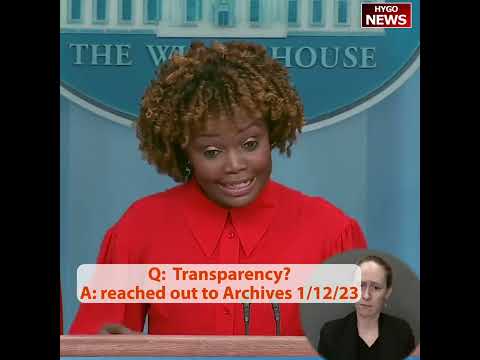
Reporter: Why Didn’t Biden Address December 20 Garage Documents Transparently? KJP: “Reached Out to Archives”
On 1/12/2023, a reporter questioned the timeline and transparency of classified documents discoveries. “On Tuesday in McSueve City, all the conversation was about the documents in the office. However, according to Attorney General, documents were found on December 20th in his garage in Wilmington. Why was that not immediately addressed, as well as being transparent about that, if that was already known and not discussed up front?” the reporter asked. White House Press Secretary Karine Jean-Pierre deflected: “So, just to, you said transparent, I want to say that we have been transparent here. That is why the minute that his lawyers found those documents, they reported it, they reached out to the archives. What he did and what his team did is the minute that they realized that the documents were there, they reached out to the archives.”
The Timeline Question
The reporter raised specific timeline concerns. “On Tuesday in McSueve City, all the conversation was about the documents in the office. However, according to Attorney General, documents were found on December 20th in his garage in Wilmington,” the reporter said.
The timeline issues:
Tuesday discussion — About office documents.
Public learned — About one discovery.
December 20 — Garage documents found.
Not mentioned Tuesday — Apparently.
Selective disclosure — Suggested.
The “McSueve City”:
Transcription error — For “Mexico City.”
Biden visit — To Mexico for North American Leaders.
January 9-10 — Mexico trip.
Documents discussion — During trip.
Classified docs focus — Internationally.
The Specific Disclosure Failure
The reporter’s precise concern:
December 20 — Garage docs found.
Public disclosure late — Until January 12 press conference.
Tuesday Mexico briefings — Didn’t mention garage.
Selective disclosure — Of information.
Timing questions — Raised.
The transparency failure:
Specific omission — In prior briefings.
Not just delay — But selective.
Public misled — Potentially.
Partial disclosure — Strategic.
Trust erosion — Systematic.
”Why Was That Not Immediately Addressed?”
The reporter’s specific question:
“Not immediately addressed” — Accountability demand.
“Transparent about that” — Direct standard.
“Already known” — Established fact.
“Not discussed up front” — Specific failure.
Substantive inquiry — Required.
The question had:
Clear factual basis — December 20 discovery.
Specific accountability demand — For transparency.
Reasonable standard — Up-front disclosure.
Legitimate concern — About selective.
Required specific answer — Not generic.
”We Have Been Transparent Here”
KJP’s defensive response. “So, just to, you said transparent, I want to say that we have been transparent here,” KJP said.
The “been transparent”:
Blanket claim — Without specifics.
Contradicted by evidence — Of omissions.
Standard administration — Framing.
Self-serving assertion — Not objective.
Deflection technique — For hard questions.
The “here”:
Current briefing — Implied.
Not retrospective — Transparency.
Limited scope — Of claim.
Doesn’t cover — Prior briefings.
Partial framing — Of transparency.
”The Minute Lawyers Found Those Documents”
KJP emphasized lawyer response. “That is why the minute that his lawyers found those documents, they reported it, they reached out to the archives,” KJP said.
“The minute”:
Immediate response — Claimed.
By lawyers — Specifically.
To archives — Legal authority.
Not to public — Important distinction.
Legal process — Emphasized.
The legal response:
Proper procedure — Followed.
Required by law — Essentially.
Administrative compliance — Standard.
Not political transparency — Different.
Legal vs. political — Distinction.
The Archives vs. Public Distinction
KJP repeatedly referenced “archives”:
National Archives — Receiving agency.
Legal custody — Transfer.
Proper handling — Of materials.
Legal compliance — Demonstrated.
Administrative process — Standard.
But:
Archives not public — Different.
Legal compliance — Necessary but not sufficient.
Transparency demands — Public disclosure.
Public interest — In knowing.
Accountability requires — Public engagement.
The archives reference:
Conflated — Legal and political transparency.
Suggested — Compliance was enough.
Avoided — Public disclosure question.
Substituted — Process for substance.
Standard deflection — Technique.
The “Team” Response
KJP broadened to Biden’s team. “What he did and what his team did is the minute that they realized that the documents were there, they reached out to the archives,” KJP said.
The “team”:
Broader than lawyers — Alone.
Administrative coordination — Implied.
Collective action — Framed.
Distributed responsibility — Somewhat.
Standard framing — For such matters.
The repetition:
Same point — Stated twice.
“Reached out to archives” — Emphasized.
Legal process — Centered.
Public transparency — Avoided.
Substantive question — Not addressed.
The Repetition Problem
KJP’s response was repetitive:
“Reached out to archives” — Twice.
Same substance — Each time.
No new information — Added.
Deflection technique — Through repetition.
Limited engagement — With specifics.
The repetition served:
Filling briefing time — Procedurally.
Avoiding follow-up — Tactically.
Reinforcing message — Strategically.
Substitute for substance — Rhetorically.
Standard technique — Across briefings.
The December 20 Specifics
The December 20 discovery:
Wilmington garage — Location.
Biden’s Delaware home — Specifically.
Near Corvette — Infamous detail.
Found by lawyers — Second search.
Different from Penn Biden Center — Discovery.
The timing:
One month before disclosure — Approximately.
Pre-Mexico trip — Existing.
Not mentioned — In Mexico briefings.
Public learned later — Despite knowledge.
Selective disclosure — Clear.
The reporter’s concern:
Valid factual basis — Supported.
Transparency standard — Not met.
Administration knew — Definitively.
Didn’t disclose — Selectively.
Question appropriate — For inquiry.
The Ongoing Pattern
The disclosure pattern:
November 2 first discovery — Secret.
November-December silence — Pre-midterm.
January 9 public learns — About first.
December 20 discovery — Not mentioned.
January 12 disclosure — Additional.
Rolling revelations — Continued.
This pattern:
Systematic concealment — Initially.
Reactive disclosure — Eventually.
Media pressure — Driving revelations.
Political timing — Considered.
Trust erosion — Progressive.
The Political Calculations
The administration’s calculations:
Pre-midterm concealment — Concerns.
Post-Trump-raid calculations — Comparison.
Rolling revelations — Damage control.
Trump contrast — Weakening.
Legal protection — Prioritized.
Each decision:
Served short-term politics — Possibly.
Damaged long-term credibility — Certainly.
Frustrated media — Predictably.
Built negative narrative — Systematically.
Created 2024 vulnerability — Substantially.
The Mexico City Trip Context
Biden’s Mexico trip:
North American Leaders Summit — January 9-10.
Major diplomatic event — With AMLO, Trudeau.
Documents scandal — Breaking.
Public attention — Split.
Administration messaging — Complicated.
During Mexico:
Classified docs questioning — Continued.
Public information limited — About scope.
Biden team responses — Controlled.
December 20 discovery — Not disclosed.
Trip success complicated — By scandal.
The Standard Non-Answer
KJP’s response pattern:
Claim transparency — Without evidence.
Emphasize legal process — Instead of political.
Reference archives — As if sufficient.
Repeat same points — For filler.
Avoid specific question — About selective disclosure.
This pattern:
Standard across topics — Not just documents.
Frustrated reporters — Consistently.
Built negative coverage — Predictably.
Maintained messaging discipline — Politically.
Damaged credibility — Over time.
The Transparency Erosion
Each briefing erosion:
Specific transparency failures — Documented.
Administration defense — Generic.
Reporter persistence — Appropriate.
Pattern recognition — By public.
Credibility damage — Cumulative.
The transparency erosion:
Undermined key promise — Of administration.
Weakened Trump contrast — Substantially.
Created 2024 vulnerability — Significant.
Affected coverage tone — Increasingly.
Standard political concern — But important.
The Administrative Limits
KJP’s limits:
Legal constraints — From lawyers.
Political messaging — Discipline.
Briefing format — Limits.
Coordination with DOJ — Required.
Administration position — Fixed.
Within limits:
Substantive engagement — Limited.
Specific answers — Constrained.
Transparency claims — Standard.
Deflection tools — Deployed.
Pattern maintenance — Expected.
The Media Frustration
Media frustration grew:
Sustained non-answers — Across briefings.
Specific questions deflected — Routinely.
Political framing — Instead of facts.
Pattern recognition — By reporters.
Professional persistence — Required.
Each briefing:
Added frustration — Accumulated.
Generated coverage — Of pattern.
Built narrative — About administration.
Affected political analysis — Of Biden.
Created expectations — For continued deflection.
The Substantive Issues
The underlying substantive issues:
Classified documents mishandling — Pattern.
Transparency failures — In disclosure.
Legal implications — For Biden.
Political vulnerabilities — Created.
2024 campaign issues — Emerging.
These issues:
Wouldn’t resolve — With deflection.
Required substantive engagement — Eventually.
Special Counsel investigation — Would proceed.
Public accountability — Inevitable.
Long-term impact — Significant.
The Archives Reference Significance
KJP’s repeated “archives” reference:
Deflected from public — To agency.
Legal over political — Transparency.
Compliance over accountability — Framing.
Process over substance — Emphasis.
Standard technique — For such questions.
The archives:
Are not public — By definition.
Receive classified materials — Properly.
Don’t disclose publicly — Usually.
Serve legal function — Not political.
Aren’t transparency mechanism — Directly.
The Political Consequences
Political consequences continued:
Trust damage — Systematic.
Media coverage — Sustained.
Republican exploitation — Predictable.
2024 implications — Growing.
Campaign complications — Real.
By early 2023:
Classified documents — Major political issue.
Biden credibility — Damaged.
Trump contrast — Weakened.
Campaign strategy — Complicated.
Base support — Maintained but strained.
The Pattern Across All Media
The transparency problem affected:
Mainstream coverage — Growing.
Conservative coverage — Extensive.
International coverage — Some.
Social media — Substantial.
All platforms — Covered issue.
Coverage patterns:
Reporter questions — Increased.
Administration defenses — Consistent.
Pattern recognition — Universal.
Political implications — Analyzed.
Long-term significance — Debated.
Key Takeaways
- A reporter pressed KJP on why the December 20 garage document discovery wasn’t mentioned during Biden’s Mexico City trip briefings.
- The reporter demanded transparency: “Why was that not immediately addressed, as well as being transparent about that?”
- KJP claimed: “We have been transparent here” — without acknowledging selective disclosure.
- She deflected to legal process: “Lawyers… reached out to the archives.”
- KJP repeated the archives response twice as deflection technique.
- The archives deflection conflated legal compliance with public transparency.
- The rolling disclosure pattern — November, December, January revelations — damaged credibility.
- Trump contrast was substantially weakened by the classified documents issues.
Transcript Highlights
The following is transcribed from the video audio (unverified — AI-generated from audio).
- On Tuesday in Mexico City, all the conversation was about the documents in the office.
- However, according to Attorney General, documents were found on December 20th in his garage in Wilmington.
- Why was that not immediately addressed, as well as being transparent about that, if that was already known and not discussed up front?
- Just to, you said transparent, I want to say that we have been transparent here.
- That is why the minute that his lawyers found those documents, they reported it, they reached out to the archives.
- What he did and what his team did is the minute that they realized that the documents were there, they reached out to the archives.
Full transcript: 115 words transcribed via Whisper AI.