 HYGO News
 Trump Agrees With Reporter: Biden's Presidency Was 'Gross Incompetence'; Ukraine Deal Progress Revealed
Trump Agrees With Reporter: Biden’s Presidency Was “Gross Incompetence”; Ukraine Deal Progress Revealed
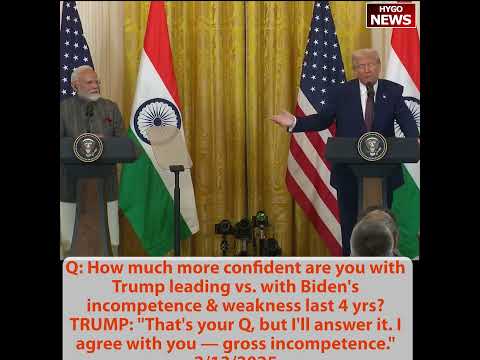
During a February 13, 2025, joint press availability with Indian Prime Minister Narendra Modi, a reporter asked Modi how much more confident he was with Trump leading the United States compared to “Biden’s incompetence and weakness over the last four years.” Trump interjected before Modi could answer: “That’s your question, but I’ll answer it. I agree with you — gross incompetence.” Trump then provided the most optimistic update yet on Ukraine peace negotiations, revealing that both Putin and Zelensky wanted to make a deal and that Special Envoy Steve Witkoff’s meeting in Moscow had been “very successful."
"Gross Incompetence”
The exchange began when a reporter directed a question to Prime Minister Modi about the contrast between Trump’s leadership and the Biden years.
“You and the President both spoke about combating ISIS. You both sounded very excited about this partnership upcoming,” the reporter said. “And I was curious, how much more confident are you with President Trump leading this country, that there will be peace through strength and you will have a successful partnership with the United States, versus with Biden’s incompetence and weakness over the last four years?”
The question was loaded, effectively asking a visiting foreign leader to criticize Biden to Trump’s face. Before Modi could navigate the diplomatic minefield, Trump stepped in with characteristic directness.
“That’s your question, but I’ll answer it,” Trump said. “I agree with you. Gross incompetence.”
The two-word assessment — “gross incompetence” — was Trump’s most concise indictment of his predecessor. He had used variations of the criticism throughout the campaign and transition, but the brevity of the statement during a bilateral press event with a major world leader gave it particular force. Trump was not merely criticizing Biden domestically; he was doing so in front of one of the most important leaders in the international system, effectively inviting the world to share his assessment.
”The World Has a Light Over It”
Trump then pivoted from criticism of Biden to a sweeping claim about the impact of his return to office. “We’re going to have a fantastic relationship,” Trump said of the U.S.-India partnership. “And it has been — look, the whole world’s been set back over the last four years by the weakness of the United States, the weak leadership of the United States.”
He argued that the change had been immediate and visible. “But I think we’ve taken care of it in just three weeks,” Trump said. “It seems to me that even some of the media that we wouldn’t prefer has been writing that this is a much different country right now, that the world has a light over it. Not only our country, but the whole world.”
Trump then attributed the sentiment to Modi himself. “The Prime Minister told me that before too — even over India,” Trump said. “The world has a light. They need the United States to be strong and powerful, but good. And I think that’s happened. And I think it’s happened in a very short period of time.”
The “light over the world” metaphor was unusually lyrical for Trump. Whether the observation originated with Modi or was Trump’s embellishment of something the Indian leader had said in private, the image was effective: a world that had been dimmed by four years of American weakness was now illuminated by the return of American strength. The fact that Trump attributed the observation to a foreign leader gave it additional credibility, suggesting that the perception of American resurgence was not merely domestic but global.
Ukraine: “I Think We’re Going to Be Able to Make a Deal”
The most substantive news from the press availability was Trump’s update on Ukraine peace negotiations, which had been moving rapidly since his inauguration.
“We had some talks, and we told the European Union, we told the NATO people, largely they overlap — you have to pay more money because it’s unfair what we’re doing,” Trump said, framing the European financial burden as a precondition for American engagement in the peace process. “We’re doing a tremendous amount more, with probably $200 billion more going into Ukraine using for Ukraine to fight. And Europe has not really carried its weight in terms of the money. It’s not equitable. And we want to see a counterbalance. We want to have them put up more money. They have to do that.”
Trump then delivered the most optimistic assessment of the peace process since the war began. “At the same time, we had a very good conversation with President Putin the other day, yesterday,” Trump said. “And we also had a very good conversation — I did both, in both cases — with President Zelensky.”
He expressed his belief that both sides were ready to negotiate. “I think we’re going to be able to do something. I think we’re going to be able to make a deal. And I hope so, because it’s a horrible war,” Trump said.
Trump painted a vivid picture of the human cost that was driving the urgency. “It’s a very terrible, bloody war with a million and a half soldiers, at least already dead on the battlefield, lying all over the fields like nobody’s ever seen anything like it, certainly since the Second World War,” he said. The casualty figure of 1.5 million soldiers — if accurate — would make the Ukraine conflict one of the deadliest wars of the modern era, far exceeding the publicly discussed estimates that had been circulating in media reports.
Both Leaders “Want to Make a Deal”
The critical revelation was Trump’s assessment that both Putin and Zelensky had signaled their willingness to negotiate.
“My impression is that — I know that President Zelensky wants to make a deal,” Trump said. “And I also feel that — I know that President Putin wants to make a deal.”
He described this as a prerequisite for his own engagement. “I wanted to know that before I began any detailed discussions,” Trump said. The comment suggested that Trump had been testing the waters through preliminary conversations and envoy meetings before committing to substantive negotiations. Having satisfied himself that both parties were willing, the detailed work could now begin.
Trump also referenced Special Envoy Steve Witkoff’s recent trip to Moscow. “The meeting with Steve Witkoff in Moscow was a very successful one,” Trump said. “And my phone call with him was a very successful one.”
The characterization of Witkoff’s Moscow meeting as “very successful” was the most positive language any American official had used about U.S.-Russia diplomatic engagement since before the invasion. Combined with Trump’s assertion that both leaders wanted a deal, it painted a picture of a peace process that was moving faster than most observers had anticipated.
The Modi Relationship
The press availability took place during Modi’s visit to Washington as the fourth foreign leader to visit the Trump White House since the inauguration. The two leaders had discussed military cooperation, trade, and the reciprocal tariff policy that Trump had announced the day before.
Despite the tariff tensions — Trump had just declared India the “highest tariffed nation in the world” — the personal relationship between the two leaders appeared warm. Trump’s prediction that “we’re going to have a fantastic relationship, and it’ll make both countries much stronger” reflected his pattern of separating personal rapport from hard-nosed trade negotiations. He could impose reciprocal tariffs on India while simultaneously cultivating a strategic partnership with Modi on defense, technology, and counterterrorism.
The combined messaging of the Modi visit — reciprocal tariffs on one hand, strategic partnership on the other — illustrated the Trump administration’s approach to international relationships: competitive on economics, cooperative on security, and personal in tone.
Key Takeaways
- Trump agreed with a reporter’s characterization of Biden’s presidency as incompetent, stating “I agree with you — gross incompetence” during a joint appearance with Indian PM Modi.
- He claimed “the world has a light over it” since his return to office, attributing the sentiment to Modi, who allegedly told Trump that “even over India, the world has a light.”
- Trump revealed that both Putin and Zelensky “want to make a deal” on Ukraine, calling it a prerequisite he needed to confirm before beginning detailed negotiations.
- He described the Ukraine war as having killed “a million and a half soldiers, at least” and called Special Envoy Witkoff’s Moscow meeting “very successful.”
- Trump demanded Europe contribute more financially to the Ukraine effort, saying the U.S. had spent “probably $200 billion more” than its allies and that the burden was “not equitable.”