 HYGO News
 Q: to change the Court? A: very clear not expand the Court, lay it out for the Americans
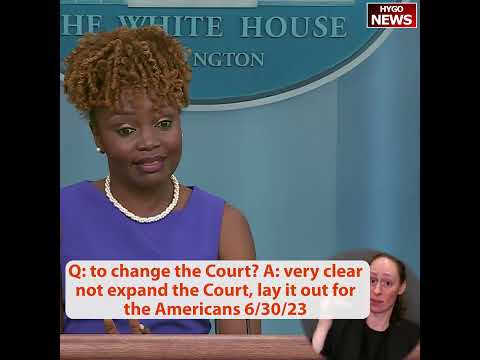
Reporter Asks If Biden Should “Change the Court” — KJP Says He Will Not Expand It
On June 30, 2023, in the wake of the Supreme Court striking down Biden’s student loan forgiveness program and the previous day’s ruling against affirmative action, a reporter asked White House Press Secretary Karine Jean-Pierre whether the President should embrace a proposal to change the Court. Jean-Pierre confirmed that Biden opposed expanding the Supreme Court but offered little else of substance, saying the President had made his views “very clear” and that the rulings would be “laid out for the American people” who could “make their decisions for themselves.” The exchange reflected the tension between the progressive wing of the Democratic Party, which was calling for structural reform of the Court, and a President who refused to act on those demands even as he publicly declared that the Court’s rulings were wrong.
The Reporter’s Question
The question arose from Biden’s own rhetoric. The President had stated publicly that the Supreme Court “doesn’t reflect the views of the American people” following its string of conservative decisions. The reporter followed that thread to its logical conclusion: “So, if the Supreme Court doesn’t reflect the views of the American people, like Biden has said, should he be embracing a proposal to change the Court?”
It was a pointed question because it exposed a gap in Biden’s messaging. If the President genuinely believed the Court was out of step with the American public, then some form of structural remedy would logically follow. Court expansion, term limits, ethics reforms, or other proposals had been floated by progressive Democrats and legal scholars. But Biden had consistently refused to embrace any of them, creating a situation in which he complained about the Court’s decisions while rejecting every proposed solution.
Jean-Pierre’s Non-Answer
Jean-Pierre’s response was a textbook example of saying something without saying anything. She began by addressing the court-expansion question directly: “I know people have asked about expanding the Court. He’s been very clear: That’s not something that he wants to do, as it relates to that.”
She then offered a series of circular statements: “Look, the President is — is — certainly has made himself very clear about how he sees these Court decisions. And the reason why he said that is — it’s pretty clear.”
When pressed, she offered: “You know, don’t have anything beyond what the President said yesterday and what he has said many times about when he’s been asked directly about the Court. But it’s — you know, I’ll lay it out for the American people, and they can see themselves and make their decisions for themselves.”
The answer amounted to: Biden thinks the Court is wrong, he will not expand the Court, and Americans can decide for themselves. No concrete proposal, no alternative reform, no acknowledgment that the President’s criticism of the Court demanded some form of constructive response.
The Contradiction in Biden’s Position
Biden’s refusal to embrace Court reform while simultaneously attacking the Court’s legitimacy created a persistent tension in his presidency. On one hand, he called the Court “not a normal Court” and accused it of misinterpreting the Constitution. On the other hand, he rejected the primary remedy his own party had proposed: expanding the number of justices to dilute the conservative majority.
This put Biden in an unusual position. Progressive Democrats, including members of the Congressional Progressive Caucus and advocacy organizations like Demand Justice, had been calling for Court expansion since the confirmation of Justice Amy Coney Barrett in 2020. The back-to-back rulings against affirmative action and student loan forgiveness intensified those calls. But Biden, who had spent decades in the Senate and valued institutional norms, was unwilling to take a step he viewed as potentially destabilizing to the judiciary.
The problem was that his alternative — criticizing the Court while doing nothing to change it — satisfied no one. Progressives saw it as weakness and a failure to use the political moment. Conservatives saw the criticism as inappropriate and potentially damaging to public confidence in the judiciary. And the general public received a confusing message: the Court was wrong, but the President would not do anything about it beyond asking voters to “make their decisions for themselves.”
What Biden Could Have Proposed
The reporter’s question was not limited to Court expansion. The phrase “a proposal to change the Court” was broader, encompassing a range of reforms that scholars and lawmakers had put forward. These included term limits for Supreme Court justices, which had bipartisan support in polling; mandatory ethics codes, which had gained urgency following revelations about undisclosed gifts and financial entanglements involving certain justices; and jurisdiction stripping, which would limit the Court’s authority in certain areas.
Biden’s Presidential Commission on the Supreme Court, which he had established in 2021, had studied many of these proposals and issued a report in December 2021. The commission did not make definitive recommendations but analyzed the arguments for and against various reforms. By the time of the June 2023 rulings, the commission’s work had been largely forgotten, and Biden had not acted on any of its analysis.
Jean-Pierre’s answer did not mention the commission’s work, any specific reform proposal, or any path forward beyond accepting the Court’s decisions and letting voters decide. The “lay it out for the American people” framing suggested the administration’s strategy was to use the Court’s unpopular decisions as a political issue in the 2024 election rather than to pursue actual reform.
The Context: A Week of Losses
The question came at the end of a particularly difficult week for the administration at the Supreme Court. On June 29, 2023, the Court struck down race-conscious college admissions in Students for Fair Admissions v. Harvard and Students for Fair Admissions v. University of North Carolina. On June 30, the Court struck down Biden’s $400 billion student loan forgiveness program in Biden v. Nebraska.
These were two of the most consequential rulings of the term, and both went against the administration’s positions. The affirmative action ruling dismantled a framework that had been in place for over four decades. The student loan ruling eliminated a program the President had personally announced and championed.
For progressive Democrats, the double blow demanded a response that went beyond rhetoric. The Court had, in the span of two days, undone both a longstanding civil rights framework and a flagship Biden domestic policy initiative. Calls for structural reform were louder than at any point since Biden took office.
Jean-Pierre’s “Lay It Out” Strategy
Jean-Pierre’s closing comment — that the administration would “lay it out for the American people, and they can see themselves and make their decisions for themselves” — was the most revealing part of her answer. It suggested that the administration’s response to the Court’s rulings was fundamentally electoral rather than institutional.
Rather than proposing reforms to address what Biden called a Court that did not reflect the American people’s views, the strategy was to present the rulings as a campaign issue. Voters could “make their decisions” at the ballot box, presumably by supporting Democrats who would appoint different justices when vacancies arose. It was a long-term strategy that offered nothing to borrowers who had lost their debt relief or to students affected by the end of affirmative action.
Key Takeaways
- A reporter asked whether Biden should embrace a proposal to change the Court after Biden himself said the Court did not reflect the views of the American people. KJP confirmed Biden opposed Court expansion.
- Jean-Pierre offered no alternative reform proposals, saying only that the administration would “lay it out for the American people” and let them decide.
- Biden’s position created a contradiction: he criticized the Court’s legitimacy while rejecting every proposed structural remedy to address it.
- The exchange came after back-to-back rulings striking down affirmative action and Biden’s $400 billion student loan forgiveness program.
- The administration’s strategy appeared to be treating the Court’s unpopular decisions as campaign material rather than pursuing institutional reform.