 HYGO News
 Q: this was ultimately Supreme Court's decision. Why blame on Republicans? A: just fact (for vote?)
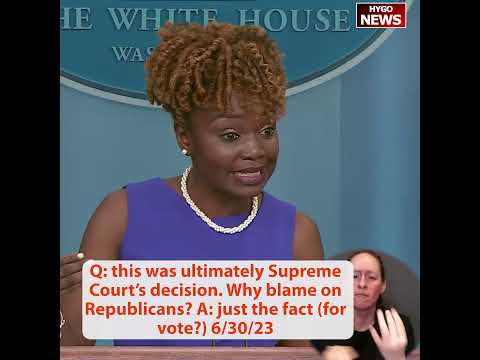
Reporter Asks: This Was the Supreme Court’s Decision — Why Blame Republicans?
On June 30, 2023, a reporter posed a question that cut through the White House’s messaging strategy on student loan forgiveness: if the Supreme Court had struck down Biden’s program, why was the President blaming Republicans? White House Press Secretary Karine Jean-Pierre responded by citing Republican efforts during budget negotiations to eliminate the program and insisted that the administration believed the Court “got it wrong,” announcing a “plan B” to pursue alternative paths to debt relief. The exchange exposed the administration’s deliberate strategy of deflecting blame from the Court’s constitutional ruling onto Republican political opponents, a framing that served Biden’s political interests but sidestepped the legal reality of the decision.
The Reporter’s Pointed Question
The exchange began with a straightforward question that highlighted the logical disconnect in the administration’s messaging. The reporter said: “The President has blamed Republicans for doing everything in their power to block the student loan forgiveness program, but this was ultimately the Supreme Court’s decision. Why the blame on Republicans?”
The question identified a fundamental problem with the White House narrative. Biden had consistently framed the loss of student loan forgiveness as the result of Republican obstruction, but the program was struck down by the Supreme Court in a 6-3 ruling in Biden v. Nebraska. The Court found that the administration had exceeded its authority under the HEROES Act. This was a constitutional determination, not a partisan political action.
While Republican state attorneys general had brought the lawsuit, they were exercising their legal right to challenge what they argued was an unconstitutional expansion of executive power. The Court agreed with their position. Blaming Republicans for the outcome was equivalent to blaming a plaintiff for winning a meritorious lawsuit — it conflated bringing a legal challenge with causing an unjust outcome, when in fact the Court determined that the law was on the challengers’ side.
Jean-Pierre’s Response
Jean-Pierre’s answer shifted the focus from the Court ruling to Republican actions in Congress: “Well, the Republicans — during the budget negotiations, as you all know, they tried to strip — they tried to take away — that was something that they wanted to put on the chopping blocks was the student debt relief. They were very clear about that.”
She continued: “And so, what the President did was protect it, and that was something that he fought just a couple of months ago. And he’s been fighting for this since he announced the student debt relief plan. You know, that’s just the fact. That’s what we had to fight for.”
The reference to budget negotiations was a pivot away from the reporter’s actual question. The reporter had asked specifically about blaming Republicans for the Supreme Court’s decision. Jean-Pierre’s answer addressed a different topic entirely: Republican attempts during the debt ceiling negotiations to include provisions eliminating the student loan program. While those congressional efforts were real, they were separate from the legal challenge that resulted in the Court’s ruling.
By conflating Republican legislative opposition with the judicial outcome, Jean-Pierre maintained the narrative that Republicans were broadly to blame for borrowers losing their relief, without addressing the fact that the Court’s 6-3 majority found the program unconstitutional on its merits.
”The Supreme Court Got It Wrong”
Jean-Pierre then stated the administration’s position on the ruling itself: “Now, we do think the Supreme Court got it wrong. And it is unfortunate, which is why we came up with a plan B. And we’re going to execute on that plan.”
The assertion that the Court “got it wrong” was a significant statement. Six of the nine justices, including the Chief Justice who authored the majority opinion, had concluded that the program violated the separation of powers. The administration’s disagreement with the ruling was, of course, its prerogative, but the blanket dismissal of a supermajority opinion without engaging with the legal reasoning reflected the same pattern of non-engagement that characterized the briefing as a whole.
The reference to “plan B” was notable for its political implications. Rather than accepting the Court’s ruling and working with Congress to pass legislation that could achieve student debt relief through constitutionally sound means, the administration signaled its intention to find alternative executive actions to accomplish the same goal. This suggested that the lesson the White House drew from the 6-3 ruling was not that the program had exceeded presidential authority but rather that a different legal theory was needed.
Why the Blame Strategy Served Political Purposes
The reporter’s question exposed the political logic behind the administration’s framing. Blaming Republicans was more useful politically than blaming the Supreme Court for several reasons.
First, Republicans were a political opponent that Biden could campaign against. Telling voters that “Republicans took away your student loan relief” was a more actionable message than “the Supreme Court ruled it unconstitutional.” Voters could punish Republicans at the ballot box; they could not directly punish Supreme Court justices.
Second, blaming Republicans maintained the fiction that the program had been legally sound. If the narrative focused on Republican obstruction rather than the Court’s constitutional analysis, it preserved the idea that Biden’s original promise was legitimate and achievable. Acknowledging that the Court had found the program unconstitutional would have required confronting the uncomfortable truth that the administration had pursued a legally dubious strategy from the outset.
Third, blaming Republicans allowed Biden to position himself as a fighter for the middle class against wealthy and powerful opposition. This narrative was central to the “Bidenomics” messaging that the White House was rolling out in the summer of 2023.
The Legal Reality
The Supreme Court’s ruling in Biden v. Nebraska was not a close call. The 6-3 decision found that the HEROES Act of 2003, which authorized the Secretary of Education to “waive or modify” student loan provisions during national emergencies, did not authorize the blanket cancellation of over $400 billion in debt. The Court applied the major questions doctrine, holding that actions of such vast economic and political significance required clear congressional authorization.
Six Republican state attorneys general had challenged the program, and the 8th U.S. Circuit Court of Appeals had blocked it in November 2022. The Supreme Court declined to lift that block and ultimately agreed that Biden had overstepped his authority. The ruling reflected a mainstream constitutional interpretation shared by numerous legal scholars, including some who supported student debt relief as policy but acknowledged that it required congressional action.
Biden had announced the program in August 2022, offering up to $10,000 in forgiveness for borrowers earning under $125,000 and up to $20,000 for Pell Grant recipients. The total cost was estimated at over $400 billion.
Key Takeaways
- A reporter asked why Biden was blaming Republicans for the loss of student loan forgiveness when it was the Supreme Court that struck the program down. Jean-Pierre pivoted to Republican actions during budget negotiations rather than addressing the Court’s ruling directly.
- Jean-Pierre said the administration believed “the Supreme Court got it wrong” and announced a “plan B” for alternative debt relief, signaling continued executive action despite the 6-3 ruling.
- The blame-shifting strategy served political purposes by keeping Republicans as the villain in the narrative while avoiding the uncomfortable truth that the program was found unconstitutional.
- The Court ruled 6-3 in Biden v. Nebraska that the $400 billion forgiveness program exceeded presidential authority under the HEROES Act.
- The exchange highlighted how the administration prioritized political messaging over engaging with the constitutional basis for the Court’s decision.