 HYGO News
Kennedy Asks Judicial Nominee How the White House Prepared Her: 'There Were Some of Your Questions' (February 15, 2023)
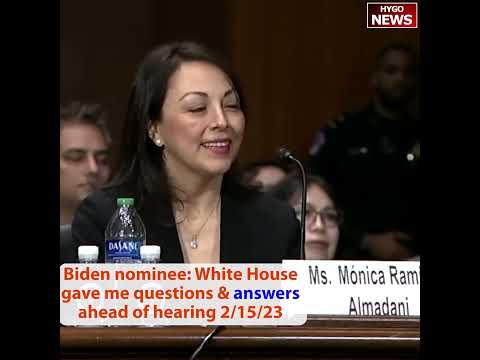
On February 15, 2023, the Senate Judiciary Committee questioned six of President Biden’s judicial nominees. After the first panel, which was dominated by the fight over First Circuit nominee Michael Delaney (see our article on that exchange), five district court nominees took the witness table: Marian Gaston for the Southern District of California, Wesley Hsu and Mónica Ramírez Almadani for the Central District of California, and LaShonda Hunt and Jeffrey Cummings for the Northern District of Illinois [1][2]. Sen. John Kennedy of Louisiana, known for asking nominees basic legal questions, used his five minutes on a rapid quiz and then on the question in this video: how the White House had prepared them. All quotes below are from the official hearing record, Senate Hearing 118-29, Part 2 [1].
Key Moments
”What did the White House give you to prepare for today’s hearing?”
Kennedy put the question to Ramírez Almadani, a former Justice Department lawyer who was then president and chief executive of Public Counsel, which Sen. Alex Padilla called “the largest provider of pro bono legal services in the country.” “Senator, there were a number of meetings with the White House Counsel’s office,” she said. Had they given her written materials? “There were some written materials.” What were they? “There were materials that were already in the record. Questions and answers from prior hearings.”
“So they give you a list of questions and answers from prior hearings?” “An overview, I would say.” How many? “I’m not sure, Senator.” More than 10? “Yes.” More than 50? “I don’t believe so.” Whose questions were they? “They were Senators’ questions.” “Which ones?” Kennedy asked, and the room laughed. “There were some of your questions, Senator,” she answered, to more laughter, adding: “But I also watched many hearings.” The committee’s chairman, Sen. Dick Durbin, closed the exchange: “That’s a tribute to you, Senator.” “I’m smiling,” Kennedy said.
The quiz
Before that, Kennedy had asked each nominee one question:
- Gaston, about a 2008 paper she co-wrote: “Children are not safer because registered sex offenders are prohibited from residing near schools, parks, daycare centers, and other places where children tend to gather.” Did she write it? “I co-wrote that article. Yes, sir.” Did she believe it? “I did.”
- Ramírez Almadani, on qualified immunity: “Qualified immunity applies in 1983 cases, as well as Bivens actions, to law enforcement officers. … Unless there is a clearly established constitutional violation, they are subject to qualified immunity.”
- Hunt, on the standard for summary judgment: “The question is whether there is a genuine issue of material fact that will require a trial,” with the moving party bearing the burden.
- Hsu, on New York Times v. Sullivan: “I believe that was a First Amendment case … and about free speech. But in my 5 years of being a judge and 25 years of practice, I haven’t had to actually apply New York Times v. Sullivan.”
- Cummings, on when the Supreme Court overturns precedent: the court looks at “the soundness of the reasoning,” “the workability of the rule,” “developments that have taken place since the decision was issued” and the “reliance that parties and litigants have placed upon that decision.”
Fact Check: How Did the Nominees Do?
- Qualified immunity: mostly right. The doctrine is broader than “law enforcement officers.” Under the Supreme Court’s 1982 decision in Harlow v. Fitzgerald, “government officials performing discretionary functions generally are shielded from liability for civil damages insofar as their conduct does not violate clearly established statutory or constitutional rights of which a reasonable person would have known” [3]. It applies to police most often, but not only to them.
- Summary judgment: right. Federal Rule of Civil Procedure 56 says a court “shall grant summary judgment if the movant shows that there is no genuine dispute as to any material fact and the movant is entitled to judgment as a matter of law.” Hunt used the older wording; a 2010 amendment changed “only one word — genuine ‘issue’ becomes genuine ‘dispute,’” and the standard “remains unchanged” [4].
- New York Times v. Sullivan: incomplete. Hsu was right that it is a First Amendment free-speech case but did not state its rule. The 1964 decision held that a public official suing for defamation over his official conduct must prove “actual malice,” meaning the statement was made “with knowledge that it was false or with reckless disregard of whether it was false or not” [5].
- Overturning precedent: right. In Janus v. AFSCME (2018), the Supreme Court named five factors as “most important”: “the quality of [the precedent’s] reasoning, the workability of the rule it established, its consistency with other related decisions, developments since the decision was handed down, and reliance on the decision” [6]. Cummings named four of the five.
Background: Kennedy’s Questions Have Sunk Nominations Before
Kennedy has questioned nominees of both parties this way. In December 2017, he asked Matthew Petersen, President Trump’s nominee for the federal district court in Washington, D.C., what a motion in limine is; Petersen could not say, and he withdrew days after the video spread [7]. On January 25, 2023, three weeks before this hearing, Kennedy asked Biden nominee Charnelle Bjelkengren what Article V and Article II of the Constitution do; she could not answer [8]. Bjelkengren later asked not to be renominated [9].
What Happened Next
Four of the five nominees in this video were confirmed, according to the Federal Judicial Center [10]:
- Wesley Hsu: confirmed May 3, 2023, 53–43.
- LaShonda Hunt: confirmed May 4, 2023, 56–41.
- Jeffrey Cummings: confirmed September 12, 2023, 50–45.
- Mónica Ramírez Almadani: confirmed November 9, 2023, 51–44.
- Marian Gaston: never confirmed. The White House did not renominate her, which Sen. Ted Cruz welcomed, citing her paper on sex offender residency restrictions and her lack of federal court experience [11].
Sources
- GovInfo: Senate Hearing 118-29, Part 2, Confirmation Hearing on Federal Appointments (February 15, 2023)
- Senate Judiciary Committee: Nominations hearing page (February 15, 2023)
- Legal Information Institute: Harlow v. Fitzgerald, 457 U.S. 800 (1982)
- Legal Information Institute: Federal Rule of Civil Procedure 56, with committee notes
- Legal Information Institute: New York Times Co. v. Sullivan, 376 U.S. 254 (1964)
- Legal Information Institute: Janus v. AFSCME (2018)
- NPR: Matthew Petersen withdraws his judicial nomination after viral video (December 18, 2017)
- NBC News: Sen. Kennedy stumps Biden judicial nominee with basic questions about Constitution
- The Spokesman-Review: Spokane County Judge Charnelle Bjelkengren will not be renominated to federal bench (January 9, 2024)
- Federal Judicial Center: Biographical Directory of Article III Federal Judges
- Sen. Ted Cruz: Statement on the Bjelkengren and Gaston nominations