 HYGO News
 Q: the $1.9T Stimulus Plan has contributed to inflation? WH: Nope. American people understand
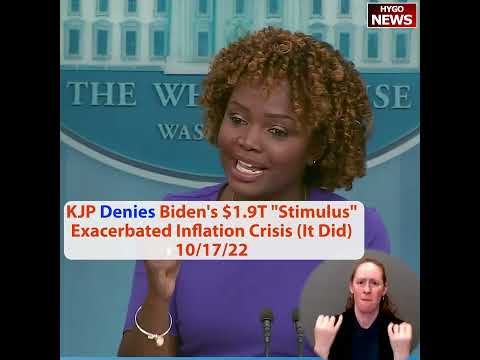
Doocy Asks If Biden’s Economic Advisers Told Him the $1.9T Stimulus Contributed to Inflation — KJP Deflects to Yellen and Says “American People Understand”
On 10/17/2022, Peter Doocy asked White House Press Secretary Karine Jean-Pierre whether Biden’s own economic advisers had told him “the general consensus now is that the American Rescue Plan has contributed to inflation.” KJP refused to answer directly, deflecting to Treasury Secretary Janet Yellen — “I will leave her words speak to that” — then pivoting to claim the IRA and CHIPS Act “are popular with the American people.” She never acknowledged the growing bipartisan consensus among economists that the $1.9 trillion stimulus package was a significant driver of the inflation crisis hitting American families.
”Has the General Consensus Reached the President?”
Doocy’s question was carefully constructed. He didn’t ask KJP to accept that the ARP caused inflation — he asked whether Biden’s own advisers had communicated the “general consensus” to the president.
“Have the president’s economic advisers told him that the general consensus now is that the American Rescue Plan has contributed to inflation?” Doocy asked.
The framing was significant because the “general consensus” was real and growing. By October 2022, a broad coalition of economists — spanning the ideological spectrum from conservative to liberal — had concluded that the American Rescue Plan was a meaningful contributor to the inflation surge. This wasn’t a partisan talking point; it was mainstream economic analysis.
Former Treasury Secretary Larry Summers, a prominent Democrat who served under Obama and Clinton, had warned in February 2021 — before the ARP was signed — that the $1.9 trillion stimulus risked triggering “inflationary pressures of a kind we have not seen in a generation.” His prediction proved accurate. Harvard economist Jason Furman, who chaired Obama’s Council of Economic Advisers, acknowledged the ARP had “overheated” the economy. Even the San Francisco Federal Reserve published a study estimating the fiscal stimulus contributed approximately 3 percentage points to inflation.
KJP’s Deflection to Yellen
KJP refused to engage with the substance. “Look, Secretary Yellen — who is incredibly well respected, as you know, in the economic space — has spoken to this,” KJP said. “So I will leave her words speak to that — to the statement that you just made.”
The deflection was notable for what it avoided. By pointing to Yellen’s past statements without specifying which statements, KJP created ambiguity. Yellen had, in fact, made contradictory statements about the ARP’s role in inflation. In May 2022, Yellen acknowledged she had been “wrong” about the path of inflation — but stopped short of directly blaming the stimulus. In other appearances, she defended the ARP as necessary for economic recovery.
By saying “I will leave her words speak to that,” KJP appeared to be citing Yellen as a shield without committing to any specific position. If Yellen’s statements were used to claim the ARP didn’t cause inflation, the White House could point to those. If pressed on Yellen’s admission of being “wrong,” the White House could claim they were referring to different remarks.
”An Economy That Is Indeed Resilient”
Before Doocy’s follow-up, KJP had been praising the ARP’s legacy. “If you think about the American Rescue Plan that has helped create an economy that is indeed resilient, that created jobs — they refused to help,” KJP said, referencing Republicans’ unanimous opposition to the bill.
The “resilient economy” characterization was strained given the conditions in October 2022. Inflation at 8.2%, declining real wages for 18 consecutive months, a stock market down 25%, mortgage rates above 7%, and GDP that had contracted in both Q1 and Q2 of 2022 did not describe an economy most Americans would call “resilient.”
The “they refused to help” line — referring to Republicans who voted against the ARP — was particularly ironic given Doocy’s question. Republicans had refused to vote for the ARP precisely because they warned it would trigger inflation. Their refusal to “help” was, in retrospect, the correct economic judgment: the stimulus was too large for an economy already recovering from the pandemic, and the resulting inflation proved the critics right.
The $1.9 Trillion Question
The American Rescue Plan, signed in March 2021, injected $1.9 trillion in spending into an economy that was already rebounding from the pandemic-induced recession. The package included $1,400 stimulus checks to most Americans, extended unemployment benefits at $300 per week, expanded child tax credits, state and local government aid, and school funding.
The scale of the spending was controversial from the beginning. Biden’s own economic advisers had debated the appropriate size internally, with some advocating for a smaller package. Larry Summers publicly argued that $1.9 trillion was roughly three times larger than the output gap — the difference between actual and potential economic production — and would inevitably create excess demand that outstripped supply.
The mechanics were straightforward: the government distributed trillions of dollars in consumer purchasing power while supply chains remained constrained by pandemic disruptions. More dollars chasing fewer goods produced higher prices — textbook demand-pull inflation. The debate among economists was not whether the ARP contributed to inflation, but how much of the inflation was attributable to the stimulus versus supply chain disruptions, energy prices, and other factors.
”They Are Popular”
KJP pivoted from the ARP question to safer ground. “When you think about the Inflation Reduction Act, you think about the CHIPS Act — they are popular. They are popular with the American people,” KJP said. “They understand — the American people understand, with these pieces of legislation.”
The pivot from the ARP’s inflationary impact to the IRA’s and CHIPS Act’s popularity was a non-sequitur. Doocy’s question was about whether the president’s advisers had acknowledged the ARP’s role in causing inflation. Whether subsequent legislation was popular had no bearing on whether the earlier stimulus contributed to the problem those later bills purported to address.
Moreover, the claim that the IRA was “popular” was itself debatable. While individual provisions polled well — particularly drug pricing negotiations — the legislation as a whole was unknown to most voters, and polls showed large majorities did not believe the law would meaningfully reduce their personal costs.
The Accountability Gap
The exchange highlighted a fundamental accountability gap in the administration’s economic messaging. The White House wanted credit for the ARP’s benefits — job creation, economic recovery, stimulus checks — while refusing to accept responsibility for its costs — inflation, declining real wages, and reduced purchasing power.
This selective accounting was unsustainable because the benefits and costs were caused by the same mechanism. The stimulus checks that “created jobs” and fueled consumer spending were the same dollars that, in aggregate, overwhelmed supply and pushed prices higher. You could not claim credit for the demand-side boost while denying responsibility for the demand-side inflation.
The refusal to acknowledge this relationship — nearly two years after the ARP was signed and the inflation it helped trigger was running at four-decade highs — represented a credibility gap that no amount of “we understand” could bridge.
Key Takeaways
- Doocy asked if Biden’s economic advisers told him the “general consensus” is that the $1.9T ARP contributed to inflation; KJP deflected to Yellen without answering.
- The consensus was real: economists from Larry Summers to Jason Furman to the San Francisco Fed had concluded the stimulus was a significant inflation driver.
- KJP called the ARP-fueled economy “resilient” despite 8.2% inflation, declining real wages, and a 25% stock market decline.
- She pivoted to claiming the IRA and CHIPS Act were “popular” — a non-sequitur that didn’t address whether the ARP caused inflation.
- Republicans who refused to vote for the ARP had warned it would trigger inflation — a prediction that proved correct.
Transcript Highlights
The following is transcribed from the video audio (unverified — AI-generated from audio).
- The American Rescue Plan has helped create an economy that is indeed resilient and that created jobs. They refused to help.
- Have the president’s economic advisers told him that the general consensus now is that the American Rescue Plan has contributed to inflation?
- Secretary Yellen, who is incredibly well respected in the economic space, has spoken to this. I will leave her words speak to that.
- The Inflation Reduction Act, the CHIPS Act — they are popular with the American people.
- The American people understand, with these pieces of legislation.
- We’re going to continue to do the work.
Full transcript: 117 words transcribed via Whisper AI.