 HYGO News
 Q: 'Surprised' By Fetterman Debate? A: It Was 'A Busy Day'
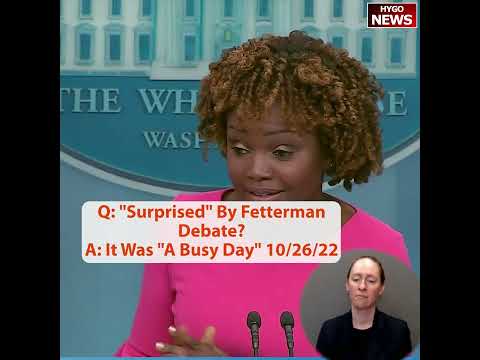
Reporter Asks If White House Was “Surprised” by Fetterman’s Debate Performance — KJP Deflects: “It’s Been a Busy Day,” Pivots to Junk Fees
On 10/26/2022, the day after John Fetterman’s widely criticized Senate debate performance, a reporter asked White House Press Secretary Karine Jean-Pierre whether the White House was “in any way surprised by the performance of the lieutenant governor in the debate” given his auditory processing difficulties following his stroke. KJP’s response was a breathtaking deflection: “It’s been a busy day. The President gave a speech on junk fees, which is going to be incredibly important to the American people, saving American people $24 billion. The Israeli President is here.” She never answered whether the White House was surprised, never addressed Fetterman’s debate difficulties, and used junk fees and a state visit as shields against a question the entire political world was asking.
”Was It a Surprise?”
The reporter’s question was carefully and sympathetically framed. “Was the White House in any way surprised by the performance of the lieutenant governor in the debate?” the reporter asked. “I know that people here — including not just the President, but others — have been in touch with him. But was there any surprise, in terms of how he performed, given the auditory processing, given the high profile of the evening, and that sort of thing? Was it a surprise to the White House at all?”
The question acknowledged Fetterman’s medical condition (“auditory processing”), noted the White House’s personal connection to Fetterman (“people here have been in touch with him”), and asked simply whether the debate performance matched internal expectations. It was a fair, even gentle, question about a debate performance that had dominated every news cycle since the previous evening.
The October 25, 2022 Fetterman-Oz debate had been widely described as difficult to watch. Fetterman used a closed-captioning system to read questions in real time and still struggled significantly with his responses. His answers frequently trailed off, contained incomplete thoughts, and at times were incoherent. When asked about fracking, he produced the now-famous response: “I do support fracking and I don’t — I don’t — I support fracking, and I stand, and I do support fracking.”
The debate performance had stunned even Fetterman’s supporters. Democratic strategists privately expressed alarm. Media coverage — including from outlets sympathetic to Fetterman — described the performance as raising serious questions about his fitness for office.
”It’s Been a Busy Day”
KJP’s response to this politically significant question was to talk about junk fees. “So, look, it’s been a busy day, as you know; you guys have been watching the President,” KJP said. “He gave a speech on junk fees, which is going to be incredibly important to the American people, saving American people $24 billion. So that was something that he was certainly focused on.”
The pivot from a question about a Senate candidate’s health-compromised debate performance to a policy announcement about airline fees and hotel surcharges was one of the most jarring deflections of KJP’s tenure. The reporter had not asked about the president’s schedule. The reporter had not asked about junk fees. The reporter had asked whether the White House was surprised by Fetterman’s debate — a yes-or-no question that KJP answered with a recitation of the president’s daily calendar.
“The Israeli President is here, who he’s hosting, as you all know,” KJP added — layering a diplomatic visit on top of junk fees to create additional distance from the actual question.
What KJP Didn’t Say
The non-answer was informative precisely because of what KJP avoided saying. She did not say the White House was not surprised — which would have implied they expected the poor performance. She did not say the White House was surprised — which would have contradicted their prior assurances that Fetterman was “just as capable as always.” She did not express confidence in Fetterman’s fitness. She did not address his health. She did not defend his debate performance.
Just one week earlier, on October 17, KJP had told reporters that Biden “found Fetterman to be an impressive individual who is just as capable as always” and was “doing great” as Lieutenant Governor “with great ability and heartfelt concern.” The debate performance had made those assurances look either dishonest or delusional. KJP’s refusal to address the debate suggested the White House recognized it could not repeat the “just as capable as always” line with a straight face after what voters had witnessed.
The “Busy Day” Technique
KJP’s “busy day” deflection was a variation of a technique she employed whenever questions became uncomfortable: listing other things the president was doing as evidence that the inconvenient topic wasn’t a priority. The implicit message was: the president is focused on important things (junk fees, foreign leaders), not on the thing you’re asking about.
The technique worked as a single-exchange deflection but failed as a communications strategy. The Fetterman debate was the dominant political story in the country. Every reporter in the room wanted to ask about it. Every viewer watching the briefing expected it to be addressed. Responding with “junk fees” and “the Israeli President is here” didn’t make the question go away — it highlighted the White House’s inability to discuss it.
The KJP-Fetterman Parallel
The exchange carried an additional irony. KJP’s struggle to address questions about a Democrat’s communication difficulties while herself struggling to communicate clearly created an uncomfortable parallel. Her extended verbal stumbles, reliance on binder notes, and inability to form coherent responses to predictable questions had drawn their own criticism throughout 2022.
The White House’s position on both Biden’s and Fetterman’s communication difficulties was identical: refuse to acknowledge the problem, insist everything is fine, and change the subject when pressed. The debate made this strategy harder to maintain because voters had seen — in real time, on national television — exactly what the White House had been dismissing.
Fetterman Won Anyway
Despite the debate performance that the White House couldn’t discuss, Fetterman defeated Dr. Mehmet Oz by approximately 5 percentage points in November 2022. The victory demonstrated that Pennsylvania voters prioritized party alignment, candidate biography, and opponent weaknesses over debate performance and health concerns.
Fetterman’s post-election trajectory validated some of the concerns the reporter was raising. He was hospitalized for clinical depression in February 2023, spending six weeks in inpatient treatment. He later spoke more openly about the severity of his stroke recovery than he had during the campaign, acknowledging difficulties that his campaign and the White House had publicly minimized.
The Accountability Gap
The exchange illustrated a broader pattern: the White House’s unwillingness to provide honest assessments of allied Democrats’ situations. When KJP said Fetterman was “just as capable as always” a week before the debate, she was either misinformed or misleading. When she deflected to junk fees the day after the debate exposed the reality, she was avoiding accountability for the prior assurance.
Voters, reporters, and political observers were left to draw their own conclusions: either the White House genuinely didn’t know the extent of Fetterman’s challenges, or it knew and chose to mislead the public. Neither option inspired confidence in the administration’s transparency.
Key Takeaways
- A reporter asked if the White House was “surprised” by Fetterman’s widely criticized debate performance; KJP pivoted to junk fees and the Israeli President’s visit without answering.
- One week earlier, KJP had called Fetterman “just as capable as always” — an assessment the debate contradicted dramatically.
- KJP didn’t say the White House was surprised, wasn’t surprised, or had any reaction at all — a total non-response to the dominant political story.
- The “busy day” deflection highlighted the White House’s inability to address Fetterman’s health honestly after publicly vouching for his fitness.
- Fetterman won the election by 5 points despite the debate but was hospitalized for depression two months into his Senate term.
Transcript Highlights
The following is transcribed from the video audio (unverified — AI-generated from audio).
- Was the White House in any way surprised by the performance of the Lieutenant Governor in the debate?
- Was there any surprise given the auditory processing, the high profile of the evening?
- Was it a surprise to the White House at all?
- It’s been a busy day. The President gave a speech on junk fees, saving American people $24 billion.
- That was something he was certainly focused on.
- The Israeli President is here, who he’s hosting, as you all know.
Full transcript: 136 words transcribed via Whisper AI.