 HYGO News
 Q: Student loans vs PPP loans (paid back expected vs forgiven, Biden vs Congress) A: Republicans ...
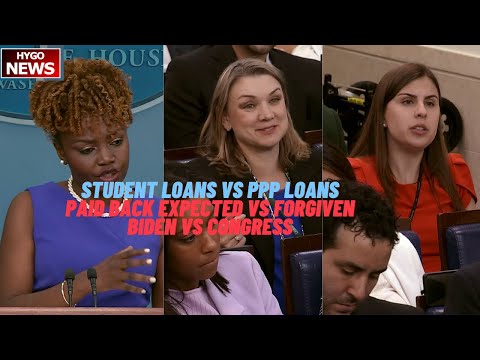
Student Loans vs PPP Loans, Court Legitimacy, and Legal Footing for SAVE Plan — White House Press Briefing
On June 30, 2023, the White House press briefing following the Supreme Court’s twin rulings on student loan forgiveness and the 303 Creative case produced several sharp exchanges between reporters and administration officials. Deputy NEC Director Bharat Ramamurti defended the administration’s comparison of student loan relief to PPP loan forgiveness, fielded questions about the legitimacy of the Supreme Court, and expressed confidence that the new SAVE income-driven repayment plan stood on solid legal ground despite the major questions doctrine that had just sunk the broader forgiveness program.
The PPP Loan Comparison: Were Republicans Hypocrites?
A reporter challenged the administration’s frequent comparison between student loan forgiveness and the Paycheck Protection Program, pointing out a fundamental structural difference between the two programs.
The reporter asked: “Isn’t the comparison between student loans and the Paycheck Protection Program a little bit strained, given that some of those federal student loans were given with the expectation that they would be paid back, and then the Paycheck Protection Program loans were given to employers with the expectation that those loans would be forgiven if they kept folks on payroll during a pandemic?”
The distinction was substantive. PPP loans were designed from the outset as forgivable grants disguised as loans — employers who maintained their payrolls were always meant to have those loans forgiven. Student loans, by contrast, were issued with the contractual expectation of repayment. Forgiving them after the fact represented a fundamentally different policy choice.
Ramamurti pivoted from the structural argument to a political one, focusing on Republican inconsistency rather than addressing the reporter’s point about the programs’ different designs.
“All of the Republicans in Congress who are saying to us, ‘This debt relief program is unacceptable’ could have also been saying, ‘Hey, take it easy on doing all this debt forgiveness,’” Ramamurti said. “We never got a single bit of incoming from Republicans saying, ‘Slow down PPP forgiveness.’ In fact, the incoming we got was people saying, ‘Do it faster. Make it easier for people to qualify for forgiveness.’ So, yeah, we think that there is a real tension between that and the idea that if we’re going to try and give $10,000 to a nurse or a firefighter, that that somehow is unacceptable or crosses the line.”
The argument effectively sidestepped the reporter’s question. Whether or not Republicans were inconsistent in their positions on PPP and student loan forgiveness, the legal and structural differences between the two programs remained. PPP forgiveness was authorized by Congress; student loan forgiveness was attempted through executive action. That distinction was precisely what the Supreme Court’s ruling turned on.
The 303 Creative Ruling and KJP’s Deflection
The briefing also touched on the Supreme Court’s decision in 303 Creative LLC v. Elenis, which held that a website designer could not be compelled under Colorado’s anti-discrimination law to create wedding websites for same-sex couples. A reporter tried to press White House Press Secretary Karine Jean-Pierre on the practical impact of the ruling.
The reporter asked about the Court’s distinction between a “service” and an “expressive original design” in Justice Gorsuch’s opinion. KJP initially asked for the question to be repeated, then acknowledged not having a clear sense of who would be impacted.
KJP said: “I mean, I don’t have like a number or a list of who — of who this is going to impact. What we know and understand is this was — this was a — the wrong decision. This was incredibly disappointing that decision was made.”
When the reporter pressed further on whether the administration understood the distinction the Court was drawing, KJP declined to engage with the substance, saying only: “So, I hear you. I’m just not going…” before trailing off.
Does the Administration Consider the Court Legitimate?
The briefing took a pointed turn when a reporter referenced President Biden’s earlier statement that the Supreme Court was “not a normal Court” and asked directly whether the administration considered the ruling legitimate.
Ramamurti responded carefully: “So on your first question, you know, we — we accept the Court’s ruling. Of course, we disagree with it. You know, we had a chance to review the dissent written by Justice Kagan. We largely agree with the points that were made in the dissent.”
The answer threaded a narrow needle. By saying the administration “accepts” the ruling while agreeing with the dissent, Ramamurti acknowledged the Court’s authority without conceding the correctness of its decision. The reference to Kagan’s dissent also served to signal that the administration viewed the majority’s reasoning as flawed on the merits, not just politically inconvenient.
Legal Footing for the SAVE Plan: “Crystal Clear” Authority
A reporter asked whether the new SAVE income-driven repayment plan might face the same legal challenges that had just killed the forgiveness program.
Ramamurti expressed strong confidence: “That authority is crystal clear. There is a specific statute allowing the Secretary to design these income-based repayment programs. And the specific details of this income-based repayment program are — are clearly within what’s permitted under the statute there. And so, we — I would be surprised, frankly, if there was a legal challenge to that proposal.”
When asked how many borrowers might fall outside the SAVE plan’s coverage, Ramamurti said the program was available to all borrowers: “Every single borrower is eligible for this program. Now, the key is that if you’re an extremely high-income borrower, your income may be so high that the specific benefit, where you cap your payment at a percentage of your income, doesn’t actually benefit you because that percentage is still higher than what your monthly payment would be. But it — it stretches pretty far up the income spectrum.”
The confidence proved premature. In subsequent months, Republican state attorneys general did in fact challenge the SAVE plan in court, and federal judges issued injunctions blocking key provisions of the program.
The Major Questions Doctrine and Future Policy
The final exchange focused on the broader implications of the Supreme Court’s ruling for executive authority. A reporter noted that the major questions doctrine the Court applied had “tripped up Biden administration policies over the last couple of years” and asked how the administration saw the doctrine affecting future policymaking.
Ramamurti acknowledged the constraint while maintaining that the HEROES Act language was clear: “When — when the HEROES Act says that the Secretary can waive or modify a provision, it seems to me that that is very clear about what the Secretary’s authorities are. It is a broad grant of authority.”
When pressed on whether the doctrine would continue to obstruct administration goals, Ramamurti conceded the challenge: “We’ll have to weigh how it would stand up against that new doctrine that the Supreme Court has issued. But again, we think that the pathway that we’re choosing here, the Higher Education Act, is available even with this doctrine in place.”
The exchange revealed the administration’s strategy going forward: rather than relying on emergency powers under the HEROES Act, which the Court had rejected, it would pursue student loan reforms under the Higher Education Act, which it believed provided clearer statutory authority that could survive scrutiny even under the major questions doctrine.
Key Takeaways
- A reporter challenged the White House comparison between student loans and PPP loans, noting that PPP was designed for forgiveness while student loans were expected to be repaid; Ramamurti pivoted to accusing Republicans of hypocrisy rather than addressing the structural difference.
- KJP was unable to articulate the practical impact of the 303 Creative ruling or explain the Court’s distinction between a service and an expressive design, calling the decision “incredibly disappointing” without engaging its substance.
- The administration said it “accepts” the Supreme Court ruling on student loans while agreeing with Kagan’s dissent, threading the needle between acknowledging the Court’s authority and disputing the correctness of the decision.
- Ramamurti called the legal authority for the SAVE plan “crystal clear” and said he would be surprised by legal challenges — a confidence that proved premature as the plan was subsequently challenged in court.
- The administration acknowledged the major questions doctrine as a constraint on executive action but said it would pursue student loan reforms through the Higher Education Act rather than the HEROES Act the Court had rejected.