 HYGO News
 Q: student loans (expected to be paid back) differs from PPP loans (forgiven) A: Republicans ...
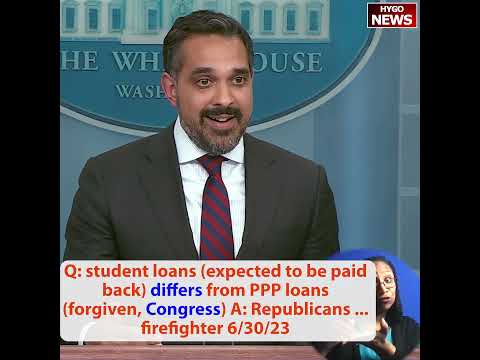
Student Loans Were Expected to Be Paid Back, PPP Loans Were Not — Reporter Challenges White House Comparison
On June 30, 2023, following the Supreme Court’s 6-3 ruling striking down Biden’s student loan forgiveness program, a reporter challenged one of the White House’s most frequently used talking points: the comparison between student loan forgiveness and the Paycheck Protection Program. The reporter pointed out a fundamental distinction the administration had been glossing over — PPP loans were designed from the start to be forgiven, while student loans were issued with the expectation they would be repaid. Deputy NEC Director Bharat Ramamurti sidestepped the structural argument and pivoted to accusing Republicans of hypocrisy.
The Reporter’s Sharp Question
The PPP comparison had become a centerpiece of the Biden administration’s defense of student loan forgiveness. Officials repeatedly pointed out that Republicans who opposed student debt cancellation had enthusiastically supported forgiving hundreds of billions in PPP loans during the COVID-19 pandemic. The implication was that opposing student loan forgiveness while backing PPP forgiveness was hypocritical.
The reporter challenged this framing head-on: “Isn’t the comparison between student loans and the Paycheck Protection Program a little bit strained, given that some of those federal student loans were given with the expectation that they would be paid back, and then the Paycheck Protection Program loans were given to employers with the expectation that those loans would be forgiven if they kept folks on payroll during a pandemic?”
The distinction was legally and structurally significant. PPP loans were created by Congress through the CARES Act with built-in forgiveness provisions. Employers who maintained their payroll levels were always supposed to have those loans forgiven — that was the entire design of the program. The forgiveness was not a later policy decision but a fundamental feature of the program as Congress enacted it.
Student loans, by contrast, were issued under terms that required repayment. Borrowers signed promissory notes agreeing to pay back their loans with interest. The Biden administration’s decision to cancel that debt was a unilateral executive action that changed the terms of millions of existing contracts — something the Supreme Court found exceeded the President’s authority under the HEROES Act.
Ramamurti Pivots to Republican Hypocrisy
Rather than engaging with the reporter’s point about the different structures of the two programs, Ramamurti shifted to a political argument about Republican inconsistency.
“All of the Republicans in Congress who are saying to us, ‘This debt relief program is unacceptable’ could have also been saying, ‘Hey, take it easy on doing all this debt forgiveness,’” Ramamurti said. “We never got a single bit of incoming from Republicans saying, ‘Slow down PPP forgiveness.’ In fact, the incoming we got was people saying, ‘Do it faster. Make it easier for people to qualify for forgiveness.’”
He concluded: “So, yeah, we think that there is a real tension between that and the idea that if we’re going to try and give $10,000 to a nurse or a firefighter, that that somehow is unacceptable or crosses the line.”
The response was rhetorically effective but legally irrelevant. The Supreme Court had not struck down the student loan forgiveness program because of any inconsistency in Republican positions on PPP. It struck it down because the President lacked the statutory authority to cancel $400 billion in debt without explicit congressional authorization. Whether Republicans were hypocritical about PPP had no bearing on the constitutional question.
The Structural Differences the White House Avoided
The reporter’s question highlighted several concrete differences between the two programs that the White House consistently minimized.
First, congressional authorization: PPP forgiveness was explicitly written into the CARES Act by Congress. Student loan forgiveness was attempted through executive action under the HEROES Act, a statute Congress passed for a different purpose. The Supreme Court’s ruling turned precisely on this distinction — the major questions doctrine requires clear congressional authorization for actions of vast economic significance.
Second, program design: PPP was structured as a forgivable loan from its inception. Employers applied knowing that if they met the payroll retention conditions, the loan would be forgiven. The terms were transparent and built into the program. Student loans were issued as traditional debt obligations with no forgiveness provision in the original terms.
Third, the purpose of forgiveness: PPP forgiveness served as an incentive mechanism during the pandemic — employers were rewarded for keeping workers on payroll. Student loan forgiveness was a retroactive policy change that altered the terms of existing obligations, benefiting borrowers who had already incurred their debt under different expectations.
Fourth, the scale of executive versus legislative action: PPP loan forgiveness was authorized through a legislative process with debate, amendment, and bipartisan votes. Student loan forgiveness was announced by the President as an executive action, bypassing Congress entirely.
The Broader Political Debate
Despite the structural differences, the White House’s PPP comparison resonated politically because it tapped into a genuine sense of unfairness. Many Americans perceived that businesses had received generous treatment during the pandemic while individual borrowers struggling with student debt were told they had to repay every penny. The fact that many PPP loans went to wealthy business owners, and that significant fraud occurred in the program, added to the sense that the government was more willing to help businesses than workers.
Ramamurti’s framing of the beneficiaries as “a nurse or a firefighter” was deliberate — it positioned student loan forgiveness as support for working-class Americans rather than the college-educated professionals who critics said were the primary beneficiaries. The $125,000 income cap the administration had placed on the forgiveness program was designed in part to address this criticism, though borrowers at that income level were far from financially struggling by most measures.
The PPP comparison also served a political purpose beyond the legal debate. By framing Republican opposition as hypocritical, the administration sought to redirect public anger away from the Supreme Court’s ruling and toward GOP lawmakers. This was politically useful even if it did not change the legal outcome, because it provided a narrative for the 2024 election cycle: Democrats tried to help borrowers, and Republicans blocked them.
The Supreme Court Ruling That Ended the Debate
The 6-3 decision in Biden v. Nebraska resolved the legal question definitively, at least as far as the HEROES Act was concerned. The Court found that the administration’s use of emergency powers to cancel $400 billion in student debt was not a “waiver or modification” of existing loan provisions but the creation of an entirely new program that required explicit congressional authorization.
Six Republican state attorneys general had challenged the program, and the 8th U.S. Circuit Court of Appeals blocked it before the Supreme Court took up the case. The final ruling upheld the injunction and invalidated the program entirely, leaving the administration to pursue alternative forms of relief through the SAVE income-driven repayment plan and other regulatory measures.
Key Takeaways
- A reporter challenged the White House’s comparison between student loan forgiveness and PPP loans, pointing out that PPP loans were designed from the start to be forgiven while student loans were issued with the expectation of repayment.
- Ramamurti sidestepped the structural argument and accused Republicans of hypocrisy, noting they had urged faster PPP forgiveness while opposing $10,000 in relief for borrowers he characterized as nurses and firefighters.
- The PPP comparison was politically effective but legally irrelevant — the Supreme Court struck down student loan forgiveness because it lacked congressional authorization, not because of any inconsistency in Republican positions.
- Key structural differences included congressional authorization (PPP was legislated, student loan forgiveness was executive), program design (PPP had built-in forgiveness provisions), and the scope of executive power involved.
- The White House used the PPP framing primarily as a political tool to redirect anger from the Supreme Court ruling toward Republican lawmakers ahead of the 2024 election cycle.