 HYGO News
 Q: Should Fed or Biden claim inflation easing? A: Biden claims credit
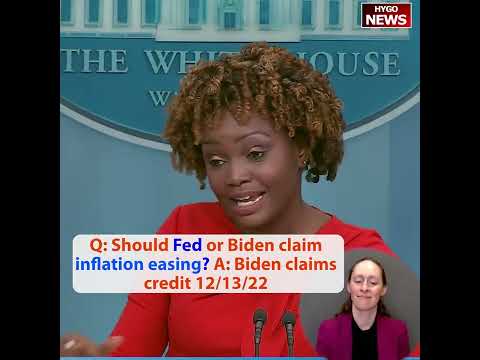
KJP on Whether Biden Credits the Fed for Inflation Easing: “I’m Just Not Going to Respond to Any Actions the Fed Has Taken” — Claims Credit for Biden’s Economic Agenda
On 12/13/2022, a reporter asked White House Press Secretary Karine Jean-Pierre whether President Biden credited the Federal Reserve’s aggressive interest rate hikes — not just his economic agenda — for easing inflation. “President talked about his economic agenda, you know, saying that it was part of the reason why we’re seeing inflation easing. Does he also credit the Fed and the rate hikes as a reason why we’re seeing inflation easing?” the reporter asked. KJP declined to credit the Fed: “I’m just not going to respond to any actions that the Fed has taken. They are independent.” She then claimed Biden’s agenda was responsible for the economic progress: “He thinks in large part it’s because of his agenda.” The response was economically dubious — most economists credit Fed monetary tightening as the primary driver of disinflation — but served political purposes by concentrating credit with the administration.
The Reporter’s Fair Question
The reporter’s question recognized a basic economic reality. Monetary policy matters enormously for inflation dynamics. The Federal Reserve’s rate hikes throughout 2022 had been the primary policy response to the inflation surge:
March 2022 — Fed began raising rates from near-zero.
Accelerating pace — 75 basis point hikes multiple times.
December 2022 — Federal funds rate around 4.25-4.5%.
Balance sheet reduction — Quantitative tightening also underway.
Forward guidance — Clear messaging about continued tightening.
These Fed actions were the textbook response to inflation and widely credited by economists as the primary factor in moderating price increases. The Fed’s independence meant that this was monetary policy, not fiscal policy — not something Biden had direct control over.
The reporter’s question was essentially asking whether Biden would give credit where economists would say credit was due. Would Biden acknowledge that disinflation was primarily the Fed’s accomplishment, not his own?
The Prior Biden Claim
The reporter referenced Biden’s economic agenda claim. “President talked about his economic agenda, you know, saying that it was part of the reason why we’re seeing inflation easing,” the reporter said.
Biden had been claiming credit for inflation moderation by pointing to:
Inflation Reduction Act — Signed August 2022.
Infrastructure legislation — Signed 2021.
CHIPS Act — Signed 2022.
American Rescue Plan — Signed 2021.
Various executive actions — Over his term.
These claims were economically questionable. Most of the legislation was recent, with effects still emerging. Some of the legislation (particularly the American Rescue Plan) had actually contributed to inflation rather than reducing it. The argument that Biden’s agenda was reducing inflation ran contrary to mainstream economic analysis.
The Fed Independence Dodge
KJP used Fed independence to avoid the question. “I’m just not going to respond to any actions that the Fed has taken. They are independent,” KJP said.
The Fed independence invocation was technically correct — the Federal Reserve operates independently from political pressure, and administrations traditionally don’t comment on specific Fed actions. This principle exists to prevent political interference with monetary policy.
But the principle didn’t justify KJP’s specific deflection. The reporter hadn’t asked:
Whether Biden endorsed Fed actions — Which would be problematic.
Whether Biden wanted Fed to continue or change policy — Which would be interference.
Whether Biden directed Fed decisions — Which would be inappropriate.
Biden’s opinion of Fed Chair Powell — Which could affect markets.
The reporter had asked a simpler question: did Biden credit the Fed for part of the disinflation? This was a question about economic analysis and attribution, not about political interference with Fed operations.
KJP’s deflection to “Fed independence” was overly broad. Acknowledging that Fed actions had contributed to inflation moderation didn’t violate Fed independence. It was just recognizing an economic reality.
”It Has Taken…”
KJP’s response had a notable break. “They are independent and it has taken, has an economic policy, economic plans that we have seen him execute over the past 20 plus months that has shown to have been effective,” KJP said.
The sentence was grammatically broken. The “it has taken” phrase started but didn’t complete. KJP seemed to switch from discussing the Fed to discussing Biden mid-sentence, producing confusion about which subject was being referenced.
The garbled structure suggested:
Real-time composition — KJP was composing the response as she spoke.
Topic shift difficulty — Moving from Fed to Biden was awkward.
Verbal stumbling — Under pressure of the difficult question.
Unprepared response — Without clear talking points.
”In Large Part Because of His Agenda”
KJP made the credit claim explicit. “I’m going to say that he thinks in large part it’s because of his agenda,” KJP said.
The “in large part” framing was an important caveat. KJP wasn’t claiming Biden took full credit — “in large part” implied some credit went elsewhere. But this was the only indirect acknowledgment that other factors (like the Fed) might contribute.
The framing had multiple features:
Credit maximization for Biden — “Large part” suggested majority credit.
Implicit acknowledgment of other factors — “Large part” not “all.”
Avoided specific attribution — Didn’t specify what other factors mattered.
Preserved Biden’s agenda narrative — As dominant explanation.
This was politically sophisticated. The administration could claim credit without being absolutely wrong if challenged. “In large part” was defensible even if the Fed was the primary driver — as long as Biden’s agenda had some effect, the claim was technically not false.
But the framing was still economically questionable. Most analysts would have said:
Fed monetary policy — Primary driver of disinflation. Supply chain healing — Secondary factor. Commodity price changes — Energy prices falling. Base effects — Comparison to prior year high readings. Biden fiscal policy — Modest effect at best, possibly negative.
The “in large part because of his agenda” framing inverted this mainstream analysis in Biden’s favor.
”Economy Being as Strong as It Is”
KJP pivoted to economic strength generally. “Well, we have said, we have said what we are seeing today with the economy being as strong as it is and what we have been able to do with job creation. And we believe that a lot of that is because of his economic policies,” KJP said.
The “economy being as strong as it is” framing was debatable in December 2022. By various measures:
Employment was strong — Low unemployment, job creation.
GDP was growing — Modestly but positively.
Consumer spending continued — Supporting demand.
But inflation was high — Reducing real wages.
Financial markets were down — S&P 500 significantly below January 2022 levels.
Housing was slowing — Due to mortgage rate increases.
Recession fears — Widespread among forecasters.
So economic strength depended on which measures one emphasized. Employment-focused analysis showed strength. Purchasing-power-focused analysis showed weakness. Market-focused analysis showed decline. The administration consistently emphasized the employment-strong narrative.
The Credit Attribution Question
The broader question was legitimate. In economic policy, credit attribution is important for political accountability:
If Biden’s policies caused inflation — He should acknowledge and respond.
If Biden’s policies reduced inflation — He could legitimately claim credit.
If Fed policy caused disinflation — The Fed should get credit.
If external factors drove outcomes — Neither should claim much credit.
Administrations often claim credit for positive economic developments regardless of actual causation. This was standard political practice but produced distorted public understanding of economic dynamics.
KJP’s framing — that Biden’s agenda was largely responsible for inflation moderation — contributed to this distortion. The actual economic analysis was more complex, with multiple factors at play. Administration messaging simplified this to political benefit.
”Top Economic Priority”
KJP concluded by emphasizing Biden’s focus. “Now, as it relates to inflation and what we’ve been seeing with inflation, of course the President has made that his top, number one, top economic priority,” KJP said.
The repetition — “top, number one, top” — was characteristic of KJP’s emphasis patterns. Three different words for the same rank showed defensive emphasis.
The “top economic priority” claim was politically important. It positioned Biden as focused on the issue voters cared about most. But it also raised questions about effectiveness:
If inflation was the priority — Why had it remained elevated throughout 2022?
If Biden was focused on it — Why did the Fed have to do the heavy lifting?
If his agenda was working — Why was disinflation only just beginning?
If it was his top priority — Why weren’t more tools being used?
The “priority” framing implicitly conceded that the problem still existed while claiming administration focus on it.
The Economic Reality
The actual drivers of the late 2022 disinflation were:
Fed tightening — Aggressive rate hikes reducing demand.
Supply chain healing — Logistics improvements after pandemic disruptions.
Commodity prices — Especially energy moderating.
Base effects — Comparing to very high prior readings.
Consumer behavior changes — Responding to higher prices.
Inventory corrections — After earlier supply/demand imbalances.
Global factors — International economic dynamics.
Biden’s direct policy actions played a modest role in this complex picture. Executive actions to release SPR oil had helped. Various administrative measures had modest effects. But the dominant drivers were Fed monetary policy and global economic dynamics that predated Biden’s term.
The Political Calculation
The political calculation behind KJP’s credit claims was straightforward:
If administration claimed credit — And inflation continued falling, Biden benefited.
If administration acknowledged Fed credit — Credit would go to Powell, not Biden.
If administration minimized its role — It couldn’t claim success at political reckoning.
If administration accepted responsibility — It might have to answer for failures too.
Claiming maximum credit for favorable developments was politically necessary for any administration seeking reelection. Acknowledging Fed primacy would have been economically accurate but politically costly.
KJP’s framing reflected this political calculation. The economic questionable claims served political purposes, and political purposes dominated administration messaging.
The 2024 Campaign Implications
Credit attribution would matter for 2024. As inflation continued moderating through 2023 and into 2024, Biden’s campaign would need to claim credit for economic improvements. This required establishing in public understanding that:
Biden’s agenda — Was responsible for the recovery.
Biden’s policies — Had produced good outcomes.
Biden’s leadership — Had navigated the challenges successfully.
The December 2022 messaging — that Biden’s agenda was “in large part” responsible for disinflation — was laying the groundwork for this 2024 narrative. The claim was being repeated consistently to build an alternative narrative to economic analysis that gave primary credit to the Fed.
By 2024, many voters would have internalized the administration’s messaging or the opposing Republican messaging. The specific economic analysis would have been less salient than the political narratives each side had built.
Key Takeaways
- A reporter asked KJP whether Biden credited the Federal Reserve’s rate hikes — not just his own economic agenda — for inflation easing.
- KJP declined to credit the Fed: “I’m just not going to respond to any actions that the Fed has taken. They are independent.”
- She then claimed Biden’s agenda deserved credit: “He thinks in large part it’s because of his agenda.”
- KJP emphasized job creation and general economic strength as evidence of Biden’s policies working.
- She concluded by noting Biden had made inflation his “top, number one, top economic priority.”
- The administration’s framing inverted mainstream economic analysis, which credits Fed monetary policy as the primary driver of disinflation.
Transcript Highlights
The following is transcribed from the video audio (unverified — AI-generated from audio).
- President talked about his economic agenda, saying that it was part of the reason why we’re seeing inflation easing.
- Does he also credit the Fed and the rate hikes as a reason why we’re seeing inflation easing?
- I’m just not going to respond to any actions that the Fed has taken. They are independent.
- I’m going to say that he thinks in large part it’s because of his agenda.
- We believe that a lot of that is because of his economic policies.
- The President has made that his top, number one, top economic priority.
Full transcript: 173 words transcribed via Whisper AI.