 HYGO News
 Q: shift from what to what? A: goes up or goes down
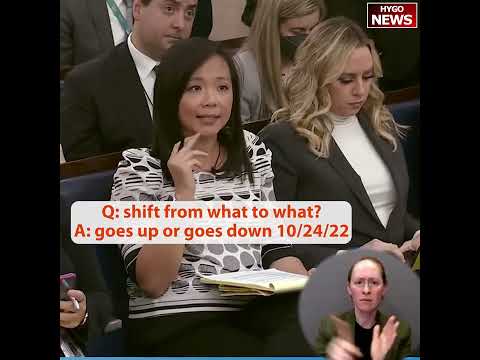
Reporter Asks KJP What Biden Meant by “Shift” for Democrats — KJP Can’t Explain: “Polls Go Up, Polls Go Down, It’s a Roller Coaster”
On 10/24/2022, a reporter asked White House Press Secretary Karine Jean-Pierre to explain what President Biden meant when he predicted a “shift” for Democrats in the closing days before the midterm elections. The reporter asked the specific follow-up: “Shift from what to what?” KJP’s response was a masterclass in saying nothing: “Polls go up, polls go down. It’s a roller coaster. And so, I don’t want to get ahead of that. I’ll just let his word stand.” She never defined what “shift” meant, what it was shifting from or to, or what evidence supported Biden’s prediction — effectively admitting the White House couldn’t explain its own president’s statement.
”Shift From What to What?”
The reporter’s question was simple and specific. “The President talked about his economic policies on Friday and today in the context of the midterms,” the reporter said. “He said he thought there would be a ‘shift’ for the Democrats. Can you provide any clarity about what he meant by ‘shift’? Shift from what to what?”
The question referenced Biden’s October 21 prediction that “we’re going to see one more shift back to our side in the closing days” — a statement Biden had attributed to declining gas prices from his SPR releases. The prediction was specific enough to invite scrutiny: Biden was forecasting a measurable change in polling direction, linked to specific policy outcomes.
When a president makes a prediction about electoral dynamics, the White House press office should be prepared to explain it. The reporter wasn’t asking for classified information or speculative analysis — he was asking KJP to clarify what the president of the United States meant by his own public statement.
”Polls Go Up, Polls Go Down”
KJP’s response abandoned any attempt to explain Biden’s prediction. “Look, you know, there’s going to be many, many polls in the short term that we have left in these next couple of weeks,” KJP said. “I’m not going to get ahead of them.”
Then came the line that defined the exchange. “And as we know, polls go up, polls go down. It’s a roller coaster,” KJP said. “And so, I don’t want to get ahead of that.”
The “polls go up, polls go down” observation was technically true in the way that “the sun rises and sets” is true — it described a phenomenon without offering any insight into the specific question asked. The reporter hadn’t asked whether polls fluctuate. He asked what Biden meant by predicting a specific directional shift.
The “roller coaster” metaphor extended the emptiness. Roller coasters go up and down — which direction was Biden predicting? KJP’s analogy suggested the midterms were unpredictable, which directly contradicted Biden’s confident prediction of a shift “back to our side."
"I’ll Just Let His Word Stand”
KJP then deployed one of her favorite deflection techniques. “I’ll just let his word stand because, again, he was talking about the midterms, so I don’t want to dive too much into it,” KJP said.
“Letting his word stand” was the briefing room equivalent of “no comment” dressed in more diplomatic language. It meant: I cannot explain what the president said, I will not try to explain it, and I hope you will move on to another question.
The justification — “he was talking about the midterms, so I don’t want to dive too much into it” — was particularly weak. The Hatch Act restricts executive branch employees from using their official positions for political campaign purposes, but it does not prevent a press secretary from explaining the president’s public statements. KJP could have simply said Biden believed economic improvements would help Democratic candidates — the explanation Biden himself had provided. Instead, she chose opacity.
”A Lot of Movement”
KJP offered one final non-explanation. “But again, there’s going to be a lot — a lot of movement in the next couple of weeks. And I think that’s what he was speaking to,” KJP said.
If Biden was merely observing that polls would fluctuate — “a lot of movement” — that was not a prediction of a “shift back to our side.” It was a truism about polling. The president had made a directional claim (shift toward Democrats), attributed it to a specific cause (gas prices declining from his actions), and his press secretary was now reducing it to a generic observation about polling volatility.
The retreat from specificity to vagueness suggested the White House recognized that Biden’s prediction was politically awkward. If the shift didn’t materialize, the prediction would be wrong. If it did materialize because of SPR releases, it would confirm the political motivation Biden had denied. KJP’s non-answer was designed to create enough ambiguity that neither outcome could be definitively measured against a clear White House position.
The Hatch Act Tightrope
KJP’s reluctance to discuss the midterms from the White House podium reflected the ongoing tension between Biden’s increasingly campaign-oriented rhetoric and the legal constraints on executive branch political activity. The Hatch Act prohibits most federal employees from engaging in political activity during official duties, and White House press briefings are official government functions.
Previous administrations had navigated this by distinguishing between explaining presidential statements (permissible) and endorsing candidates or predicting electoral outcomes (restricted). KJP’s approach — refusing to explain Biden’s own words because they were about the midterms — was an overcorrection that left the press office unable to perform its basic function of communicating the president’s positions.
The irony was that Biden himself had made the political predictions freely during official events — speaking about “shifts” and midterm outcomes while delivering remarks from the White House or during official trips. The Hatch Act constraints that limited KJP’s responses didn’t appear to limit Biden’s initial statements.
Biden’s Prediction in Context
Biden’s “shift” prediction was one of several optimistic midterm forecasts he made in the final weeks of October 2022. He had told donors he expected Democrats to hold both chambers. He had credited his SPR releases with improving the political landscape. He had insisted the economy was “strong as hell.”
The predictions reflected either genuine confidence or strategic messaging designed to energize Democratic turnout by projecting inevitability. Either way, they created an accountability trail: if Biden predicted a shift and it happened, he would claim credit; if it didn’t, the prediction would be added to the list of statements the White House couldn’t explain.
The midterm results would offer partial vindication — Democrats performed better than historical patterns predicted, holding the Senate and losing the House by a narrower margin than expected. But whether this constituted the specific “shift” Biden predicted, caused by the specific factors he cited, remained debatable.
The Briefing Room Standard
The exchange illustrated a recurring problem with KJP’s briefing room tenure: the inability to provide straightforward explanations of presidential statements. A press secretary’s primary job is to translate presidential communication for the press corps — adding context, providing details, and clarifying ambiguities.
When the response to “what did the president mean?” is “I’ll let his words stand” and “polls go up, polls go down,” the press secretary has failed at the core function. The reporter left the exchange knowing less than when he started — which was the opposite of what briefings were supposed to achieve.
The pattern had become so common by October 2022 that reporters had largely stopped expecting substantive answers from KJP’s podium. Questions were asked for the record — to document what the White House refused to address — rather than with any expectation of receiving illuminating responses.
Key Takeaways
- A reporter asked KJP to explain what Biden meant by predicting a “shift” for Democrats — “Shift from what to what?”
- KJP responded with “polls go up, polls go down, it’s a roller coaster” — reducing a specific presidential prediction to a truism about polling fluctuation.
- She said “I’ll just let his word stand” — the briefing room equivalent of refusing to explain the president’s own public statement.
- The retreat from specificity suggested the White House recognized Biden’s prediction was politically awkward regardless of outcome.
- KJP cited the midterm context as a reason not to elaborate, though Biden himself had made the prediction freely during official events.
Transcript Highlights
The following is transcribed from the video audio (unverified — AI-generated from audio).
- The president said he thought there would be a shift for the Democrats. Can you provide any clarity about what he meant by shift?
- Shift from what to what?
- There’s going to be many, many polls in the short term that we have left in these next couple of weeks.
- Polls go up, polls go down. It’s a roller coaster. I don’t want to get ahead of that.
- I’ll just let his word stand because he was talking about the midterms, so I don’t want to dive too much into it.
- There’s going to be a lot of movement in the next couple of weeks, and I think that’s what he was speaking to.
Full transcript: 147 words transcribed via Whisper AI.