 HYGO News
 Rubio on Garcia: 'I'd Never Tell You -- Or a Judge'; Lutnick: TSMC '$165 Billion' in Arizona; Trump: 'Most Successful 100 Days Ever'
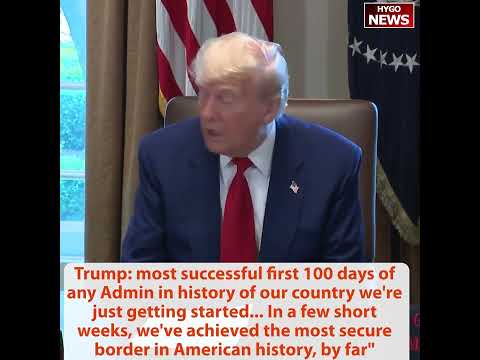
Rubio on Garcia: “I’d Never Tell You — Or a Judge”; Lutnick: TSMC “$165 Billion” in Arizona; Trump: “Most Successful 100 Days Ever”
Secretary Rubio delivered a sharp constitutional argument when asked about Garcia at the 100-day cabinet meeting in April 2025: “I would never tell you that. And you know who else I’ll never tell? A judge. Because the conduct of our foreign policy belongs to the President and the Executive Branch, not some judge.” Commerce Secretary Lutnick announced TSMC’s $165 billion investment in Arizona: “11,000 acres, the highest-tech chip manufacturing semiconductors. 40,000 people to build, 20,000 people employed for the rest of time — all driven by your tariff policies.” Trump capped the meeting: “We’ve completed what many consider the most successful first 100 days of any administration in history. We’ve achieved the most secure border ever — 99.9%. Biden thought you had to pass legislation. You didn’t. You just had to have the right President."
"I’d Never Tell a Judge”
A reporter pressed Rubio on the Garcia case.
“You brought up El Salvador in your remarks,” the reporter said. “Have you been in touch with El Salvador about returning Abrego Garcia?”
Rubio’s response was a constitutional assertion: “Well, I would never tell you that.”
He expanded: “And you know who else I’ll never tell? A judge.”
He stated the principle: “Because the conduct of our foreign policy belongs to the President of the United States and the Executive Branch, not some judge.”
He was definitive: “So we will conduct foreign policy appropriately if we need to. But I’ll never discuss it. And no one will ever make us discuss it, because that’s how foreign policy works.”
Rubio’s response elevated the Garcia case from an immigration dispute to a separation-of-powers question. The administration’s position was that communications between the United States and foreign governments about deportees were matters of foreign policy — a domain constitutionally reserved for the Executive Branch. A federal judge who demanded information about those communications was, in the administration’s view, overstepping into territory where the judiciary had no authority.
The “never tell a judge” declaration was legally aggressive but constitutionally grounded. The executive privilege over foreign affairs communications had been recognized since the earliest days of the republic. Presidents had consistently maintained that diplomatic discussions with foreign governments were not subject to judicial review. Rubio was asserting that principle explicitly and publicly.
TSMC: “$165 Billion”
Commerce Secretary Lutnick delivered the investment announcement that embodied the tariff strategy’s success.
“They’re investing $165 billion in 11,000 acres in Arizona,” Lutnick said.
He described the facility: “They’re building the highest-tech chip manufacturing semiconductors, 4,000 employees, American tradecraft. The classic foundation of America is building it.”
He scaled the workforce: “They have 14,000 people. They’re expecting 40,000 people to build the rest of their plants and to employ 20,000 people for the rest of time.”
He attributed the cause: “This is all driven by your tariff policies. No chance this would be happening without.”
The TSMC investment was the single largest foreign direct investment in American manufacturing history. TSMC — Taiwan Semiconductor Manufacturing Company, the world’s most advanced chipmaker — was committing $165 billion to build semiconductor fabrication facilities in Arizona. The investment would create 40,000 construction jobs and 20,000 permanent manufacturing positions producing the most advanced semiconductors in the world.
Lutnick’s “all driven by your tariff policies” attribution connected the investment directly to the administration’s trade strategy. Without tariffs on imported semiconductors, TSMC could have continued manufacturing in Taiwan and exporting to the United States at lower cost. The tariffs changed the calculus: building in America, despite higher labor costs, became more economical than paying tariffs on every chip shipped to American customers.
The national security implications were profound. Taiwan’s semiconductor industry — which produced the vast majority of the world’s advanced chips — was vulnerable to Chinese military action. If China invaded or blockaded Taiwan, the global semiconductor supply would be severed. By bringing TSMC’s manufacturing to American soil, the tariff strategy was simultaneously securing the supply chain and creating American jobs.
”Most Successful 100 Days”
Trump delivered his self-assessment.
“We’ve just completed what many consider to be the most successful first 100 days of any administration in the history of our country,” Trump said. “And we’re just getting started. Things are happening that are amazing.”
He cited the border: “In a few short weeks, we’ve achieved the most secure border in American history, by far. 99.9%, which is a number that nobody thought was doable.”
He contrasted with Biden: “Biden thought you had to go back to the legislature to get legislation passed in order to create a secure border. You didn’t. You just had to have the right President and the right people working it.”
He provided the data: “For two months in a row, we have set the all-time records for the lowest number of illegal border crossings ever recorded. The number of illegal border crossings released into the United States is down 99.999%. And that is usually 100%.”
He cited enforcement actions: “We officially designated Tren de Aragua, MS-13, and the Mexican drug cartels as foreign terrorist organizations. And we’re expelling these monsters from our country rapidly.”
He acknowledged judicial obstacles: “We’re having some judge problems. Some judges that don’t like killers, murderers being thrown out of the country. So I don’t know what their problem is.”
He cited his mandate: “We won on the basis of a great border and of getting criminals out of our country. We won every swing state. We won by millions of votes. It was a massive victory.”
He expressed hope: “I hope the Supreme Court is going to fully understand what’s going on.”
The 99.999% catch-and-release reduction — from 189,604 to effectively zero — was the administration’s most dramatic statistic. Trump’s point that Biden “thought you had to pass legislation” to secure the border was a direct rebuttal of the argument Democrats had made for years: that border security required congressional action. Trump had demonstrated that executive enforcement of existing law was sufficient — that the border crisis had always been a choice, not an inevitability.
Key Takeaways
- Rubio on Garcia: “I’d never tell you. And I’d never tell a judge. Foreign policy belongs to the President, not some judge.”
- Lutnick: TSMC investing $165 billion in 11,000 acres in Arizona — 40,000 construction jobs, 20,000 permanent jobs. “All driven by tariff policies.”
- Trump: “Most successful 100 days of any administration in history. Most secure border ever — 99.9%. Biden thought you needed legislation. You just need the right President.”
- Border crossings released: down 99.999%. “Two months in a row, all-time records for lowest crossings ever.”
- Cartels designated as foreign terrorist organizations; Trump called on the Supreme Court to resolve judicial obstruction.