 HYGO News
 NEC Dir Hassett: Replacing Income Tax with Tariff Revenue 'Absolutely' Possible; $500B-$1T from China Alone
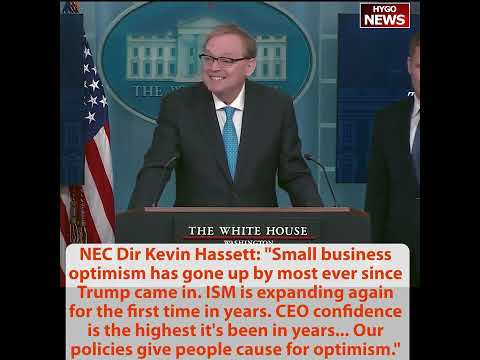
NEC Dir Hassett: Replacing Income Tax with Tariff Revenue “Absolutely” Possible; $500B-$1T from China Alone
National Economic Council Director Kevin Hassett confirmed in February 2025 that replacing income tax with tariff revenue was “absolutely” a possibility, revealing that the administration estimated China tariffs alone would generate between $500 billion and $1 trillion over ten years. Hassett then outlined the administration’s multi-level inflation-fighting strategy — cutting spending through DOGE and Congress while “exploding supply” through tax cuts and factory expensing — and cited economic indicators showing small business optimism had risen “by the most ever” since Trump took office. Senior Advisor Stephen Miller added that “cutting spending as DOGE is doing, and cutting taxes, is the key” to Trump’s promise of both tax relief and price relief for the working class.
”Absolutely” — Tariff Revenue Could Replace Income Tax
A reporter asked the question that had been circulating since Trump first floated the idea during the campaign: “President Trump has spoken about replacing income tax with tariff revenue, especially with all this waste, fraud, and abuse that we’re seeing cut. Is that a possibility?”
Hassett’s answer was unambiguous: “Absolutely.”
He then provided the revenue estimate that gave the concept substance. “If you think about the China tariff revenue that we’re estimating is coming in from the 10 percent that we just added, plus the de minimis thing, that it’s between $500 billion and $1 trillion over 10 years — that’s our estimate,” Hassett said.
The range was significant. Between $50 billion and $100 billion per year from China tariffs alone represented a substantial revenue stream. When combined with reciprocal tariffs on all other trading partners — which the administration was in the process of implementing — the total tariff revenue could approach or exceed the amount currently collected through the income tax from certain brackets.
Hassett connected the tariff revenue to the legislative agenda. “That’s something that is outside of the reductions that markets are seeing through the negotiations up on the Hill,” he said. “We expect that the tariff revenue is actually going to make it much easier for Republicans to pass a bill, and that was the president’s plan all along.”
The implication was that tariff revenue was not merely a trade policy tool but a fiscal strategy designed to offset the cost of the tax cuts Trump was pursuing through reconciliation. If tariffs generated $500 billion to $1 trillion in revenue, that money could fund the elimination of taxes on tips, Social Security, and overtime without increasing the deficit.
Fighting Inflation: “Every Level”
Hassett then pivoted to the administration’s top domestic economic priority. “The first thing is that the president has told us to prioritize fighting inflation,” he said. “And he had to do that because, as you know, President Biden let inflation get completely out of control. And he did it with policies that made no sense. They made no sense.”
He asked the question he had been posing throughout his tenure: “A lot of times you people say to us, our friends, the journalists, ‘Why are you doing that?’ But I like to think: why did they do that? Why did they spend so much money? And then why did the Fed print so much money so that we had inflation as high as we’ve ever seen since Jimmy Carter?”
Hassett contrasted the current situation with Trump’s first term: “We didn’t have to address it in the first term because it was always in the ones, almost always. But we’re going to get it back there.”
He then laid out the plan in detail, describing it as operating at “every level of fighting inflation.”
“First, the macroeconomic level,” Hassett said. “We’re cutting spending. We’re cutting spending in negotiations with people on the Hill. We’re cutting spending with the advice of our IT consultant, Elon Musk.”
The humorous description of Musk as an “IT consultant” drew attention, but the substance was serious. DOGE’s spending cuts, combined with Congressional action through reconciliation, represented the demand-side component of the anti-inflation strategy: reduce the amount of money the government was injecting into the economy.
“And then we’re also looking into supply-side things like restoring Trump’s tax cuts, maybe even expensing new factories, so that there is an explosion of supply,” Hassett continued. “If you have an explosion of supply and a reduction in government demand, then inflation goes way down.”
The economic logic was textbook: inflation occurs when too much money chases too few goods. The Trump approach attacked both sides simultaneously — less money (spending cuts) and more goods (supply expansion through deregulation, tax incentives, and energy production).
The 10-Year Treasury Signal
Hassett provided a market-based indicator that the strategy was already showing results. “The first thing that you’ll see when the markets believe that we’re going to get inflation under control is that the 10-year Treasury rate goes down, because that’s how they think about future expected inflation,” he explained.
He then cited the data: “The 10-year Treasury before the last consumer price index had dropped about 40 basis points.”
Translating the financial jargon for a general audience, Hassett said: “40 basis points is kind of not a fun thing to say. I kind of just talked that way, I apologize. But the way to think about it is: for a typical mortgage, if that affects the mortgage rate, then it’s going to save a typical family buying a house about $1,000 a year.”
The $1,000 annual savings figure made the abstract market movement tangible. A 40-basis-point decline in Treasury rates, if passed through to mortgage rates, would reduce monthly payments for millions of American families. And Hassett noted that this was just the beginning: “And that’s just at our first month.”
Economic Indicators: “The Most Ever”
Hassett then delivered a rapid-fire series of economic data points that supported the administration’s narrative of restored confidence.
“Small business optimism has gone up by the most ever since President Trump came in,” Hassett said. “ISM, which is the measure of what’s going on in manufacturing, it’s expanding again for the first time in years. CEO confidence is the highest it’s been in years.”
Each indicator pointed in the same direction: businesses and entrepreneurs were more optimistic than they had been under Biden, and the optimism was translating into real economic activity. Manufacturing expansion, in particular, was significant because it suggested that the administration’s tariff and deregulation policies were already encouraging domestic production.
“The reason people are thinking this is that our policies give people cause for optimism,” Hassett said.
The DOGE Dividend Mechanics
Stephen Miller then fielded a question about how the proposed DOGE dividend — 20% of savings returned to taxpayers — would actually work.
“The way that it works is when you achieve savings, you can either return it to taxpayers, you can return it to our debtors, or it can be cycled into next year’s budget and then it just lowers the overall baseline for next year,” Miller explained. “So in other words, you can just transfer it into the next fiscal window and then lower the overall spending level. And that means that you can achieve a permanent savings that way, and that reduces the deficit.”
When asked when Americans might see dividend checks, Miller pointed to the legislative process. “It’s all going to be worked on through the reconciliation process with Congress that’s going on right now,” he said. “The Senate’s moving a bill, the House is moving a bill. The President has great confidence in both chambers to deliver on his priorities.”
Miller then delivered the closing message. “President Trump has made a historic commitment to the working class of this country to fight for major tax relief and major price relief,” he said. “And cutting spending as DOGE is doing and cutting taxes is the key to delivering on both of those promises. And President Trump is resolutely committed to doing both.”
Key Takeaways
- NEC Director Hassett confirmed that replacing income tax with tariff revenue was “absolutely” possible, estimating China tariffs alone would generate $500 billion to $1 trillion over 10 years.
- The anti-inflation plan operates at “every level”: cutting government spending through DOGE and Congress while “exploding supply” through tax cuts and factory expensing.
- The 10-year Treasury rate had already dropped 40 basis points, which Hassett said would save a typical family about $1,000 per year on mortgage payments — “and that’s just at our first month.”
- Small business optimism rose “by the most ever,” manufacturing ISM was “expanding again for the first time in years,” and CEO confidence reached its highest level in years.
- Miller said the DOGE dividend would be structured through reconciliation, with 20% to taxpayers, 20% to debt reduction, and 60% cycled into lower spending baselines for permanent deficit reduction.