 HYGO News
 Q: Release more oil as Midterms 'Ploy'? WH: more reserve release even prices already decline
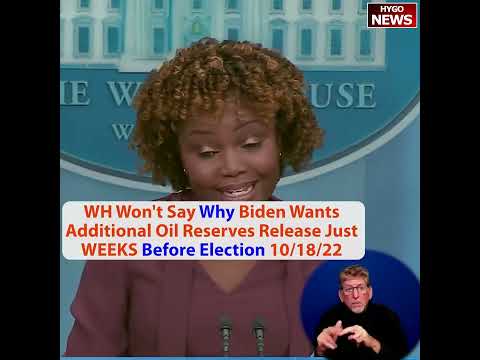
Bloomberg Reporter Asks Why Biden Is Releasing More Emergency Oil When Prices Are Already Dropping — “Is This a Ploy Ahead of the Midterms?”
On 10/18/2022, Bloomberg News reporter Jennifer Jacobs pressed White House Press Secretary Karine Jean-Pierre on the administration’s planned additional release from the Strategic Petroleum Reserve. With gas prices already declining, Jacobs asked the obvious question: “Why would the U.S. need another SPR release from that 180 million barrels that you already announced? Why would you need that now if prices are already dropping?” She then asked directly whether the release was “a ploy ahead of the midterms.” KJP responded with a rhetorical question of her own — “Should the president not do everything that he can to lower prices?” — without addressing why emergency reserves were being tapped when the stated emergency was subsiding.
”Why Would You Need That Now?”
Jacobs laid out the contradiction methodically. “Some White House officials have been talking for the last few days about the fact that it’s a possibility,” Jacobs said. “Can you explain why, with gas prices — you mentioned earlier that gas prices are going down again — why would the U.S. need another SPR release from that 180 million barrels that you already announced? Why would you need that now if prices are already dropping?”
The question cut to the heart of the SPR controversy. The Strategic Petroleum Reserve was designed as an emergency stockpile for genuine supply disruptions — wars, hurricanes, pipeline failures. Biden had authorized the release of 180 million barrels beginning in March 2022, the largest drawdown in the reserve’s history, citing the energy price impact of Russia’s invasion of Ukraine.
But by October 2022, gas prices had already fallen significantly from their June peak. If the purpose of SPR releases was to address an emergency price spike, and the spike was subsiding on its own, the justification for continued releases disappeared — unless the purpose was not emergency supply management but rather political price manipulation ahead of an election.
”I’m Not Going to Get Ahead of the President”
KJP initially deflected. “So, again, I’m not going to get ahead of the president. As you know, there’s going to be an announcement tomorrow on the president’s policy, next move — his next move forward on what he’s going to do,” KJP said.
The preview of a “next move” confirmed what Jacobs was reporting: another SPR release was coming, timed for maximum pre-election impact. The timing was notable — the announcement would come on October 19, with the midterm election on November 8, leaving exactly 20 days for lower gas prices to influence voter behavior.
KJP then attempted to reconcile the declining prices with continued releases. “So, you know, as you note, gas prices have indeed come down. I just listed some of the states where we had seen an increase and now we’re seeing a decline this past week,” KJP said. “They came down at the fastest pace in over a decade this summer and have continued to fall in recent days.”
The admission that prices were already falling made the case for additional releases weaker, not stronger. If prices were declining “at the fastest pace in over a decade” without additional releases, the market was correcting on its own. Releasing more emergency reserves into a declining market looked less like crisis management and more like an attempt to push prices even lower before Election Day.
”A Ploy Ahead of the Midterms?”
Jacobs then asked the question directly. “Do you have any response to those who would say — who are criticizing the White House saying that this seems like a ploy ahead of the midterms?” Jacobs asked.
KJP’s response was a rhetorical deflection. “Look, the president — I would say this to folks: Should the president not do everything that he can to lower prices?” KJP said. “Should he not continue to keep his promise to give American people a little bit of breathing room? You know, that’s the promise that he’s made. Should he not do that?”
The “should he not” construction was clever — it reframed the timing question as a question about the president’s intent, making anyone who questioned the timing appear to be arguing against lower gas prices. But the reporter wasn’t asking whether lower prices were desirable; she was asking why emergency reserves were being released when the emergency was fading and the timing happened to coincide perfectly with an election.
“And so, that’s what you’re seeing right now. This is something that he has done throughout the summer,” KJP added — suggesting consistency rather than political calculation, though the “throughout the summer” timeline tracked precisely with the period when gas prices were a top political liability for Democrats.
The SPR by the Numbers
Biden’s SPR drawdown was historically unprecedented in both scale and purpose. The reserve, established in 1975 after the Arab oil embargo, had a capacity of roughly 714 million barrels. When Biden took office, it held approximately 638 million barrels. By October 2022, the authorized 180-million-barrel release had reduced the stockpile to its lowest level since the 1980s — approximately 400 million barrels and declining.
Critics raised several concerns about the drawdown:
First, the reserve existed for genuine emergencies — not for managing consumer prices before elections. A hurricane disrupting Gulf Coast refining, a military conflict blocking the Strait of Hormuz, or a catastrophic pipeline failure were the scenarios the SPR was designed to address. Every barrel released for political purposes was one fewer barrel available for an actual emergency.
Second, the economics were questionable. The administration was selling oil at market prices around $80-90 per barrel, having acquired much of the reserve at lower prices over decades. Biden had proposed refilling the reserve at $70 per barrel — a plan that assumed oil prices would decline enough to make repurchase affordable. If prices remained elevated or rose further, refilling would cost significantly more than the revenue generated by the releases.
Third, the releases didn’t address the underlying supply constraints that elevated prices. Biden’s own energy policies — canceling Keystone XL, pausing federal leasing, signaling rapid fossil fuel phase-out — had discouraged long-term investment in domestic production. Temporary SPR releases masked the policy-driven supply shortage without fixing it.
The Political Timeline
The timing of SPR releases throughout 2022 aligned conspicuously with political need:
- March 2022: Biden announced the 180-million-barrel release as gas prices spiked following Russia’s Ukraine invasion
- Summer 2022: Releases continued as gas prices hit $5 per gallon nationally, Biden’s approval cratered, and midterm anxiety peaked
- October 2022: Additional releases announced 20 days before the midterm election, despite prices already declining
After the November midterm election, the pace of releases slowed dramatically. The political utility had expired, and the emergency reserve was approaching levels that genuinely concerned national security planners.
Key Takeaways
- A Bloomberg reporter asked why Biden was releasing more emergency oil when gas prices were already “going down” — and whether it was “a ploy ahead of the midterms.”
- KJP responded with “should the president not do everything he can to lower prices?” without addressing the timing question.
- She admitted gas prices “came down at the fastest pace in over a decade” — undermining the case for additional emergency releases.
- The SPR had been drawn down to its lowest level since the 1980s, from 638 million to roughly 400 million barrels.
- The additional release was announced October 19, exactly 20 days before the November 8 midterm election.
Transcript Highlights
The following is transcribed from the video audio (unverified — AI-generated from audio).
- Can you explain why, with gas prices going down again, would the U.S. need another SPR release from that 180 million barrels? Why would you need that now if prices are already dropping?
- I’m not going to get ahead of the president. There’s going to be an announcement tomorrow.
- Gas prices have indeed come down. They came down at the fastest pace in over a decade this summer.
- Do you have any response to those criticizing the White House saying that this seems like a ploy ahead of the midterms?
- Should the president not do everything that he can to lower prices? Should he not continue to keep his promise?
- This is something that he has done throughout the summer.
Full transcript: 277 words transcribed via Whisper AI.