 HYGO News
 Q: related to procedure A: refer you to White House Counsel
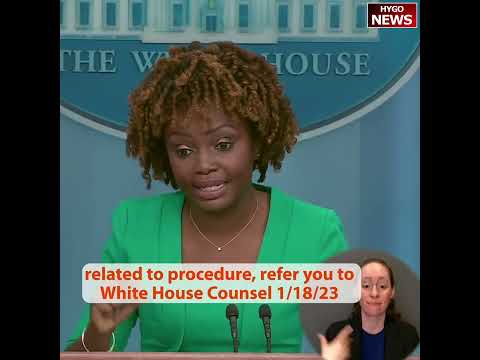
KJP Refers Procedural Questions to White House Counsel — Even When Reporter Clarifies They’re Not About DOJ Investigation
In January 2023, White House Press Secretary Karine Jean-Pierre refused to answer reporter questions about White House procedures for handling classified documents — even after the reporter explicitly clarified the questions were about process, not about the DOJ investigation into President Biden’s classified documents. The reporter asked how the classified documents episode had “prompted a review of the process in which staffers handle classified information and how they are turned over to national archives during a transition.” KJP’s response was to refer the reporter to White House Counsel: “I’m going to refer you to my colleagues at the White House Council’s office. They will be able to address that particular questions. I’m just not going to address something that is even related to an ongoing legal process.” When the reporter pressed — “Why not? I mean, I’m having a hard time understanding why” — and reiterated “Questions about procedures,” KJP simply repeated: “the White House Council’s office will be able to address that question.” A follow-up on whether Biden was “satisfied with the current SOP of handling classified materials” got the same deflection.
The Reporter’s Clarification
The reporter’s opening framing was explicit about what the question was not about. “To be clear my questions about procedures here at the White House and not about anything specific related to the DOJ investigation,” the reporter said.
The preemptive clarification was strategic. The reporter was:
Anticipating KJP’s usual deflection — That questions related to the DOJ investigation.
Establishing question scope — Procedural, not investigative.
Limiting deflection options — By explicit exclusion.
Creating accountability — For direct response.
Trying to break the pattern — Of automatic DOJ referrals.
The clarification was professional and specific. It acknowledged KJP’s position on DOJ-related questions and tried to work within it — asking about matters that KJP’s stated reason couldn’t apply to.
”Prompted a Review of the Process”
The reporter’s substantive question was about process review. “I’m just wondering how this episode has prompted a review of the process in which staffers handle classified information and how they are turned over to national archives during a transition,” the reporter asked.
The question was reasonable and focused:
Internal review — Standard response to problems.
Process focus — How things are done.
Staffer handling — Operational procedures.
National Archives turnover — Specific requirement at transition.
Transition timing — When the incident occurred.
Any organization experiencing a significant problem would typically conduct internal reviews. Asking whether and how the White House was reviewing its procedures was standard due diligence. This was exactly the kind of question that should be answerable.
The White House Counsel Referral
KJP’s response maintained the deflection pattern. “And to be clear, I’m going to refer you to my colleagues at the White House Council’s office. They will be able to address that particular questions,” KJP said.
The referral had problems:
Counsel wasn’t briefing — Reporters regularly.
No scheduled sessions — For Counsel to address questions.
Deflection pattern — Consistent KJP approach.
No alternative process — For actually getting answers.
Effective blackout — On procedural questions.
KJP’s referral to White House Counsel was not a pathway to information — it was a way to avoid providing information. White House Counsel wasn’t doing press briefings. Without a mechanism to actually get Counsel’s input, the referral was effectively a refusal.
”Even Related to an Ongoing Legal Process”
KJP expanded her refusal scope. “I’m just not going to address something that is even related to an ongoing legal process,” KJP said.
The “even related to” expansion was significant:
Not just legal matter — But anything related.
Broad scope — Could include many topics.
Self-serving definition — KJP decided what was related.
Effectively unlimited — When administration chose.
Breaking usual practice — For government spokesperson accountability.
The expansion was important. By claiming that anything “even related” to the investigation couldn’t be addressed, KJP had effectively made most questions about classified documents off-limits. The reporter’s procedural question, having nothing to do with the DOJ investigation itself, could still be characterized as “related” to an “ongoing legal process."
"Why Not? I Mean, I’m Having a Hard Time Understanding Why”
The reporter pushed back directly. “Why not? I mean, I’m having a hard time understanding why,” the reporter said.
The challenge was reasonable and genuine:
Logical difficulty — With KJP’s position.
Procedural focus — Already established.
No DOJ connection — For process review questions.
Honest confusion — About KJP’s logic.
Professional challenge — Not hostile but firm.
The reporter’s frustration was understandable. KJP had extended her refusal to cover questions that by any reasonable interpretation were not about the investigation. Having a hard time understanding the logic was appropriate — the logic didn’t particularly hold together.
”I Just Said — Questions About Procedures”
The reporter reiterated the scope. “I just said- Questions about procedures,” the reporter said, emphasizing the framing that KJP was ignoring.
The repetition was necessary because KJP’s response had ignored the clarification. By referring procedural questions to White House Counsel as if they were investigation-related, KJP had effectively treated the reporter’s preemptive clarification as meaningless.
The reporter was essentially saying: “I already made clear this isn’t about the investigation — so your deflection reason doesn’t apply.” But KJP continued to apply it anyway, showing the deflection wasn’t really about the stated reason but about broader avoidance.
The Repeated Deflection
KJP’s response to the push-back was literal repetition. “And I just said, and I just said to you, the White House Council’s office will be able to address that question,” KJP said.
The “I just said, and I just said” construction was notable:
Verbal pattern repetition — KJP signature.
Frustration tell — Pressure response.
Content unchanged — Same deflection.
No engagement — With the reporter’s logic.
Stonewalling — Not actually briefing.
The double “I just said” suggested KJP felt pressed but couldn’t move beyond the deflection script. Her only response to substantive challenge was repetition of the original deflection.
The SOP Follow-Up
The reporter tried a different angle. “Is President Biden satisfied with the current SOP of handling classified materials here and turning them over to national archives?” the reporter asked.
The new question sought Biden’s view on:
Current SOP — Standard Operating Procedures.
Biden’s satisfaction — His personal opinion.
Adequacy of procedures — Policy assessment.
Future handling — Going forward.
Leadership position — On procedural issues.
This was a different kind of question. Not about facts of the incident or process reviews, but about Biden’s assessment of existing procedures. This was exactly the kind of question a president should be able to answer through his spokesperson — an opinion question about policy adequacy.
The Same Deflection
KJP’s response was identical. “Again, I will refer you to the White House Council,” KJP said.
Even Biden’s own view on his administration’s procedures was being deflected to White House Counsel. This was particularly problematic:
Counsel can’t give opinion — On president’s views.
Counsel is legal office — Not policy.
Biden’s views — Belonged to Biden.
Press Secretary role — To convey those views.
Complete deflection — Across all related questions.
The pattern showed that KJP’s deflection wasn’t actually about DOJ involvement — it was about any question touching on classified documents, whatever the nature. The White House had decided to essentially not comment on anything in this space publicly, even matters that had nothing to do with the investigation.
The Stonewalling Strategy
The exchange revealed a broader stonewalling strategy:
Wide deflection scope — Anything “related to” was off limits.
Pre-emptive refusal — Before reporters could establish non-related context.
Repetitive deflection — Wearing down reporters.
No alternative answers — Providing no route to information.
Procedural questions excluded — Along with substantive ones.
The strategy’s effectiveness was debatable. It certainly prevented direct statements that could be quoted or scrutinized. But it also generated its own coverage — the very pattern of deflection became news. Reporters were increasingly framing stories around what KJP wouldn’t say rather than what she did.
The “SOP” Dimension
The reporter’s reference to “SOP” (Standard Operating Procedures) suggested growing focus on policy aspects. By late January 2023, the conversation had moved beyond “what happened” to “what should change”:
Existing procedures — Were they adequate?
Incident response — Was review happening?
Future handling — How would this be prevented?
Presidential position — Did Biden have views?
Congressional interest — Would there be oversight?
These were legitimate questions that didn’t require any comment on the DOJ investigation. Deflecting them was a choice, not a necessity. The administration was declining to discuss forward-looking improvements that didn’t depend on the investigation’s outcome.
The Transparency Question
KJP’s pattern raised questions about accountability:
Public interest — In classified document handling.
Voter concerns — About how this was managed.
Congressional oversight — Required information.
Media accountability — Function of press briefings.
Democratic norms — About government transparency.
The White House position — that anything related to this topic must be deflected to counsel — essentially precluded public accountability through normal channels. Counsel wasn’t briefing the public. So the information wasn’t flowing.
The Precedent Concern
The broad deflection standard created concerning precedent:
Future incidents — Could similarly be blacked out.
Other legal processes — Might be used to avoid questions.
Administration discretion — Over what was “related.”
Accountability weakening — Through expansion of deflection.
Press limitation — On ability to get information.
If the standard became that any matter touching a legal process was off-limits to press briefings — broadly interpreted — then substantial topics could become permanent no-go zones. The press would have less ability to hold government accountable.
The Administrative Realities
Of course, the White House had genuine concerns. Legal processes do require some care about public statements. Counsel involvement in sensitive matters is legitimate. Some questions really were better handled by legal officers.
But the reporter had tried to accommodate these concerns by explicitly limiting the scope to procedures, not investigation details. KJP’s refusal to accept this limitation showed that the deflection was not actually responsive to the stated concerns. The deflection was broader than the legitimate scope of legal caution would require.
The Pattern Across Briefings
This exchange was one of many similar ones across multiple briefings in January 2023. The pattern was consistent:
Reporters asked procedural questions — About process, review, change.
KJP deflected to Counsel — Regardless of specific scope.
Reporters pushed back — About relevance of deflection.
KJP repeated deflection — With occasional verbal frustration.
Nothing advanced — In terms of public understanding.
The consistency suggested deliberate administration strategy. This wasn’t KJP improvising — this was a decided approach to a specific topic. The White House had chosen to comment minimally on all aspects of classified documents, regardless of question type.
Key Takeaways
- In January 2023, a reporter asked KJP about White House procedures for handling classified information, explicitly clarifying the questions were about process, not the DOJ investigation.
- KJP deflected all procedural questions to White House Counsel, claiming they were “even related to an ongoing legal process.”
- When the reporter pressed (“Why not? I’m having a hard time understanding why”) and reiterated “Questions about procedures,” KJP simply repeated the Counsel referral.
- A follow-up on whether Biden was “satisfied with the current SOP of handling classified materials” got the same deflection: “Again, I will refer you to the White House Council.”
- The exchange showed the administration’s deflection strategy extended beyond investigation-specific questions to any topic “even related” to the classified documents matter.
- The broad deflection standard effectively precluded public accountability through normal press channels on significant procedural and policy questions.
Transcript Highlights
The following is transcribed from the video audio (unverified — AI-generated from audio).
- To be clear my questions about procedures here at the White House and not about anything specific related to the DOJ investigation.
- I’m just wondering how this episode has prompted a review of the process in which staffers handle classified information and how they are turned over to national archives during a transition.
- I’m going to refer you to my colleagues at the White House Council’s office. They will be able to address that particular questions.
- I’m just not going to address something that is even related to an ongoing legal process.
- Why not? I mean, I’m having a hard time understanding why. I just said- Questions about procedures.
- Is President Biden satisfied with the current SOP of handling classified materials here and turning them over to national archives? Again, I will refer you to the White House Council.
Full transcript: 166 words transcribed via Whisper AI.