 HYGO News
 Trump on Putin: 'I'll Let You Know in Two Weeks If He's Tapping Us Along'; 'I Told Netanyahu Inappropriate to Disrupt Talks Right Now -- Iran Deal with Inspections and No Trust'; VP Vance on Tariff Court Ruling: 'We Are in a National Emergency -- Pharmaceutical Ingredients, Critical Supply Chain'
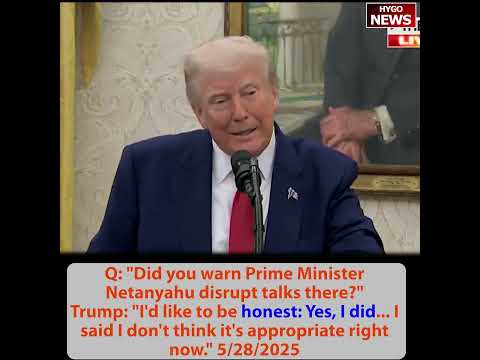
Trump on Putin: “I’ll Let You Know in Two Weeks If He’s Tapping Us Along”; “I Told Netanyahu Inappropriate to Disrupt Talks Right Now — Iran Deal with Inspections and No Trust”; VP Vance on Tariff Court Ruling: “We Are in a National Emergency — Pharmaceutical Ingredients, Critical Supply Chain”
In late May 2025, Trump addressed Russia-Ukraine, Iran negotiations, and Netanyahu communications. On Putin: “Do you still believe Putin actually wants to end the war?” Trump: “I can’t tell you that, but I’ll let you know in about two weeks. We’re going to find out whether or not he’s tapping us along or not. And if he is, we’ll respond a little bit differently.” On Netanyahu: “Did you warn Prime Minister Netanyahu against taking actions that could disrupt the talks?” Trump: “I’d like to be honest. Yes, I did. I said I don’t think it’s appropriate right now because we’re very close to a solution.” On Iran: “I want it very strong where we can go in with inspectors. We can take whatever we want. We can blow up whatever we want, but nobody getting killed. No trust. I don’t trust anybody.” VP Vance on court ruling against Trump tariffs: “We are in an emergency. You’ve seen foreign governments threaten the American people with the loss of critical supplies — pharmaceutical ingredients, critical pieces of the manufacturing supply chain. That is, by definition, a national emergency.”
Putin: “Two Weeks”
Trump addressed the Russia-Ukraine situation with characteristic patience.
A reporter asked: “Do you believe the Russians are being disrespectful when they say that your criticisms of Putin are simply an emotional response? And do you still believe that Putin actually wants to end the war?”
Trump’s response: “I can’t tell you that, but I’ll let you know in about two weeks, within two weeks. We’re going to find out very soon.”
He described the evaluation process: “We’re going to find out whether or not he’s tapping us along or not. And if he is, we’ll respond a little bit differently, but it’ll take about a week and a half, two weeks.”
He praised Steve Witkoff: “Mr. Witkoff is here, is doing a phenomenal job, is dealing with them very strongly right now.”
He noted the apparent Russian posture: “They seem to want to do something, but until the document is signed, I can’t tell you. Nobody can.”
He described his disappointment: “I can say this, I can say this, that I’m very disappointed at what happened a couple of nights now where people were killed in the middle of what you would call a negotiation. I’m very disappointed by that.”
The “Two Weeks” Pattern
Trump’s “two weeks” framing was a recurring pattern in his foreign policy:
Recent applications:
- Russia-Ukraine resolution: “Two weeks” to assess Putin’s sincerity
- Iran nuclear deal: “Two weeks” to complete negotiations
- Various trade deals: “Two weeks” to finalize terms
The “two weeks” meaning:
- Signal of urgency without being specific about deadline
- Timeline sufficient for serious negotiation
- Short enough to prevent extended foot-dragging
- Long enough for genuine diplomatic work
- Flexible enough to extend if progress justifies
What it communicated:
- Serious engagement with counterparty
- Willingness to walk away if no progress
- Clear timeline expectation
- Accountability for results
The specific application to Russia-Ukraine was important. Trump was signaling:
- Putin’s continued rocket attacks were unacceptable during ongoing negotiations
- The diplomatic process had a definite timeline
- If Putin failed to de-escalate military operations, American policy would shift
- “Respond a little bit differently” suggested increased pressure (sanctions, weapons to Ukraine, etc.)
The “tapping us along” phrase captured Trump’s concern. Putin might be:
- Engaging in negotiations for diplomatic cover
- Continuing military operations to improve negotiating position
- Hoping American attention would fade
- Trying to extract concessions without real commitment
- Exploiting Trump’s preference for deals to avoid hard constraints
If Putin was indeed “tapping along,” Trump was signaling that American response would be substantive rather than merely rhetorical.
Disappointment at Killings
The “very disappointed” framing reflected Trump’s genuine frustration.
Russian missile and drone attacks had continued throughout late May 2025, with substantial civilian casualties in Ukrainian cities. The pattern had been:
- Diplomatic discussions between American officials and Russian counterparts
- Parallel continued (or even intensified) Russian military operations
- Ukrainian casualties mounting during negotiations
- Russian officials claiming progress while attacks continued
Trump’s “disappointed” framing was diplomatic understatement. The practical message was that Russia’s military escalation during negotiations was undermining the diplomatic process. If this pattern continued, Russian conduct would force American response rather than diplomatic resolution.
Netanyahu: “Inappropriate Right Now”
A reporter asked about Netanyahu communications.
“Mr. Witcoff, did you warn Prime Minister Netanyahu against taking some sort of actions that could disrupt the talks there in a phone call last week?”
Trump’s response was characteristically direct: “Well, I’d like to be honest. Yes, I did. Next question, please.”
Asked for clarification: “I did.”
He described his framing: “It’s not a warning. I said, I don’t think it’s appropriate.”
“What exactly did you tell them? Did you call them?”
Trump: “I said, I don’t think it’s appropriate. We’re having very good discussions with them.”
He laid out the strategic context: “And I said, I don’t think it’s appropriate right now, because if we can settle it with a very strong document, very strong, with inspections and no trust."
"No Trust”
Trump’s framing of the Iran deal approach was revealing.
“I don’t trust anybody,” Trump said. “I don’t trust anybody. So no trust.”
He described the verification regime: “I want it very strong where we can go in with inspectors. We can take whatever we want. We can blow up whatever we want, but nobody getting killed.”
He laid out the comparison: “We can blow up a lab, but nobody’s going to be in the lab as opposed to everybody being in the lab and blowing it up, right? Two ways of doing it.”
This framing captured the essential American objective: a verified end to Iranian nuclear weapons capability without military conflict.
The “no trust” principle:
- Iran had been deceptive about nuclear programs for decades
- Various nuclear agreements had been violated or evaded
- Iranian proxies had conducted hostile operations throughout
- Iranian rhetoric about “death to America” was sincere
- Any agreement would require verification, not trust
The “inspections” requirement:
- American or international inspectors with full access
- Ability to examine any facility
- Unannounced inspection capability
- Documentary evidence access
- Personnel interview access
The “blow up” capability:
- Ability to destroy nuclear facilities if found in violation
- Access to attack targeting information
- Ability to act unilaterally if needed
- No procedural barriers to enforcement action
- Credible threat as basis for compliance
The “no killing” preference:
- Destruction of facilities without personnel
- Warning before major strikes
- Minimization of civilian casualties
- Preservation of Iranian people’s welfare
- Distinction between regime and population
This was a classic “peace through strength” approach. A weak agreement without verification and enforcement would fail. An agreement with real enforcement capability could succeed because the cost of violation would be severe and certain.
Netanyahu’s Potential Disruption
The Netanyahu communications reflected tension in the US-Israel relationship.
Netanyahu had reportedly been considering:
- Military strikes on Iranian nuclear facilities
- Expanded military operations in Gaza
- Preemptive action against various targets
- Responses to specific incidents
Trump’s “inappropriate right now” was strategic:
- Israeli military action could derail American diplomacy
- Iranian compliance might be possible through pressure
- Military action should be last resort, not first option
- American diplomatic credibility required Israeli cooperation
- Timing mattered — military action might make sense later
The “very close to a solution” framing reflected American confidence that diplomatic pressure was working. Iran had:
- Faced unprecedented economic sanctions
- Seen proxy networks decimated
- Experienced internal political pressure
- Watched Syrian ally collapse
- Lost key military capabilities
Under these conditions, Iran might actually negotiate seriously rather than continue stalling. If diplomacy could succeed, military action would be unnecessary.
Trump’s message to Netanyahu was:
- Give diplomacy a chance
- Don’t disrupt the current moment
- Military action could come later if needed
- American policy coordination required Israeli restraint
- Timing was strategically important
The Negotiating Philosophy
Trump’s Iran framework captured his broader negotiating philosophy:
“That could change at any moment,” Trump said. “It could change with a phone call. But right now, I think they want to make a deal. And if we can make a deal, save a lot of lives.”
“Save a lot of lives”: War with Iran would produce massive casualties — Iranian civilians, Israeli civilians, American service members, regional populations. A diplomatic solution would save all these lives.
“Could change at any moment”: Diplomatic conditions were volatile. Current favorable conditions could deteriorate. Current unfavorable conditions could improve. Flexibility was essential.
“A phone call”: Personal engagement with counterparties was Trump’s signature diplomatic style. Major shifts in strategic outcomes could come from specific conversations rather than formal processes.
VP Vance on Tariff Court Ruling
Vice President JD Vance addressed the recent federal court ruling against Trump tariffs.
“The president has very broad discretion to engage in foreign policy, to actually protect American consumers from foreign predators, from people who are trying to access our markets, dump it to our markets, destroy American industries,” Vance said.
He made the legal framing: “The president has a lot of power to prevent that stuff from happening. Now, this court decision, I think, is really based on a legal technicality.”
He stated the administration’s position: “And so my second point is the president also has broad discretion to deal with this stuff. So even if you somehow had this legal technicality hold up in court, I think there are a lot of ways in which the president in the United States can protect American workers and protect American workers from these very, very unfair, unfair trade practices.”
The “National Emergency” Framework
Vance articulated the legal and policy foundation.
“We believe, and we’re right, that we are in an emergency,” Vance said.
He described the specifics: “You’ve seen foreign governments, sometimes our adversaries, threaten the American people with the loss of critical supplies.”
He distinguished essential from trivial: “I’m not talking about toys, plastic toys. I’m talking about pharmaceutical ingredients. I’m talking about the critical pieces of the manufacturing supply chain.”
He identified the triggering condition: “If these governments are threatening to cut us off from that stuff, that is, by definition, a national emergency.”
He stated the executive authority: “And in that national emergency, the president has very broad discretion to fight back, to bring American industry back home, and to make American consumers protected and much safer.”
He closed: “That’s all he’s trying to do. So whatever this court has said, I think the president has the authority to do his job. We’re going to keep on fighting the court cases. We’re also going to keep on doing the work for the American people.”
The Substantive Emergency
Vance’s emergency framing addressed real vulnerabilities:
Pharmaceutical ingredients: The United States had become dependent on Chinese and Indian sources for pharmaceutical active ingredients (API). Most generic drugs consumed in America were made from ingredients that originated in Asia. If Chinese government decided to restrict API exports to America:
- Antibiotics could become unavailable
- Common blood pressure medications could run out
- Pain medications could be rationed
- Essential cancer drugs could be unavailable
- Public health crisis would be immediate
Critical supply chain: American manufacturing had offshored significant portions of capability:
- Semiconductor manufacturing (Taiwan dependency)
- Rare earth processing (China dependency)
- Basic industrial materials (various dependencies)
- Medical device production (global dependencies)
- Military equipment inputs (various dependencies)
If geopolitical conditions disrupted any of these supply chains, American industry would be unable to function. The American economy, American standard of living, American military capability — all depended on supply chains that had become vulnerable.
Foreign government threats: Various foreign governments had explicitly or implicitly threatened to leverage these dependencies:
- Chinese officials had threatened rare earth restrictions
- Russia had threatened grain supplies
- Various countries had threatened strategic materials
- Trade disputes had repeatedly triggered supply threats
These threats created legitimate national security concerns. The International Emergency Economic Powers Act (IEEPA) and related authorities gave presidents authority to respond to national emergencies. The question was whether current conditions constituted such an emergency.
The Court Ruling Context
The “legal technicality” court ruling Vance referenced was the Court of International Trade’s decision on Trump’s tariffs. Key aspects:
The ruling: Federal court had ruled that Trump’s reciprocal tariffs exceeded the president’s authority under IEEPA.
The basis: The court’s reasoning involved statutory interpretation of what constituted a legitimate emergency justifying tariff action.
The appeal: The administration was appealing to higher courts.
The interim: Tariffs continued under various authorities while appeals proceeded.
The stakes: If courts ultimately struck down tariff authority, the administration’s entire trade strategy could be affected.
Vance’s framing was:
- The ruling was on a technicality rather than substantive law
- Even if upheld, other executive authorities existed
- The emergency was genuine regardless of legal technicality
- The administration would continue using all available tools
This was legally and practically defensible. The president had multiple sources of authority for tariffs:
- IEEPA (currently contested)
- Section 232 (national security)
- Section 301 (unfair trade practices)
- Section 122 (balance of payments)
- Various other specific authorities
If one authority was restricted, others remained available. The tariff strategy could continue under different legal frameworks even if IEEPA authority were successfully challenged.
Key Takeaways
- Trump on Putin: “I’ll let you know in two weeks whether he’s tapping us along. If he is, we’ll respond differently.”
- Trump disappointed: “People killed in the middle of what you would call a negotiation.”
- Trump told Netanyahu “inappropriate right now” to disrupt Iran talks — diplomacy close to solution.
- Iran framework: “Inspections and no trust. I don’t trust anybody. Blow up lab without people in it, as opposed to blowing it up with people.”
- VP Vance: “We are in a national emergency. Foreign governments threatening pharmaceutical ingredients, critical supply chain. President has broad discretion.”