 HYGO News
 Q: now 30K/month legally, what about previous were paroled illegal, they’re here, don’t have jobs
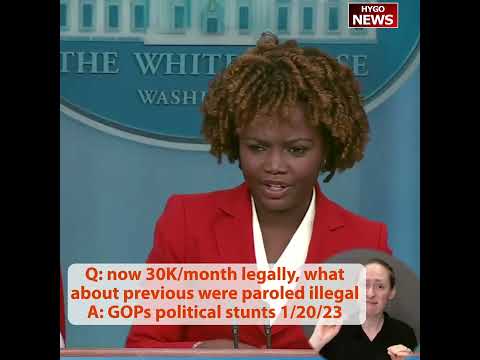
Reporter Asks About Previously Paroled Migrants — KJP: “I’m Not Sure What Executive Action I Think I Was Talking About”
In January 2023, a reporter asked White House Press Secretary Karine Jean-Pierre about whether the administration was considering relief for migrants who had been paroled into the U.S. before the new 30,000-per-month legal parole program. “I was just wondering if the administration is considering any help or relief for thousands of immigrants that were paroled into this country before the agreement of the 30,000 a month. They’re here, they don’t have jobs, they’re depending on different communities, charity work, and some of them have told us that they don’t have court dates for another two years,” the reporter said. KJP’s response was confused: “So, a couple of things, I’m not sure what executive action I think I was talking about. I may have been talking about something else, I’m not quite sure.” This confession of confusion was notable — KJP apparently couldn’t remember what executive actions she had just mentioned, leading to confused back-and-forth about which program the reporter was asking about.
The Reporter’s Specific Concern
The reporter raised specific humanitarian concern:
Previously paroled migrants — Currently in U.S.
Pre-dating new program — Before 30,000/month.
Without jobs — Working status unclear.
Community dependence — Charity, services.
Long court dates — Two years out.
Legal limbo — Essentially.
This was a real situation. Migrants paroled under previous rules often had limited work authorization, uncertain legal status, and long waits for immigration court hearings. They were dependent on community support while navigating the backlogged system.
The Policy Context
The January 2023 policy changes included:
Expanded parole program — 30,000/month.
For Venezuelans, Cubans, Nicaraguans, Haitians — Specific nationalities.
Sponsor requirement — U.S. sponsors.
Two-year authorization — Initial.
Work authorization — Included.
The new program had specific benefits — legal entry, work authorization, defined status. Previously paroled migrants didn’t necessarily have these benefits. The reporter was asking about the disparity.
The Previously Paroled Population
The previous parole population had varied statuses:
Traditional parole — Case-by-case.
Emergency parole — For specific situations.
Humanitarian parole — Special circumstances.
Various countries — Origin.
Different terms — Granted.
Some without work auth — Unable to work legally.
This population had different experiences. Some had work authorization; others didn’t. Some had clear status paths; others were in limbo. The category included many different situations.
The Specific Hardships
The reporter cited specific hardships:
No jobs — Employment restrictions.
Charity dependence — Community support.
Long court dates — Two years out.
Uncertainty — About final status.
Daily difficulty — Accumulating.
These were real, documented situations. Migrants who couldn’t work legally faced significant hardship. Community organizations had been stretched supporting this population. Long wait times for immigration court compounded the uncertainty.
”I’m Not Sure What Executive Action”
KJP’s response was unusual. “So, a couple of things, I’m not sure what executive action I think I was talking about,” KJP said.
The confusion:
“Not sure” — Uncertainty expressed.
“Executive action” — Topic unclear.
Recent memory — Apparently failing.
Briefing coherence — Breaking down.
Public acknowledgment — Of confusion.
This was a notable moment. KJP was expressing uncertainty about what she had recently mentioned. The reporter had referenced something KJP had said, but KJP couldn’t remember the context.
”I May Have Been Talking About Something Else”
KJP hedged further. “I may have been talking about something else, I’m not quite sure,” KJP said.
The hedge:
“May have been” — Conditional.
“Something else” — Topic confusion.
“Not quite sure” — Uncertainty.
Memory of own remarks — Unclear.
Professional acknowledgment — Of gap.
For a press secretary to acknowledge uncertainty about what she had just said was unusual. This suggested either she had been reading from notes without full engagement with content, or she had been covering many topics quickly and losing track.
The Reporter’s Patience
The reporter said “Okay, okay” — apparently moving past the confusion. This patience was notable:
Professional courtesy — Extended.
No sharp follow-up — On the confusion.
Focus on substance — Remained.
Accepting adjustment — By KJP.
Collegial dynamic — Maintained.
Reporters could have pressed the confusion as news itself. Instead, this reporter chose to let KJP regroup and address the substantive question. This was professional choice.
”The Pro-Parole Program”
KJP regrouped. “You’re talking about the pro-parole program that the president Biden announced is, because I know that’s usually how this question is connected to, to individuals who are seeking to enter the United States in illegal,” KJP said.
The regrouping:
“Pro-parole program” — Biden’s new program.
Question framing — Usual.
Individuals entering — Topic identified.
“Illegal” reference — Uncertain.
Context reconstruction — By KJP.
KJP was trying to reconstruct what topic was being discussed. She mentioned the new parole program and referenced people seeking to enter illegally. But this was ironically off-topic — the reporter had asked about people already in the U.S., not those seeking to enter.
The Topic Mismatch
KJP apparently misunderstood the question:
Reporter’s question — About previously paroled.
KJP’s reconstruction — About new program.
Topic shift — By KJP.
Actual topic lost — In reconstruction.
Answer likely off-point — From start.
Even after regrouping, KJP was addressing different topic than the reporter had asked. The reporter wanted to know about migrants already in the U.S. KJP was reconstructing a conversation about the new program for those still entering.
The Substantive Question Abandoned
The reporter’s original concern went addressed:
Previously paroled people — Still without status.
Current hardship — Real.
Administration response — Unclear.
Policy solutions — Not offered.
Humanitarian concern — Unanswered.
The substantive humanitarian question about how the administration was addressing people already in parole status with hardships was essentially abandoned. KJP’s confusion prevented even beginning to answer.
The Administrative Complexity
The previous parole situation was administratively complex:
Different programs — Over time.
Various status rules — Changed.
Work authorization rules — Evolved.
Court date scheduling — Backlogged.
Case-by-case factors — Numerous.
This complexity made clear policy response difficult. Administration couldn’t easily announce blanket relief for varied population. But the question deserved engagement, not confusion.
The Press Briefing Function Issue
The exchange raised briefing function issues:
Preparation adequacy — Questionable.
Topic retention — Failing.
Complex policy questions — Poorly handled.
Reporter questions — Deserving response.
Briefing value — Reduced.
When the press secretary couldn’t remember what she had said moments earlier, the briefing’s information value was compromised. Reporters seeking substantive response were left without answers.
The Policy Gap
The reporter’s question highlighted real policy gap:
New program for some — Venezuelans, Cubans, Nicaraguans, Haitians.
Previously paroled others — Different status.
Inequity — Between groups.
Policy attention needed — To address.
Administration response required — Eventually.
The administration was focusing on new programs while previously paroled populations remained in uncertain status. This was policy choice that had consequences. Addressing the inequity would require specific administration attention.
The Community Dependencies
The reporter noted community dependencies:
Charity work — Supporting migrants.
Community services — Being used.
Local strain — From population.
Civil society role — Important.
Limited capacity — Over time.
These dependencies had political implications. Communities supporting migrants had capacity limits. Extended support without pathways to work authorization created strain. This was politically visible in various localities.
The Court Date Issue
The two-year court date issue was significant:
Immigration court backlog — Severe.
Two-year wait — Common.
Status uncertainty — During wait.
Limited work authorization — Often.
Life planning difficulty — Extended.
Immigration court backlogs were a structural issue not easily addressed. Additional judges, administrative procedures, and resources had been attempted with limited success. The two-year wait was reflection of systemic overload.
The Expected Follow-Through
After KJP’s regrouping, she presumably attempted to address the question in some way, though the transcript ended at her topic identification. The likely continuation would have included:
Administration’s broader approach — Generally.
Congressional action needed — Standard.
Work authorization — Being expanded where possible.
Humanitarian concerns — Acknowledged.
No specific new relief — For existing paroled.
This would have followed standard administration patterns — acknowledging concerns while not offering specific new policy for the described population.
The KJP Performance Question
This exchange raised performance questions:
Topic confusion — Acknowledged.
Memory issues — Noted.
Topic handling — Uncertain.
Substantive response — Compromised.
Briefing quality — Affected.
KJP’s acknowledgment of confusion was noteworthy. While not hiding uncertainty was professionally honest, it also highlighted gaps in briefing effectiveness. This would be part of ongoing discussion about her performance.
The Broader Immigration Context
The exchange was part of broader immigration discussion:
Border continuing — To be issue.
Policy complexity — Extensive.
Different populations — Varied situations.
Administration response — Multi-faceted.
Political attention — Intense.
Every immigration briefing topic was difficult. The administration faced complex situations with limited options. Each specific question — like this one about previously paroled migrants — required careful response that wasn’t always forthcoming.
The Transparency Concern
Briefing confusion raised transparency concerns:
Clear information — Limited.
Policy specifics — Obscured.
Public understanding — Reduced.
Accountability — Affected.
Press function — Compromised.
When briefings produced confusion rather than clarity, the entire press briefing function suffered. Reporters needed coherent responses to convey administration positions to the public. Confusion meant missed opportunities for informed coverage.
Key Takeaways
- A reporter asked about relief for migrants paroled into the U.S. before the new 30,000-per-month legal program — people without jobs, depending on charity, with two-year court waits.
- KJP’s response was notable for its confusion: “I’m not sure what executive action I think I was talking about. I may have been talking about something else.”
- When regrouping, KJP referenced “the pro-parole program that the president Biden announced” but was addressing different topic than the reporter asked.
- The reporter’s humanitarian concern about people already in the U.S. in limbo status went effectively unanswered.
- The exchange raised questions about briefing preparation and KJP’s retention of briefing content.
- The underlying policy issue — inequities between new and previously paroled populations — remained without administration response.
Transcript Highlights
The following is transcribed from the video audio (unverified — AI-generated from audio).
- You were just mentioning possibility of executive actions on behalf of the American people.
- I was just wondering if the administration is considering any help or relief for thousands of immigrants that were paroled into this country before the agreement of the 30,000 a month.
- They’re here, they don’t have jobs, they’re depending on different communities, charity work.
- Some of them have told us that they don’t have court dates for another two years.
- So, a couple of things, I’m not sure what executive action I think I was talking about. I may have been talking about something else, I’m not quite sure.
- You’re talking about the pro-parole program that the president Biden announced.
Full transcript: 141 words transcribed via Whisper AI.