 HYGO News
 Q: not existing issues, someone who would be the right person to lead a review?
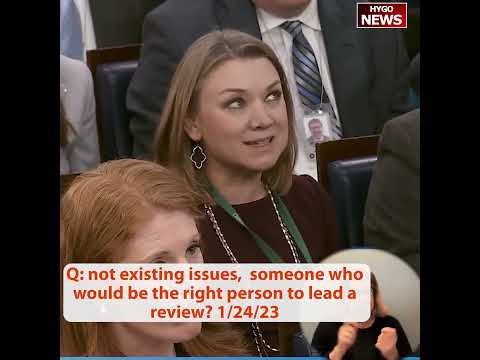
Reporter Asks About Broader Classification Review — KJP Refers Even Policy Review Question to Counsel
In January 2023, a reporter asked White House Press Secretary Karine Jean-Pierre a thoughtful forward-looking question about broader classified materials policy. “On documents, I realize you don’t want to comment on existing issues. But there is clearly an ongoing issue across administrations with handling of classified materials. Perhaps this isn’t the right time for this White House to lead a review of US policy on classified materials. But is that something that that the White House is considering? Is there someone who would be the right person to lead a review of the current challenges that are obviously tripping up people from all parties?” the reporter asked. KJP’s response was predictable: “Understand the question and I know it’s going to come in many different ways but I’m going to refer you to the White House counsel’s office.” The classified materials problem was clearly systemic — affecting Trump, Biden, Pence — yet the administration wouldn’t even discuss potential review.
The Reporter’s Thoughtful Framing
The question was notably thoughtful. “I realize you don’t want to comment on existing issues. But there is clearly an ongoing issue across administrations with handling of classified materials,” the reporter said.
The framing:
Scope limited — Not existing issues.
Systemic issue — Acknowledged.
Across administrations — Bipartisan.
Policy question — Forward-looking.
Review proposal — Substantive.
By explicitly excluding existing issues from scope, the reporter was trying to get past KJP’s standard deflections. This was question about systemic policy rather than specific investigations.
”Clearly an Ongoing Issue Across Administrations”
The reporter correctly noted:
Trump issues — Documents at Mar-a-Lago.
Biden issues — Current situation.
Pence issues — Just discovered.
Obama-era issues — Some reported.
Systemic challenge — Clear.
The pattern was undeniable. Different administrations, different political parties, similar issues. This suggested systemic problem with how classified materials were handled during transitions.
”Perhaps This Isn’t the Right Time”
The reporter was diplomatic. “Perhaps this isn’t the right time for this White House to lead a review of US policy on classified materials,” the reporter said.
The diplomatic framing:
Timing acknowledged — Sensitive.
White House position — Considered.
Not demanding — Immediate.
Reasonable allowance — For circumstances.
Still asking — If considering.
The framing acknowledged that Biden administration was in awkward position to lead such review — currently under investigation for classified materials handling. But the diplomatic framing didn’t excuse not engaging with the systemic issue.
”But Is That Something the White House Is Considering?”
The core question. “But is that something that that the White House is considering?” the reporter asked.
The inquiry:
Administrative consideration — Asked.
Future policy review — Possible.
White House initiative — Potential.
Systemic response — To problem.
Policy leadership — Offered.
This was genuinely thoughtful policy inquiry. Was the administration thinking about broader response to the systemic issue? Would they initiate review? These were legitimate questions.
”Someone Who Would Be the Right Person”
The reporter suggested possibility. “Is there someone who would be the right person to lead a review of the current challenges that are obviously tripping up people from all parties?” the reporter asked.
The suggestion:
Review leader — Potential.
“From all parties” — Bipartisan framing.
Systemic issue — Recognized.
Administrative action — Possible.
Concrete proposal — Essentially.
The reporter was essentially proposing that someone should lead a review. This was constructive policy suggestion rather than confrontational question. It invited administration to respond constructively.
The Deflection Anyway
KJP deflected despite thoughtful question. “Understand the question and I know it’s going to come in many different ways but I’m going to refer you to the White House counsel’s office,” KJP said.
The deflection:
Question acknowledged — Intellectually.
“Many different ways” — Pattern noted.
Standard deflection — Deployed.
Counsel referral — Again.
No engagement — With substance.
Even thoughtful policy questions got the Counsel referral. This showed the comprehensive nature of the deflection strategy. Literally any classified materials topic was deflected.
The Systemic Problem Reality
The systemic problem was real:
Classification overuse — Documented concern.
Transition procedures — Inadequate.
Individual accountability — Unclear.
Training gaps — Real.
System design flaws — Evident.
Multiple presidents and VPs had ended up with classified materials. This wasn’t coincidence or individual failure — it was systemic issue. Addressing it through policy review was reasonable.
The Over-Classification Problem
Over-classification was widely recognized:
Too much classified — Experts agreed.
Routine markings — Overused.
Quality reviews — Lacking.
Cost burdens — Significant.
Declassification — Inefficient.
Government reviewers, academic experts, and various officials had noted over-classification for years. The recent incidents were partially byproduct of this systemic issue.
The Transition Process Issues
Presidential/VP transitions had issues:
Quick timing — After loss/success.
Various materials — Accumulated.
Packing rushed — Sometimes.
Oversight limited — During transition.
Tracking difficult — For all materials.
The transition process itself was challenging for classified document handling. Systems for ensuring everything was properly transferred had gaps. This was area where systematic improvement was possible.
The Political Environment for Review
Political environment made review difficult:
Active investigations — Of multiple figures.
Partisan tensions — High.
Credibility questions — For administration.
Policy attention — On current issues.
Future review — Politically awkward.
The current environment made policy review challenging. Any review led by Biden administration would face credibility questions. But waiting for investigation conclusion could take years. Some approach was needed.
”In Many Different Ways”
KJP acknowledged question patterns. “I know it’s going to come in many different ways,” KJP said.
The acknowledgment:
Pattern recognized — Explicitly.
Reporter adaptation — To deflections.
Different framings — Tried.
Question variations — Expected.
Deflection consistent — Regardless.
KJP was essentially saying that regardless of how reporters framed classified documents questions, she would deflect. This was honest about her approach while defending it.
The Counsel’s Office Policy Role
Was Counsel appropriate destination?
Counsel = legal advisor — To president.
Not policy review — Leader.
Investigation related — Only.
Systematic review — Different.
Wrong referral — Arguably.
Counsel’s office wasn’t actually appropriate for policy review questions. Their role was legal advice, not policy leadership. Referring policy question to Counsel was procedurally incorrect but rhetorically effective.
The Policy Leadership Question
Who could lead policy review:
ODNI — Director of National Intelligence.
National Security Council — Cross-agency.
Congressional Committees — Intelligence.
Academic experts — External.
Ombudsman figures — Various.
Multiple possible review leaders existed. The reporter’s question was asking administration to identify who they thought would be appropriate. Various legitimate options existed.
The Administrative Decision
Administration had apparently decided:
Not engage — With policy questions.
Not propose — Review.
Not discuss — Systemic issues.
Wait — For investigation conclusions.
React — Rather than lead.
The decision to not lead on policy response to systemic issue was itself significant. Leadership on classification policy would have been responsive governance. Not doing so was passive approach.
The Lost Opportunity
The opportunity being lost:
Constructive policy response — To situation.
Administrative leadership — On systemic issue.
Potential bipartisan — Cooperation.
Long-term improvement — Of system.
Legacy opportunity — For Biden.
Biden could have turned the situation into opportunity for systemic improvement. Leading classified materials review could have been legacy contribution even if Biden’s own case produced no prosecution. This was being passed up.
The Congressional Alternative
If administration wouldn’t lead:
Congressional action — Possible.
Committee reviews — Available.
Legislation — Conceivable.
Oversight function — Natural.
Alternative leadership — Exists.
Congress could lead classified materials policy review. The Intelligence Committees had authority. House and Senate could initiate reviews. Administrative silence didn’t prevent this but meant administration wouldn’t be shaping response.
The Public Interest
Public interest was served by review:
System improvement — Serves everyone.
Prevention of incidents — Beneficial.
Accountability structures — Better.
Oversight enhanced — Democratic function.
Policy learning — Valuable.
The public interest in systematic review was clear. Current system wasn’t working. Reviewing and improving it would serve everyone. Refusing to discuss was passive.
The Bipartisan Opportunity
The issue was genuinely bipartisan:
Both parties affected — By classification incidents.
Common interest — In system improvement.
Political incentives — Aligned.
Reform possibility — Real.
Cooperation available — In theory.
Classified materials handling wasn’t inherently partisan. Both parties had interest in improving system. Bipartisan policy review could have been achievable. Administration wasn’t pursuing this.
The Long-Term Policy Agenda
Biden’s policy legacy:
Infrastructure legislation — Major.
Inflation Reduction Act — Significant.
Chips Act — Important.
But classification reform — Could add.
Legacy opportunity — Being missed.
Adding classification reform to Biden’s policy legacy would have been straightforward win. The current approach was leaving this potential contribution unmade.
The Media Function
Media pushing for policy engagement:
Reporter questions — Pressing.
Policy framing — Attempted.
Constructive approach — Offered.
Administrative silence — Met.
Coverage — Of absence.
The media was trying to elicit policy response. Administration silence meant coverage was about silence rather than substance. This was another opportunity cost of the deflection approach.
The Academic Perspective
Academic analysis:
Classification studies — Extensive.
Policy recommendations — Many.
Reform proposals — Numerous.
Expert consensus — Some.
Implementation — Rarely.
Academic literature on classification policy was extensive. Multiple expert reviews had made recommendations. Implementation had been limited. A policy review could have built on existing academic work.
The GAO Involvement
Government Accountability Office role:
Audit function — Authority.
Reports issued — Various.
Recommendations — Many.
Implementation — Variable.
Future reviews — Likely.
GAO had done reviews of classification systems. Their work could inform administrative policy response. Building on existing GAO work would have been natural starting point.
The International Dimension
International dimensions:
Allied intelligence sharing — Affected.
Foreign partner concerns — Real.
System reliability — Questioned.
International cooperation — Important.
Global implications — Present.
U.S. classification system had international implications. Allied partners shared intelligence based on U.S. classification integrity. System problems affected international relations.
The Historical Attempts
Previous reform attempts:
Clinton administration — Some effort.
Obama administration — Some reforms.
Bush administration — Limited.
Reagan-era — Historical.
Mostly unsuccessful — Overall.
Classification reform had been attempted multiple times. Most efforts had produced limited results. Systemic nature of issue made reform difficult. But need for reform wasn’t disappearing.
Key Takeaways
- A reporter asked KJP a thoughtful forward-looking question about whether the White House might lead review of classified materials policy given systemic issues across administrations.
- The reporter diplomatically acknowledged this “isn’t the right time” while asking if it was being considered.
- KJP deflected: “Understand the question and I know it’s going to come in many different ways but I’m going to refer you to the White House counsel’s office.”
- The deflection to Counsel for a policy review question was procedurally inappropriate — Counsel handles legal matters, not policy leadership.
- The exchange highlighted lost opportunity for Biden administration to lead constructive response to systemic classified materials handling issues.
- The issue was genuinely systemic — affecting Trump, Biden, Pence, and potentially others — but administration wouldn’t engage with policy dimension.
Transcript Highlights
The following is transcribed from the video audio (unverified — AI-generated from audio).
- On documents, I realize you don’t want to comment on existing issues.
- But there is clearly an ongoing issue across administrations with handling of classified materials.
- Perhaps this isn’t the right time for this White House to lead a review of US policy on classified materials.
- But is that something that that the White House is considering?
- Is there someone who would be the right person to lead a review of the current challenges that are obviously tripping up people from all parties?
- Understand the question and I know it’s going to come in many different ways but I’m going to refer you to the White House counsel’s office.
Full transcript: 109 words transcribed via Whisper AI.