 HYGO News
 Q: new exciting thing solid legal footing? lawsuits challenging as well? A: authority crystal clear
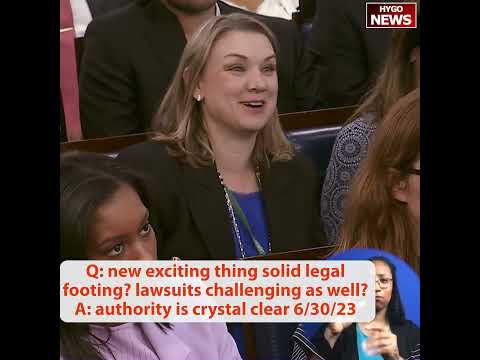
Is the SAVE Plan on Solid Legal Footing? White House Says Authority Is “Crystal Clear”
On June 30, 2023, with the wreckage of the student loan forgiveness program still fresh from the Supreme Court’s 6-3 ruling that morning, a reporter asked the obvious next question: would the administration’s alternative plan — the new SAVE income-driven repayment program — survive the same kind of legal challenges? Deputy NEC Director Bharat Ramamurti expressed unequivocal confidence that the program’s legal authority was “crystal clear,” a prediction that would prove overly optimistic as courts later moved to block key provisions of the SAVE plan.
Reporter Asks the Obvious Question
The reporter’s question reflected the natural skepticism that followed the administration’s legal defeat. The White House had spent months expressing confidence in the legality of the original forgiveness program, only to see it struck down decisively. Now, on the same day, officials were announcing a new program and asking the public to trust that this one was legally sound.
The reporter asked: “Are you on totally solid legal footing with the income-based repayment changes or could there be lawsuits challenging that as well?”
Ramamurti’s response was emphatic: “That authority is crystal clear. There is a specific statute allowing the Secretary to design these income-based repayment programs. And the specific details of this income-based repayment program are — are clearly within what’s permitted under the statute there. And so, we — I would be surprised, frankly, if there was a legal challenge to that proposal.”
The confidence was grounded in a genuine legal distinction. The forgiveness program had relied on the HEROES Act’s emergency powers — a statute the Court found did not authorize mass debt cancellation. The SAVE plan, by contrast, operated under the Higher Education Act, which explicitly grants the Secretary of Education authority to create income-contingent repayment plans. The administration believed this direct statutory authorization insulated the SAVE plan from the major questions doctrine that had sunk the forgiveness program.
Every Borrower Eligible, but Benefits Vary
A follow-up question probed the coverage of the new plan, asking how many people would be left out of the “exciting thing” the administration had just offered.
The reporter asked: “And you say it’s not a substitute, obviously, for debt forgiveness. Are there — and — and I think this is a known answer, so I’m sorry for even asking it — but, like, how big is the universe of people who don’t qualify for the income-based repayment who just aren’t going to be covered by this exciting thing you just offered?”
Ramamurti said the program’s eligibility was universal: “Every single borrower is eligible for this program. Now, the key is that if you’re an extremely high-income borrower, your income may be so high that the specific benefit, where you cap your payment at a percentage of your income, doesn’t actually benefit you because that percentage is still higher than what your monthly payment would be. But it — it stretches pretty far up the income spectrum.”
The answer revealed an important design feature of income-driven repayment. Unlike the forgiveness program, which had a hard income cutoff at $125,000, the SAVE plan was available to all borrowers regardless of income. However, its practical benefits diminished at higher income levels. A borrower earning $200,000 per year might find that 10 percent of their discretionary income still exceeded their standard monthly payment, making the income-driven option no cheaper than the default repayment plan.
For lower and middle-income borrowers, however, the SAVE plan offered substantial relief. Combined with the provision preventing balance growth during periods of reduced payments and the halving of undergraduate payment amounts, the program represented significant changes to the economics of student loan repayment.
The Legal Distinction That Mattered
The administration’s confidence in the SAVE plan’s legality rested on a straightforward argument: Congress had specifically authorized the Secretary of Education to create income-driven repayment programs under the Higher Education Act. This was not a case of stretching emergency powers to cover something never contemplated by the statute. The authority to design the terms of federal student loan repayment — including payment caps, interest subsidies, and eventual forgiveness timelines — was core to the Department of Education’s mandate.
The HEROES Act, which the administration had used to justify the broad forgiveness program, gave the Secretary authority to “waive or modify” student loan provisions during national emergencies. The Supreme Court had found that canceling $400 billion in debt went far beyond “waiving or modifying” anything — it was creating an entirely new program. The SAVE plan’s restructuring of repayment terms, by contrast, fell squarely within the kind of programmatic changes the Higher Education Act contemplated.
This distinction was legally meaningful but not legally bulletproof. The SAVE plan’s most aggressive provision — eventual forgiveness of remaining balances after 20 or 25 years of payments (reduced to 10 years for borrowers with small original balances) — blurred the line between restructuring repayment and creating de facto forgiveness. Critics would later argue that the administration was using the SAVE plan to achieve through the back door what the Supreme Court had prohibited through the front door.
The Prediction That Proved Wrong
Ramamurti’s statement that he would “be surprised, frankly, if there was a legal challenge” to the SAVE plan reflected either genuine confidence in the program’s legal footing or a calculated decision to project certainty to encourage borrower enrollment. In either case, the prediction did not hold.
In the months following the SAVE plan’s launch, Republican state attorneys general filed legal challenges arguing that the plan’s generous terms — particularly the accelerated forgiveness timeline for small-balance borrowers and the interest subsidy provisions — exceeded the Secretary of Education’s statutory authority. Federal courts issued injunctions blocking several key components of the program, leaving millions of borrowers in yet another period of uncertainty about the terms of their loan repayment.
The pattern was becoming familiar: the administration would announce student loan relief, express confidence in its legality, face legal challenges from Republican officials, and see courts block or limit the program. The cycle eroded borrower confidence in any promise of federal student loan reform.
The Background: Supreme Court Strikes Down Forgiveness
The SAVE plan discussion came in the immediate aftermath of the Supreme Court’s decision in Biden v. Nebraska. The Court’s 6-3 ruling found that the administration had overstepped its authority in using the HEROES Act to cancel up to $10,000 in student debt for borrowers earning under $125,000 (and up to $20,000 for Pell Grant recipients). Six Republican attorneys general had challenged the program, and the 8th U.S. Circuit Court of Appeals had blocked it in November 2022 before the Supreme Court took up the case.
The administration’s rapid pivot from the forgiveness program to the SAVE plan demonstrated that contingency planning had been underway for some time. The new program offered a different kind of relief — not outright cancellation, but fundamentally restructured repayment terms — and relied on a different legal authority. Whether that distinction would prove sufficient to survive judicial scrutiny remained to be seen.
Key Takeaways
- White House official Ramamurti said the legal authority for the SAVE income-driven repayment plan was “crystal clear” and he would be “surprised” by legal challenges — a prediction that proved incorrect as courts later blocked key provisions.
- The SAVE plan relied on the Higher Education Act’s direct authorization for income-driven repayment programs, a legally stronger foundation than the HEROES Act emergency powers the Court had just rejected for the forgiveness program.
- Ramamurti said every single borrower was eligible for the SAVE plan, though benefits diminished for high-income borrowers whose income-based payments would exceed their standard monthly amounts.
- The administration’s confidence echoed its earlier assurances about the forgiveness program’s legality, raising questions about whether officials were projecting certainty to encourage enrollment rather than accurately assessing legal risk.
- The exchange highlighted the emerging pattern of the administration announcing relief, expressing legal confidence, and then facing successful court challenges from Republican state attorneys general.