 HYGO News
 Q: Miscrosoft layoff A: layoffs remain near record lows
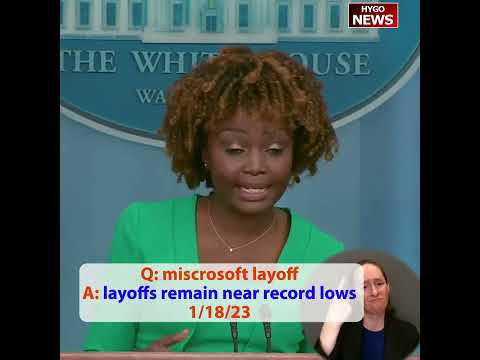
White House on Microsoft Layoffs: “Layoffs Remain Near Record Lows” — Deflects to Aggregate Data Amid Big Tech Cuts
In January 2023, a reporter asked the White House about Microsoft’s newly announced massive layoffs in the context of President Biden’s optimistic economic messaging. “The president has been quite optimistic in his latest statements about the possibility of a soft landing for the economy, but at the same time we also have massive layer of announcements like Microsoft just today. Is this a matter of concern for the White House?” the reporter asked. The White House spokesperson acknowledged the layoffs as something they “watch closely” and referenced Biden’s personal experience with job loss, but declined to comment on Microsoft specifically and pointed to aggregate data: “I don’t have a comment on specific moves announced by particular companies. As you know, we are very careful from here talking about private companies, but more broadly speaking, layoffs remain near record lows according to job openings data.” The response highlighted the tension between growing tech layoff headlines and the administration’s aggregate economic messaging.
The Microsoft Layoff Context
Microsoft had announced major layoffs in January 2023:
10,000 job cuts — Announced January 18, 2023.
~5% of workforce — Substantial percentage.
Broad cuts — Across functions and regions.
Severance costs — $1.2 billion charge.
Industry trend — Part of broader tech contraction.
The Microsoft layoffs were a significant corporate announcement. One of the world’s largest tech companies was cutting 10,000 jobs. The layoffs followed substantial cuts at Meta, Amazon, Twitter, Salesforce, and other tech giants. A broader tech industry contraction was underway.
The Soft Landing Messaging
Biden’s “soft landing” optimism was the reporter’s frame:
Economic positive messaging — Administration line.
Soft landing possibility — Biden’s claimed hope.
Avoiding recession — While reducing inflation.
Optimistic tone — Despite warning signs.
Presidential posture — Of confident leadership.
The Biden administration had been pushing the possibility that the Fed could engineer a “soft landing” — bringing inflation down without triggering a recession. This optimistic framing contrasted with concerns about rising unemployment, falling stock markets, and corporate layoffs.
The Specific Tension
The reporter highlighted the tension between Biden’s optimism and corporate reality:
Biden optimism — Soft landing possible.
Microsoft cuts — 10,000 jobs.
Pattern of tech layoffs — Across industry.
Workforce concerns — For affected workers.
Economic signal — Of broader challenges.
When the president was expressing optimism and a major tech company was cutting 10,000 jobs on the same day, reporters would naturally ask how these narratives fit together. The question was legitimate and reflected appropriate journalistic function.
”Something We Watch Closely”
The spokesperson’s opening was measured. “So that is something, as you know, that we watch closely,” the spokesperson said.
The framing:
“Watch closely” — Observer posture.
Not intervening — In private decisions.
Monitoring activity — Not action.
Awareness claim — Without response.
Appropriate administration role — For economic observations.
“Watching closely” was the standard administration phrase for acknowledging economic events without taking specific positions. It signaled attention while preserving distance. The phrase appeared in various contexts whenever economic developments were mentioned.
”Biden Knows Firsthand the Impact of Losing a Job”
The spokesperson invoked Biden’s personal experience. “Any time there are reports of Americans losing their jobs, President Biden knows firsthand the impact of losing a job and what that can have to your entire family,” the spokesperson said.
The personal experience reference:
Empathic framing — Biden understands.
Family impact — Emphasizing breadth.
Firsthand knowledge — From personal experience.
Humanizing response — Individual-focused.
Standard Biden brand — Working-class empathy.
Biden’s narrative about his father’s job difficulties had long been part of his political brand. Scranton upbringing, father telling him “Joey, a job is about a lot more than a paycheck, it’s about dignity” — these narratives positioned Biden as someone who understood economic hardship. Invoking them here was standard administration messaging.
”This Is Something He Knows and Understands Very Well”
The spokesperson doubled down on the empathy framing. “This is something that he knows and understands very well,” the spokesperson said.
The reinforcement:
Repetition — Of empathy claim.
Personal connection — Biden to affected workers.
Understanding positioning — President knows impact.
Emotional framing — Rather than policy.
Political deflection — To Biden’s brand rather than substance.
This approach — substituting empathy for policy specifics — was characteristic of administration responses to economic concerns. Rather than addressing specific economic indicators, the response pivoted to Biden’s understanding of hardship. This was emotionally valid but substantively thin.
”I Don’t Have a Comment on Specific Moves”
The spokesperson explicitly declined commenting on Microsoft. “I don’t have a comment on specific moves announced by particular companies. As you know, we are very careful from here talking about private companies,” the spokesperson said.
The specific deflection:
Company-specific refusal — On Microsoft.
“Very careful” — Describing administration approach.
Private companies — As category.
General practice — Not Microsoft-specific.
Appropriate restraint — Framed as policy principle.
There was legitimate reason for administration caution about commenting on private company decisions. Presidential commentary on specific corporate actions could:
Influence markets — Inappropriately.
Create liability — For statements.
Pick winners and losers — Among companies.
Politicize business decisions — Problematically.
Exceed appropriate executive role — In private economy.
So declining to comment specifically on Microsoft had defensible rationale. But reporters weren’t asking for market-moving judgments — they were asking about administration assessment of economic trends.
”Layoffs Remain Near Record Lows”
The spokesperson pivoted to aggregate data. “More broadly speaking, layoffs remain near record lows according to job openings data,” the spokesperson said.
The aggregate framing:
Layoff data — From BLS JOLTS survey.
Near record lows — Historically.
Broader context — For tech cuts.
Administration-friendly statistic — Chosen carefully.
Legitimate data point — But selective.
The claim had statistical basis. Aggregate layoffs in the U.S. economy had remained historically low through 2022. The JOLTS (Job Openings and Labor Turnover Survey) data did show layoffs near record lows.
The Statistical Context
The “near record lows” claim was true but required context:
Aggregate measure — Across whole economy.
Tech concentration — Cuts heavy in specific sector.
Timing issue — Recent cuts not yet in full data.
Distribution matters — Which workers affected.
Forward-looking concerns — Trend direction.
Aggregate layoff data captures lagging economic reality. When tech companies announced cuts in January 2023, those weren’t fully reflected in the JOLTS data yet. And even if aggregate numbers remained low, concentrated cuts in specific sectors created real distress for affected workers.
The administration was effectively using aggregate data to minimize specific sector concerns. This was defensible macro policy but insufficient for workers facing layoffs in concentrated industries.
The Sector Concentration Problem
Tech layoffs had specific characteristics:
High-skill workers — Not typical low-wage affected.
Specific geography — West Coast concentration.
Major companies — Visible brand-name employers.
Economic signal — About tech valuations.
Political significance — Tech industry’s role.
Aggregate data couldn’t capture what tech layoffs represented. These weren’t random workers losing jobs in a generally strong labor market — they were skilled workers in high-profile companies where mass layoffs signaled broader issues. The significance exceeded the numerical impact on aggregate statistics.
”We Are Very Careful From Here”
The spokesperson emphasized administration restraint. “As you know, we are very careful from here talking about private companies,” the spokesperson said.
The “from here” qualifier:
White House specifically — Not broader government.
Briefing context — In particular.
Official statements — Carefully managed.
Market sensitivity — Acknowledged.
Policy tradition — Of restraint.
The qualifier recognized that various other government officials — Treasury, Commerce, Labor — might comment on specific companies. But the White House podium was treated as especially consequential for market communication.
The Political Message Management
The spokesperson’s response showed careful message management:
Empathy framing — Biden understands.
Aggregate statistics — That favor administration.
Private sector restraint — Appropriate distance.
No policy specifics — On tech workers.
Standard deflection — To bigger picture.
Each element was chosen to manage the political impact of the Microsoft news. The response:
Didn’t acknowledge — Broader concern.
Didn’t offer — Specific policy.
Didn’t engage — With trend implications.
Maintained positive — Aggregate framing.
Protected Biden’s — Soft landing messaging.
The Tech Layoff Wave
Microsoft was part of a broader pattern. By January 2023:
Meta (Facebook) — 11,000 cuts announced November 2022.
Amazon — 18,000 cuts announced in early 2023.
Twitter — Major Musk-era reductions.
Salesforce — Thousands in January 2023.
Google — 12,000 cuts announced late January 2023.
The Microsoft cuts were one of many. Collectively, major tech companies had announced over 100,000 job cuts in the period. This was a significant industry event.
The administration’s reliance on aggregate data seemed increasingly strained as the tech layoff wave grew. At some point, sector-concentrated cuts would ripple through broader economic data, potentially changing the narrative.
The Messaging Limits
The exchange showed limits of administration economic messaging:
Aggregate focus — Had strong days.
Sector concerns — Required acknowledgment.
Specific workers — Needed attention.
Forward indicators — Couldn’t be ignored.
Narrative adjustment — Eventually needed.
Administrations could rely on aggregate data for a time, but major sector disruptions would eventually require engagement. The question was whether the administration would proactively adjust messaging or be forced to by accumulating evidence.
The Soft Landing Outlook
Biden’s soft landing optimism depended on things working out a specific way:
Inflation continuing — To decline.
Labor market — Remaining strong.
Consumer spending — Holding up.
No major shocks — External or internal.
Fed execution — Of monetary policy.
Tech layoffs weren’t inconsistent with a soft landing — they could even help moderate wage pressures. But they were also potential early signs of labor market weakening that could compound if broader economic conditions deteriorated.
The Biden Economic Narrative
Biden’s economic storytelling had established themes:
Job creation — Record numbers under his administration.
Unemployment low — Historic by some measures.
Wages rising — According to administration.
Manufacturing reshoring — CHIPS Act and infrastructure.
Green jobs — From Inflation Reduction Act.
These themes had some validity but faced specific challenges. Tech layoffs tested the narrative’s coherence. If the economy was so strong, why were major companies announcing massive cuts? The administration had answers but they required nuance that simple messaging didn’t capture.
Key Takeaways
- A reporter asked the White House about Microsoft’s announcement of 10,000 layoffs in light of Biden’s “soft landing” economic optimism.
- The spokesperson said “we watch closely” and invoked Biden’s personal experience: “President Biden knows firsthand the impact of losing a job.”
- They declined to comment on Microsoft specifically, citing standard practice: “We are very careful from here talking about private companies.”
- The spokesperson pivoted to aggregate data: “More broadly speaking, layoffs remain near record lows according to job openings data.”
- The response highlighted the tension between concentrated tech-sector cuts and aggregate economic data favored by the administration.
- Microsoft’s cuts were part of a broader tech layoff wave (Meta, Amazon, Google, etc.) that was increasingly straining the administration’s optimistic messaging.
Transcript Highlights
The following is transcribed from the video audio (unverified — AI-generated from audio).
- The president has been quite optimistic in his latest statements about the possibility of a soft landing for the economy.
- At the same time we also have massive layer of announcements like Microsoft just today. Is this a matter of concern for the White House?
- Any time there are reports of Americans losing their jobs, President Biden knows firsthand the impact of losing a job.
- I don’t have a comment on specific moves announced by particular companies.
- As you know, we are very careful from here talking about private companies.
- But more broadly speaking, layoffs remain near record lows according to job openings data.
Full transcript: 135 words transcribed via Whisper AI.