 HYGO News
 Q: message voters for better poll? A: we have been very clear, we understand what they're feeling
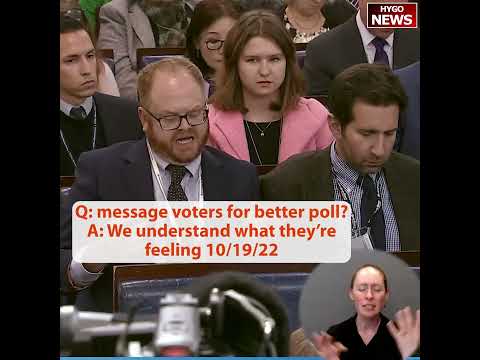
Pelosi Says Democrats Have a Messaging Problem on Inflation — KJP Insists “We Have Always Been Very Clear” as Polls Show Voters Favor GOP on Economy
On 10/19/2022, a reporter confronted White House Press Secretary Karine Jean-Pierre with House Speaker Nancy Pelosi’s own admission that Democrats “need to improve their messaging when it comes to inflation over the next three weeks before the midterms.” The reporter noted that polling showed voters concerned about inflation were “favoring Republicans over Democrats” and asked for the White House’s response. KJP insisted “we have always been very clear” and “we understand what they’re feeling” — a response that inadvertently proved Pelosi’s point by substituting empathy language for a substantive economic message.
Pelosi’s Admission
The reporter laid out the internal Democratic dissonance. “House Speaker Nancy Pelosi, in an interview posted today by Punchbowl News, said that Democrats need to improve their messaging when it comes to inflation over the next three weeks before the midterms,” the reporter said. “She calls inflation a ‘global issue’ and argues that because unemployment has decreased under Democrats and Biden, that inflation has gone up.”
Pelosi’s admission was significant because it came from the most senior Democratic officeholder in Congress — someone who had spent decades mastering political messaging. If Pelosi believed Democrats had a messaging problem on inflation three weeks before an election, the problem was real and severe. The Speaker was not prone to publicly airing her party’s weaknesses without reason.
Pelosi’s substantive argument — that low unemployment under Biden had caused inflation — was itself problematic. While there was an economic relationship between tight labor markets and price pressures, the framing implied that employment gains had caused the inflation Americans were suffering through, making it sound like prosperity was the problem. It was an argument unlikely to resonate with families paying 11% more for groceries.
”Voters Are Favoring Republicans”
The reporter connected Pelosi’s admission to polling data. “What’s your response to the Speaker of the House saying that there is a messaging issue, and that message is not getting out to voters right now, as indicated by polling that shows that voters that are concerned about the economy and inflation are favoring Republicans over Democrats?” the reporter asked.
The polling gap on economic trust was consistent and significant throughout the fall of 2022. Multiple surveys showed voters trusted Republicans over Democrats on the economy by margins of 10 to 20 percentage points. An October CBS/YouGov poll found 51% of likely voters trusted Republicans more on inflation compared to 33% for Democrats. A Fox News poll showed similar margins. Even an ABC News/Washington Post poll — traditionally more favorable to Democrats — showed a significant Republican advantage on economic issues.
The gap was not new or surprising. Republicans had historically held an advantage on economic trust. What made the 2022 numbers notable was the magnitude of the gap at a time when inflation was the dominant voter concern — and the party responsible for economic policy was the one voters trusted less on the issue.
”We Have Always Been Very Clear”
KJP’s response demonstrated the very problem Pelosi had identified. “As it relates to messaging: Look, we have always been very clear. The President has always been very clear,” KJP said.
The assertion was factually questionable. The White House’s economic messaging in 2022 had been anything but clear. It had cycled through multiple contradictory positions:
- Inflation was “transitory” (early 2021)
- Inflation was caused by supply chains (mid 2021)
- Inflation was “Putin’s price hike” (spring 2022)
- The economy was in a “transition to stable growth” (fall 2022)
- The economy was “strong as hell” (October 2022)
- Biden’s “top priority” was fighting inflation (throughout 2022)
- The Inflation Reduction Act would fix things (summer-fall 2022)
These messages were not “very clear.” They were a shifting collection of explanations and deflections that changed as previous messages became untenable. Claiming clarity in the face of this record was itself a form of unclear messaging.
”We Understand What They’re Feeling”
KJP then returned to the empathy language that had become her default. “We understand — I know you were talking about polls and what the American people are feeling. We understand what they’re feeling,” KJP said. “We understand that they are feeling a bit of a crunch, because of cost, because of inflation.”
The phrase “a bit of a crunch” was a notable minimization. Americans were not feeling “a bit of a crunch” — they were experiencing the worst inflation in 40 years, with cumulative price increases of 13% since Biden took office, real wages declining for 18 consecutive months, and a housing affordability crisis that had priced millions of first-time buyers out of the market. Describing this as “a bit of a crunch” was the kind of tone-deaf characterization that contributed to the messaging problem Pelosi had identified.
The repetition of “we understand” — used three times in a short response — had become a KJP verbal crutch. It was the equivalent of a doctor telling a patient “I understand you’re in pain” without prescribing treatment. Understanding without action is empathy without substance.
The Messaging vs. Reality Problem
The core issue was not messaging — it was reality. Pelosi framed the problem as one of communication: Democrats had good policies but were failing to convey them effectively. The alternative interpretation — that the policies themselves were the problem — was not one any Democrat was willing to voice publicly.
But the polling data suggested voters were not simply uninformed about Democratic economic policies. They were informed and disapproving. They had experienced 40-year-high inflation under Democratic governance, watched gas prices more than double before partially declining, seen their grocery bills surge, and felt their purchasing power erode. No amount of improved messaging could change the lived experience of paying significantly more for everything.
The assumption that better communication would change voter sentiment reflected a common political fallacy: the belief that disagreement stems from misunderstanding rather than genuine difference. Voters understood perfectly well that Democrats had signed the $1.9 trillion American Rescue Plan, that inflation had surged afterward, and that the Inflation Reduction Act’s name didn’t match its impact. The message was received; voters simply rejected the premise.
Pelosi’s “Global Issue” Defense
Pelosi’s attempt to frame inflation as a “global issue” was the Democratic Party’s longest-running defensive argument. It was true that inflation was elevated worldwide — Europe, the UK, and other major economies were also experiencing price pressures. But the argument had limitations.
U.S. inflation was higher than in many peer economies through much of 2022, and the U.S. had enacted significantly larger fiscal stimulus than most comparable countries. The American Rescue Plan was one of the largest pandemic spending bills in the world relative to GDP. The correlation between stimulus size and inflation severity undermined the “it’s global” defense.
Moreover, telling American voters that other countries also had inflation didn’t help them buy groceries. The “global” framing was analytically relevant but politically useless — it explained why inflation existed without offering any comfort to the families experiencing it.
Three Weeks Before Midterms
The timing of this exchange — three weeks before the November 2022 midterms — added urgency. With 21 days until Election Day, Pelosi was acknowledging that Democrats hadn’t figured out how to talk about their biggest political liability. The White House was still defaulting to “we understand” and “we’ve been very clear.” And polling showed voters had already made up their minds on who they trusted more on the economy.
The midterm results would show that Democrats’ decision to emphasize abortion, democracy, and anti-MAGA messaging over economic defense was the correct strategic calculation. But the economic trust gap remained — voters who cited the economy as their top concern broke heavily Republican.
Key Takeaways
- Pelosi admitted Democrats needed to “improve their messaging” on inflation three weeks before the midterms — a remarkable public acknowledgment of strategic failure.
- KJP insisted “we have always been very clear” despite the White House cycling through multiple contradictory economic messages throughout 2022.
- She described families’ economic pain as “a bit of a crunch” — minimizing the worst inflation in 40 years.
- Polling showed voters trusted Republicans over Democrats on the economy by 10-20 percentage points across all major surveys.
- The “messaging problem” framing assumed voters misunderstood Democratic policies rather than understood and rejected them.
Transcript Highlights
The following is transcribed from the video audio (unverified — AI-generated from audio).
- Pelosi said Democrats need to improve their messaging when it comes to inflation over the next three weeks before the midterms.
- She calls inflation a global issue and argues that because unemployment decreased, inflation has gone up.
- Voters concerned about the economy and inflation are favoring Republicans over Democrats.
- As it relates to messaging, we have always been very clear. The President has always been very clear.
- We understand what they’re feeling. We understand that they are feeling a bit of a crunch because of cost, because of inflation.
- I know you were talking about polls and what the American people are feeling.
Full transcript: 171 words transcribed via Whisper AI.