 HYGO News
 Trump: 'Sometimes You Have to Take Medicine'; 'Unless We Solve the Trillion-Dollar Trade Deficit, I'm Not Making a Deal'
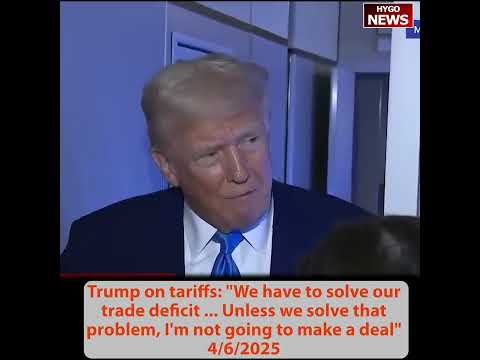
Trump: “Sometimes You Have to Take Medicine”; “Unless We Solve the Trillion-Dollar Trade Deficit, I’m Not Making a Deal”
President Trump addressed the post-Liberation Day market turbulence in April 2025 with characteristic bluntness. When asked about market pain, he called the question “so stupid” and said: “Sometimes you have to take medicine to fix something.” He revealed the scale of the China trade deficit — “a trillion dollars” — and declared: “Unless we solve that problem, I’m not going to make a deal.” Trump said the U.S. “can’t lose $1.9 trillion on trade and also spend a lot of money on NATO to protect European nations — the whole thing is crazy.” He added that the world’s biggest tech CEOs told him over the weekend: “We don’t blame you."
"Your Question Is So Stupid”
The exchange that produced the most-replayed moment came from a reporter’s question about market tolerance.
“Is there pain in the market at some point you’re unwilling to tolerate — this idea of a Trump put, is there a threshold?” the reporter asked.
Trump’s response was immediate: “I think your question is so stupid.”
He then provided the substantive answer: “I don’t want anything to go down. But sometimes you have to take medicine to fix something.”
He assigned blame: “We have been treated so badly by other countries because we had stupid leadership that allowed this to happen. They took our businesses, they took our money, they took our jobs. They moved it to Mexico, they moved it to Canada, they moved a lot of it to China.”
He stated the trajectory: “And it’s not sustainable. We’re not going to do it.”
The “medicine” metaphor — the third medical analogy Trump had used since Liberation Day, following the surgical comparisons — was deliberate. Medicine was unpleasant but necessary. No one enjoyed taking it, but the alternative — allowing the disease to progress untreated — was worse. The market decline was the bitter taste of the medicine; the cure was a restructured trading system that would produce prosperity for decades.
”A Trillion-Dollar Trade Deficit with China”
Trump provided the most specific articulation of his negotiating position with China.
“When you look at the trade deficit that we have with certain countries — way over a billion per country,” he said. “With China, it’s a trillion dollars. We have a trillion-dollar trade deficit with China. Hundreds of billions of dollars a year we lose with China.”
His position: “And unless we solve that problem, I’m not going to make a deal.”
He expressed willingness to negotiate: “Now I’m willing to deal with China, but they have to solve their surplus. We have a tremendous deficit problem with China. They have a surplus of at least a trillion dollars a year. I think it’s like a trillion one. I want that solved.”
He noted the historical failure: “No other president’s taking it on. I had to take it on the last time. And then we had a rigged election. No other president’s taking it on.”
The “not going to make a deal” unless the deficit was addressed was the clearest statement of Trump’s negotiating floor. Previous administrations had negotiated trade deals with China that addressed specific complaints — intellectual property theft, currency manipulation, market access — without fundamentally reducing the trade deficit. Trump was saying those incremental deals were not sufficient. The deficit itself had to shrink, and any deal that did not accomplish that was not worth making.
”$1.9 Trillion and NATO”
Trump connected the trade deficit to the NATO defense spending question in the most integrated argument he had offered.
“This is not sustainable,” he said. “The United States can’t lose $1.9 trillion on trade.”
He added the military dimension: “And also spend a lot of money on NATO in order to protect European nations. We cover them with military, then we lose money on trade. The whole thing is crazy.”
He cited his mandate: “And I got elected on that basis. We explained it. You know, the American people understand it a lot better than the media. But the media understands it. And much of the media writes correctly about it, I must say.”
The $1.9 trillion figure represented the annual global trade deficit — the total amount the United States imported in excess of what it exported. When combined with the hundreds of billions spent on military protection for allies who simultaneously ran trade surpluses against the U.S., the total outflow was staggering. America was simultaneously subsidizing other countries’ security and their trade surpluses — paying twice for the privilege of being taken advantage of.
”$7 Trillion Already Committed”
Trump countered the market narrative with the investment data.
“As you know, because of the tariffs, we have $7 trillion already committed to be invested in the United States,” he said. “Building auto plants, building chip companies, and all sorts of companies are coming into our country at levels that we’ve never seen before.”
The comparison: “Biden had nothing coming. This was a dead country with Biden. We didn’t know what he was doing. And that’s now been proven, at least.”
The $7 trillion figure had escalated from the $4 trillion cited weeks earlier, reflecting the continued flow of investment announcements. Each new commitment — from Hyundai, TSMC, Apple, Nvidia, and dozens of others — was evidence that the corporate world, whatever the stock market was doing on any given day, was making long-term bets on the Trump economic environment.
”We Don’t Blame You”
Trump revealed private conversations with technology executives.
“I talked to the biggest in the world,” he said. “I talked to the biggest of them all. Many of them. But I’ve talked to, I would say, four or five that are considered the biggest.”
Their message: “You know what they said? ‘We don’t blame you.’”
The “we don’t blame you” from tech CEOs was significant because the technology sector was often characterized as opposed to tariffs. If the world’s largest technology companies — whose supply chains depended on global manufacturing — were privately telling the president they understood and did not blame him for the tariff policy, the public narrative about universal corporate opposition was overstated.
The CEOs’ private support versus the market’s public selling illustrated the disconnect between short-term trading and long-term strategy. Traders sold stocks based on daily news; CEOs committed billions based on decade-long plans. The traders were reacting to tariff headlines; the CEOs were responding to the underlying business environment the tariffs were creating.
”Open to Talking”
Trump concluded with his negotiating posture.
“I do want to solve the deficit problem that we have with China, with the European Union, and other nations,” he said. “And they’re going to have to do that. And if they want to talk about that, I’m open to talking. But otherwise, why would I want to talk?”
The formulation was precise. Trump was not seeking negotiations for their own sake. He was seeking specific outcomes — reduced deficits — and was willing to negotiate only with parties who were prepared to deliver those outcomes. The tariffs were the default position; negotiations were the opportunity to change that default. Countries that wanted tariff relief knew exactly what they needed to offer.
Key Takeaways
- Trump called a market pain question “so stupid” and said: “Sometimes you have to take medicine to fix something.”
- He revealed a trillion-dollar trade deficit with China: “Unless we solve that problem, I’m not going to make a deal.”
- The combined complaint: “Can’t lose $1.9 trillion on trade and spend on NATO to protect European nations. The whole thing is crazy.”
- $7 trillion in investment already committed: “Building auto plants, chip companies — at levels never seen before.”
- World’s biggest tech CEOs privately told Trump: “We don’t blame you.”