 HYGO News
 Q: legally sound A: all lawyers reviewed new plan, they did same for HEROES Act, Supreme Court wrong
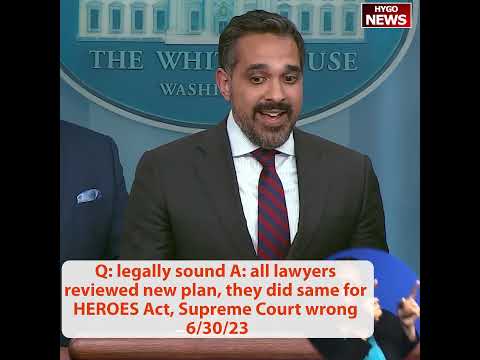
Reporter Asks How New Plan Is “Legally Sound” — Ramamurti Admits Same Lawyers Approved the HEROES Act
On June 30, 2023, following the Supreme Court’s 6-3 ruling striking down Biden’s student loan forgiveness program, a reporter pressed Deputy National Economic Council Director Bharat Ramamurti on the President’s claim that the newly announced alternative plan was “legally sound.” Ramamurti’s answer inadvertently undermined the administration’s credibility: he confirmed that the same lawyers from the Department of Education, the White House, and the Department of Justice who had reviewed the new plan under the Higher Education Act were the same lawyers who had approved the HEROES Act approach that the Supreme Court had just struck down. The admission raised an obvious question: why should anyone trust these same lawyers’ legal analysis the second time around?
The Reporter’s Incisive Question
The reporter posed a simple but devastating question: “And the President said that this new plan is legally sound. How did you reach this conclusion? Did you do an analysis, or what exactly?”
The question went to the heart of the administration’s credibility on student loan policy. Biden had just spent over a year telling the American people that the HEROES Act gave him the authority to cancel $400 billion in student debt. That claim had been reviewed and approved by administration lawyers. And the Supreme Court had just said, in a supermajority opinion, that the administration was wrong.
Now the President was asking the public to believe that a different legal theory — using the Higher Education Act instead of the HEROES Act — was legally sound. The reporter was asking the obvious follow-up: on what basis should anyone believe this claim, given the administration’s track record?
Ramamurti’s Self-Defeating Answer
Ramamurti’s response was remarkably forthright in its implications, even if he did not seem to recognize the problem with what he was saying: “Lawyers from the Department of Education, from the White House, from the Department of Justice all reviewed this plan. They weighed in and believe that it was legally available.”
He then added the admission that destroyed the argument: “I should be clear that they did the same for the HEROES Act.”
In one sentence, Ramamurti had confirmed that the legal review process behind the new plan was identical to the legal review process that had produced the HEROES Act strategy — the strategy the Supreme Court had just found to be unlawful. The same lawyers, the same departments, the same process, the same conclusion that the action was “legally available.” And the last time those lawyers reached that conclusion, six Supreme Court justices disagreed.
Ramamurti then attempted to salvage the argument by blaming the Court: “And obviously, we ran into a Supreme Court that had a different view of things — frankly, a view that we believe is out of step with where the law is.”
The phrasing was remarkable. Rather than acknowledging that the Court’s interpretation of the law was, by definition, the authoritative interpretation, Ramamurti suggested that six justices of the Supreme Court were out of step with the law. In the American constitutional system, the Supreme Court is the final arbiter of what the law is. Claiming that the Court was “out of step” with the law was a logical impossibility — the Court defines the law.
”All the Relevant Attorneys”
Ramamurti concluded with an appeal to authority: “But we have the backing of all of the relevant attorneys here — from the Department of Justice, from the Department of Education, and from the White House — all believing that this is a valid pathway to providing debt relief to many borrowers.”
The appeal to “all the relevant attorneys” was meant to inspire confidence but achieved the opposite. These were not independent legal analysts providing an objective assessment. They were administration lawyers who served at the pleasure of the President and whose jobs included finding legal justifications for the President’s policy priorities. Their role was to find pathways that would support the administration’s goals, not to provide a dispassionate assessment of legal risk.
Moreover, the fact that the same attorneys had reached the same conclusion about the HEROES Act — a conclusion the Court had just rejected — meant that their legal judgment on student loan policy had been proven wrong in the most authoritative way possible. Citing their backing of the new plan was the equivalent of a doctor whose diagnosis was just proven incorrect assuring a patient that the second diagnosis used the same methodology.
The Circular Logic Problem
The exchange exposed a circular logic at the heart of the administration’s approach to student loan relief. The sequence was:
Step one: Administration lawyers determine the HEROES Act provides legal authority for mass debt cancellation. Step two: The Supreme Court rules 6-3 that the administration was wrong. Step three: The same administration lawyers determine the Higher Education Act provides legal authority for mass debt cancellation. Step four: The administration presents this as evidence that the new plan is “legally sound.”
The problem was that nothing in the process had changed. The same lawyers were using the same analytical framework and reaching the same type of conclusion. The only thing that had changed was the specific statute being cited. If the legal review process was flawed the first time — as the Supreme Court’s ruling demonstrated — there was no reason to believe it would produce a more reliable result the second time.
A more credible approach would have been to acknowledge that the HEROES Act strategy had been struck down, explain what the Court’s reasoning implied for alternative approaches, and describe how the new plan addressed the specific constitutional concerns the Court had identified. Instead, Ramamurti’s answer essentially said: the same people who were wrong before are confident they are right this time.
The Political Context
The exchange took place during a press briefing that followed Biden’s public remarks on the student loan ruling. The administration was under enormous pressure to demonstrate that it had not given up on student debt relief, particularly with the 2024 presidential election approaching. The “Plan B” announcement served a dual purpose: it kept the promise of relief alive for borrowers who were the target demographic, and it provided a campaign message that the President was continuing to fight.
The Supreme Court had ruled 6-3 in Biden v. Nebraska that the original $400 billion forgiveness program exceeded presidential authority under the HEROES Act. Biden had announced that program in August 2022, offering up to $10,000 for borrowers earning under $125,000 and up to $20,000 for Pell Grant recipients. Six Republican state attorneys general had challenged the program on separation of powers grounds, and the Court agreed that the administration had overstepped.
The new plan under the Higher Education Act would require a formal rulemaking process that administration officials acknowledged would take months. It would also face its own legal challenges, with opponents likely to argue that the same major questions doctrine that doomed the HEROES Act approach applied to any attempt at mass debt cancellation through executive action.
Key Takeaways
- A reporter asked how the new student loan plan was “legally sound,” and Ramamurti admitted that the same lawyers from DOE, DOJ, and the White House who approved the HEROES Act approach also reviewed the new plan.
- Ramamurti acknowledged these were the same lawyers who had determined the HEROES Act was legally available — a determination the Supreme Court had just overruled 6-3.
- He claimed the Court was “out of step with where the law is,” an assertion that contradicted the fundamental principle that the Supreme Court is the final authority on legal interpretation.
- The circular logic of the administration’s approach — the same review process, the same lawyers, the same type of conclusion — undercut the credibility of the “Plan B” legal analysis.
- The exchange occurred as the administration faced pressure to maintain the promise of debt relief heading into the 2024 election, despite the Court having found the original program unconstitutional.