 HYGO News
 Q: legal or public Transparency? A: you should reach out to the White House Counsel
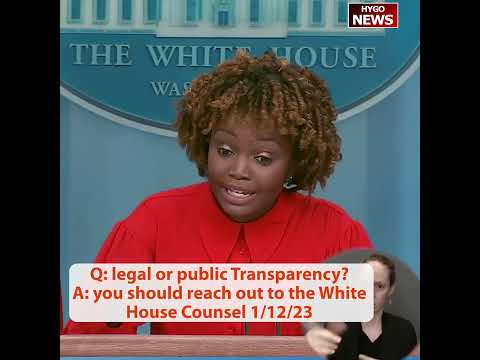
Reporter Pins Down Reach-Out Timeline: Archives First, Then DOJ — KJP Deflects to WH Counsel
On 1/13/2023, a reporter tried to clarify the specific agencies Biden’s team reached out to about classified documents. The reporter noted Attorney General Garland’s statement that “the attorneys reached out to the archives. It was only later in December when the second batch was apparently dropped. Then they were reaching out to the Justice Department.” White House Press Secretary Karine Jean-Pierre deflected: “I will leave it to what the Department of Justice is laying out. What we are saying that we reached out to the Archivist, we reached out to the Department of Justice.” She defended: “What has been transparent in this as well is that the White House Council has laid out in detail on Monday to all of you.” Then notably admitted: “First of all, I can’t talk about this.”
The Timeline Distinction
The reporter distinguished between:
First batch (Penn Biden Center) — Archives contacted.
Second batch (Wilmington) — DOJ contacted.
Different agencies — For different batches.
Garland’s statement — Confirming sequence.
Timing significance — Notable.
The specific timeline:
November 2, 2022 — Penn Biden Center discovery.
Archives notified — First.
December 20, 2022 — Wilmington discovery.
DOJ notified — Second.
Sequence established — By Garland.
The Agency Distinction
Archives vs. DOJ:
National Archives — Receives classified materials.
Department of Justice — Handles criminal investigation.
Different purposes — For contact.
Different processes — Followed.
Different implications — For political.
Each agency:
Archives: administrative — Routine.
DOJ: legal investigation — Serious.
Shift between — Significant.
Investigation elevation — Implied.
Public interest — In distinction.
The Garland Context
Attorney General Garland had spoken:
Morning press conference — Same day.
Announced Special Counsel — Hur.
Explained process — Publicly.
Some details shared — About timeline.
Administrative information — Provided.
Garland’s statement:
Archives contact — For first batch.
DOJ contact — For second batch.
Two different contact points — Clarified.
Professional process description — Standard.
Investigation justification — Provided.
The Reporter’s Clarification Pursuit
The reporter sought:
Timeline clarity — From White House.
Confirmation of Garland — Account.
Specific facts — About administration.
Substantive engagement — With timeline.
Public information — Sought.
The pursuit:
Professional clarification — Approach.
Standard inquiry — Procedure.
Fact-checking exercise — Essentially.
Accountability role — Performed.
Substantive question — Appropriate.
”I Will Leave It to What DOJ Is Laying Out”
KJP deferred to DOJ. “I will leave it to what the Department of Justice is laying out,” KJP said.
The deference:
DOJ owns the information — Administratively.
White House defers — Procedurally.
Standard deflection — To agency.
Legal separation — Maintained.
Substantive avoidance — Continued.
This deflection:
Administrative separation — Appropriate partially.
But White House knowledge — Must exist.
Coordination happens — Inevitably.
Full disclosure limits — Political.
Standard technique — For avoiding.
”We Reached Out to Archivist and DOJ”
KJP confirmed the contacts. “What we are saying that we reached out to the Archivist, we reached out to the Department of Justice,” KJP said.
The “we reached out”:
First-person administration — Acknowledgment.
Both agencies — Confirmed.
Sequential implication — Less clear.
Both contacts made — Established.
Standard framing — Of cooperation.
The framing:
Implicit sequence — Not explicit.
Both agencies — Contacted.
Timing unclear — In KJP’s words.
Generic confirmation — Of contacts.
Substantive detail — Avoided.
”The Right Thing to Do”
KJP repeated moral framing. “That is what is the right thing to do in this case,” KJP said.
“Right thing”:
Moral characterization — Standard.
Administration self-assessment — Repeated.
Political framing — Over legal.
Trump contrast implicit — Presumably.
Repeated across briefings — Pattern.
The “right thing”:
Required to some extent — Legally.
Discretionary to some extent — Possibly.
Political framing — As virtue.
Substantive avoidance — Through language.
Standard administration — Approach.
”White House Counsel Has Laid Out”
KJP referenced White House Counsel statements. “What has been transparent in this as well is that the White House Council has laid out in detail on Monday to all of you,” KJP said.
The WH Counsel reference:
Richard Sauber — Likely person.
Formal statements — Released.
Monday statement — January 9.
Public record — Created.
Administrative communication — Standard.
The “laid out in detail”:
Formal statement — Specific content.
Public record — Created.
Details provided — Some.
Questions remained — Many.
Limited scope — Of disclosure.
”First of All, I Can’t Talk About This”
KJP’s notable admission. “First of all, I can’t talk about this,” KJP said.
“I can’t talk about this”:
Notable admission — Of limits.
Legal constraints — Implied.
Administrative silence — Enforced.
Standard cover — For deflection.
Honest in some way — About limits.
The admission:
Revealed briefing limits — Directly.
Legal advice — To remain silent.
Political calculation — Maintained.
Substantive avoidance — Confirmed.
Pattern established — Explicitly.
The Archives vs. DOJ Significance
The agency distinction mattered because:
Archives: administrative — Records handling.
DOJ: criminal investigation — Possibly.
Different legal frameworks — Involved.
Different political implications — Obvious.
Escalation trajectory — Revealed.
The escalation:
From Archives — Administrative.
To DOJ — Potential criminal.
Automatic escalation — For classified.
Investigation warranted — At some level.
Special Counsel inevitable — Perhaps.
The Timeline’s Significance
The reported timeline:
November 2 — First discovery, Archives contacted.
Silence — Pre-midterm.
December 20 — Second discovery.
DOJ escalation — Then.
January 9 — Public disclosure.
Each event:
Had political implications — Real.
Raised transparency questions — Legitimate.
Required administrative response — Professional.
Generated media coverage — Sustained.
Built accountability pressure — Gradually.
The Transparency Defense
KJP’s “transparent” defense:
White House Counsel statements — Released.
Some information shared — Belatedly.
Public communications — Made.
Post-disclosure transparency — Only.
Limited temporal scope — Definitionally.
The defense:
Ignored pre-disclosure concealment — Selectively.
Claimed post-disclosure transparency — Technically.
Generic framing — Over substance.
Standard political — Messaging.
Pattern inconsistent — With prior conduct.
The WH Counsel Deflection Pattern
KJP deflected to:
White House Counsel — For details.
DOJ — For specifics.
Archives — For administrative.
Biden personally — Sometimes.
“Process” — Generically.
Each deflection:
Served briefing purposes — Different.
Avoided substantive — Engagement.
Standard administrative — Technique.
Political convenience — Maintained.
Pattern recognized — By observers.
The “I Can’t Talk About This” Admission
The admission’s significance:
Administrative silence — Confirmed.
Legal constraints — Acknowledged.
Press Secretary limits — Revealed.
Substantive avoidance — Explicit.
Honesty about restrictions — Somewhat.
The admission showed:
Coordination with lawyers — Strict.
Political calculations — Deliberate.
Substantive engagement — Constrained.
Standard crisis management — Pattern.
Limited transparency — Explicit.
The Agencies Involved
Classified documents case involved:
White House — Political management.
National Archives — Records custody.
Department of Justice — Criminal investigation.
Special Counsel — Independent investigation.
Congressional oversight — Potentially.
Each agency:
Had specific role — Defined.
Shared some information — Limited.
Maintained independence — Formally.
Created briefing complexity — For administration.
Served different functions — Distinct.
The Briefing Complexity
Multiple agencies meant:
KJP couldn’t speak — For all.
Deflections appropriate — To specific agencies.
Administrative structure — Used for cover.
Substantive engagement — Limited by structure.
Political management — Through agency separation.
The structure:
Served administrative function — Legitimately.
Also served political — Convenience.
Limited briefing scope — Appropriately sometimes.
Enabled substantive avoidance — Other times.
Standard modern — Briefing technique.
The Investigation Trajectory
The investigation trajectory:
Initial internal review — Biden lawyers.
Archives notification — Administrative.
Preliminary U.S. Attorney review — John Lausch.
Escalation to Special Counsel — Robert Hur.
Year-long investigation — Full.
Each step:
Increased seriousness — Of investigation.
Generated media coverage — Additional.
Raised political stakes — Gradually.
Signaled concerns — About documents.
Created accountability process — Formal.
The Administrative Position
The administration’s position:
Full legal cooperation — Claimed.
Limited public engagement — Practiced.
Legal strategy priority — Over political.
Political messaging — Managed carefully.
Crisis management — Ongoing.
The position:
Legally coherent — Generally.
Politically protective — Strategically.
Transparency claims — Strained.
Media engagement — Limited.
Standard crisis approach — Maintained.
The Transparency Promise Strain
The classified documents case strained:
Biden’s transparency promise — Central campaign commitment.
Administration credibility — Gradually.
Trump contrast — Weakened.
Base support — Somewhat.
2024 positioning — Complicated.
Each briefing:
Added to strain — On transparency claims.
Frustrated media — Consistently.
Built public skepticism — Gradually.
Damaged credibility — Incrementally.
Standard political cost — Of crises.
The Hur Investigation Preview
The Special Counsel investigation:
Just beginning — January 12.
Year-long ahead — Of administration.
Extensive examination — To come.
Political implications — Growing.
Report eventually — February 2024.
The investigation would:
Establish full timeline — Eventually.
Examine all administrative — Responses.
Interview witnesses — Many.
Produce findings — Detailed.
Affect politics substantially — Long-term.
The “Laid Out in Detail” Claim
The WH Counsel “laid out in detail”:
Some details shared — In formal statement.
Many questions remained — Unanswered.
Legal framing — Dominant.
Political strategy — Implicit.
Limited scope — Of detail.
What was laid out:
Some timeline elements — Basic.
Cooperation claims — Standard.
Agency contacts — Confirmed.
Legal compliance — Emphasized.
Public transparency — Less emphasized.
What remained unlaid:
Specific motivations — Of search.
Individual dates — Often.
Access patterns — Unknown.
Storage history — Unclear.
Chain of custody — To be examined.
The Standard Pattern
KJP’s pattern across classified docs:
Defer to DOJ — Standard.
Defer to Counsel — Routine.
Defer to Archives — Administrative.
“Laid out in detail” — Selectively.
Substantive avoidance — Consistent.
The pattern:
Fragmented responsibility — Administratively.
Limited briefing engagement — Substantively.
Maintained messaging discipline — Politically.
Frustrated reporters — Systematically.
Standard technique — Recognized.
The Eventual Hur Findings
The February 2024 Hur report:
Complete timeline — Established.
Administrative responses — Examined.
Biden knowledge — Documented.
Memory issues — Highlighted.
No charges — Recommended.
The report:
Answered timeline questions — Largely.
Revealed additional issues — Memory.
Damaged politically — Substantially.
Affected 2024 — Decisively.
Historical significance — Substantial.
Key Takeaways
- A reporter sought to clarify the timeline of agency contacts regarding Biden’s classified documents.
- Attorney General Garland had stated: Archives contacted for first batch, DOJ contacted only after second December discovery.
- KJP deferred to DOJ: “I will leave it to what the Department of Justice is laying out.”
- She confirmed generic contact: “We reached out to the Archivist, we reached out to the Department of Justice.”
- KJP made a notable admission: “First of all, I can’t talk about this.”
- The distinction between Archives and DOJ contacts signaled investigation escalation.
- The administration’s transparency claims were strained by repeated deflections.
- The Hur investigation would eventually establish the full timeline and examine administrative responses.
Transcript Highlights
The following is transcribed from the video audio (unverified — AI-generated from audio).
- The Archivist or the Justice Department?
- The Attorney General this morning said that the attorneys reached out to the archives. It was only later in December when the second batch was apparently dropped. Then they were reaching out to the Justice Department.
- I will leave it to what the Department of Justice is laying out.
- What we are saying that we reached out to the Archivist, we reached out to the Department of Justice.
- What has been transparent in this as well is that the White House Council has laid out in detail on Monday to all of you.
- First of all, I can’t talk about this.
Full transcript: 126 words transcribed via Whisper AI.