 HYGO News
 Q: layoffs, sales drop, inflation is back to 40-year highs? A: still seeing transition to stable
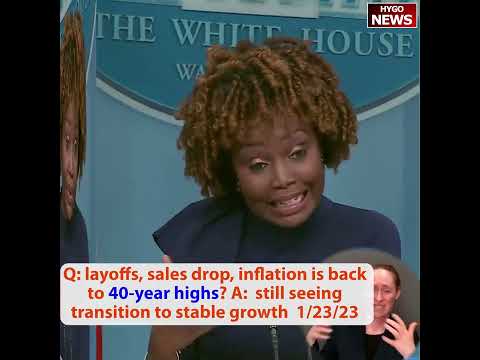
Reporter on Economy: Layoffs, Retail Drop, Inflation at 40-Year Highs — KJP: “Still Seeing Transition to Stable and Steady Growth”
In January 2023, a reporter confronted White House Press Secretary Karine Jean-Pierre with troubling economic indicators. “More companies are announcing layoffs. We’re seeing retail sales drop off for two months in a row now, and inflation is back to 40-year highs. Is this the stable growth that you’ve been talking about? And if not, when does that stable growth get here?” the reporter asked. KJP defended the administration framing: “Look, we are still seeing a transition to a stable and steady growth. That is what we are seeing when we look at the data.” On layoffs she deployed standard line: “Layoffs remain near record lows according to job opening data.” When pressed on when Americans would see stable growth, KJP pointed to CPI and PPI data showing inflation declining.
The Reporter’s Trio of Concerns
The reporter listed three economic issues:
Layoffs — Companies announcing.
Retail sales — Two months declining.
Inflation — 40-year highs.
Combined picture — Concerning.
Stable growth — Questioned.
These were three separate indicators suggesting economic weakness. Each had administration-favorable interpretations, but all three together painted concerning picture.
The Layoffs Context
January 2023 layoffs context:
Tech layoffs — Major wave.
Google, Microsoft, Amazon — Among cutters.
100,000+ affected — Collectively.
Spread to other sectors — Beginning.
Economic signal — Present.
The tech layoffs had expanded beyond single companies. Pattern was extending to other sectors. Salesforce, Goldman Sachs, and others had announced cuts. This was becoming broader pattern.
The Retail Sales Drop
Retail sales data:
December 2022 — Decline.
November 2022 — Also declined.
Two-month drop — Pattern.
Consumer weakening — Indicator.
Economic slowing — Signal.
Two consecutive months of retail sales decline was significant indicator. Consumer spending is 70% of U.S. economy. Sustained decline suggested consumer caution or weakness.
The Inflation Issue
Inflation context:
Peak 9.1% — Summer 2022.
Decline since — Continuing.
December 2022 — 6.5% CPI.
Still high — By historical standards.
“40-year highs” — Reporter’s framing.
The “40-year highs” framing might have been slight exaggeration — inflation had peaked in summer 2022 and was declining. But rates remained elevated by historical standards. The concern was valid even if framing was sharp.
”Transition to Stable and Steady Growth”
KJP deployed administration framing. “Look, we are still seeing a transition to a stable and steady growth. That is what we are seeing when we look at the data,” KJP said.
The framing:
“Transition” — Implies current state isn’t stable.
“Stable and steady” — Destination.
“Data shows” — Claim.
“We are seeing” — Confident assertion.
Time implied — Transition ongoing.
The “transition” framing was useful administratively. It acknowledged current state wasn’t stable while claiming trajectory was toward stability. The transition was indefinite — could last however long needed.
”Layoffs Remain Near Record Lows”
KJP used standard response. “I guess there are layoffs that you’re asking me about. And we’ve previously said on the broader economy, layoffs remain near record lows according to job opening data,” KJP said.
The response:
JOLTS data — Cited.
Near record lows — Aggregate.
Previous response — Referenced.
Standard template — Deployed.
Specific concerns — Aggregated away.
The JOLTS aggregate layoffs response was becoming standard deflection from specific layoff concerns. It was technically true but didn’t address concentrated sectoral concerns.
”Economic Plan That Is Working”
KJP asserted plan success. “This is an economic plan that is working. And a lot of it is because the president’s has taken bold steps,” KJP said.
The assertion:
Plan success — Claimed.
“Working” — Despite indicators.
Biden’s steps — Credited.
“Bold” — Characterization.
Administration framing — Positive.
The “plan is working” claim was defensive in context of reporter’s concerns. If plan was working, why were layoffs, retail drops, and inflation happening? The claim and evidence were in tension.
”When Does Stable Growth Get Here?”
The reporter pressed timing. “When can Americans see that stable growth you’re talking about?” the reporter asked.
The timing question:
Specific answer — Sought.
“When” — Temporal.
Americans’ experience — Not statistics.
Accountability — For projections.
Concrete commitment — Sought.
The reporter was pushing past abstract statements to concrete timing. When exactly would Americans feel the stable growth? This was question about real experience, not data point.
The CPI and PPI Reference
KJP pointed to data. “Well, I think you look at this, again, I pointed to the CPI data. I pointed to the PPI data where we have seen inflation coming down,” KJP said.
The data reference:
CPI — Consumer Price Index.
PPI — Producer Price Index.
Inflation declining — Per data.
Indicators improving — Claim.
“Let’s not forget” — Emphasis.
CPI and PPI did show inflation declining. This was real data supporting administration messaging. But it didn’t answer when stable growth would arrive — just that inflation was coming down.
The Inflation Decline Reality
Inflation decline was real:
Peak 9.1% June — 2022.
Down to 6.5% — December 2022.
Trajectory — Continuing decline.
Projection — Further decline.
Still above target — Fed 2% target.
The decline was real and substantial. However, inflation remained significantly above Federal Reserve’s 2% target. “Inflation coming down” didn’t mean “price stability achieved.”
The Aggregate vs. Specific Tension
The tension throughout:
Aggregate indicators — Sometimes favorable.
Specific sectors — Often not.
Administration framing — Aggregate.
Reporter framing — Specific.
Disconnect — Real.
The administration preferred aggregate framing. Reporters pressed specific concerns. Both were legitimate but showed different pictures. The administration couldn’t address specific concerns with aggregate data consistently.
The Consumer Experience
What Americans were experiencing:
High prices — Despite declining rate.
Retail pulling back — Some stores.
Employer uncertainty — Job market.
Wage pressure — From inflation.
Economic anxiety — Broad.
Consumer experience of the economy didn’t match administration’s positive framing. Most Americans felt the economy negatively despite aggregate indicators. This gap mattered politically.
The Polling Context
Political polling:
Biden approval — Low.
Economy rating — Negative.
Right track/wrong track — Wrong track majority.
Economic pessimism — Widespread.
Political implications — Significant.
Polling consistently showed Americans viewing economy negatively despite administration’s positive data. This was persistent disconnect that affected political prospects.
The Recession Question
Recession concerns:
Yield curve inverted — Recession indicator.
Leading indicators — Negative.
Forecasters — Divided.
Consumer sentiment — Weak.
Possible recession — Debated.
Many economists thought recession was likely in 2023. Administration was betting against this, claiming soft landing possible. The reporter’s concerns reflected recession possibility.
The “Bold Steps” Claim
Biden’s “bold steps”:
Infrastructure legislation — Major.
Inflation Reduction Act — Significant.
CHIPS Act — Important.
American Rescue Plan — Controversial.
Various executive actions — Multiple.
The legislation was real. Whether it was producing positive results was contested. Critics argued American Rescue Plan contributed to inflation. Supporters pointed to infrastructure investment. The evaluation was political.
The Job Market Paradox
Job market paradox:
Unemployment low — 3.5%.
Layoffs increasing — In some sectors.
Wages rising — Slowly.
Worker shortage — Continued.
Mixed signals — Overall.
The job market had contradictory indicators. Low unemployment but tech layoffs. Worker shortage but some layoffs. Administration cited positive elements; reporters cited concerning ones.
The Fed Policy Role
Federal Reserve policy affected economy:
Aggressive rate hikes — During 2022.
Continuing tightening — Into 2023.
Intended slowing — Of economy.
Side effects — Including layoffs.
Policy working — In some sense.
Fed tightening was specifically designed to cool economy. Layoffs were partly intended effect. The administration couldn’t easily criticize Fed moves while claiming economic success.
The 2024 Election Implications
For 2024:
Economy likely top issue — For voters.
Administration narrative — Positive.
Voter experience — Mixed.
Polling gap — Persistent.
Campaign challenge — Real.
The disconnect between administration claims and voter experience was political problem. If voters felt economy was bad despite administration claims, electoral consequences would follow.
The Messaging Strategy
Administration messaging strategy:
Emphasize positives — Aggressively.
Minimize negatives — When possible.
Look forward — To improvement.
Reference legislation — For credit.
Claim success — Persistently.
This was standard economic messaging approach. But with mixed indicators, the approach required repeated assertion against contrary evidence. Messaging discipline was apparent but effectiveness questionable.
The Recession Semantics
Recession semantics:
Technical definition — Two quarters negative GDP.
NBER declaration — More nuanced.
2022 mid-year — Had two negative quarters.
Not officially recession — Per NBER.
Current situation — Ambiguous.
Whether 2023 would produce “official” recession was question. The economy had elements of downturn even without official designation. The semantics mattered politically.
The Soft Landing Hope
Biden’s hope was soft landing:
Inflation — Comes down.
Unemployment — Stays low.
Growth — Slows but positive.
No recession — Avoided.
Fed success — In managing.
The soft landing scenario was possible but not guaranteed. If achieved, it would vindicate administration approach. If not, recession would be political problem.
The Long-Term Economy
Long-term economic picture:
Structural changes — Post-COVID.
Supply chain adjustments — Ongoing.
Labor market shifts — Continuing.
Technology disruptions — Accelerating.
Global factors — Complex.
The broader economic picture had long-term factors beyond immediate indicators. Administration couldn’t easily control these but would be held accountable politically.
Key Takeaways
- A reporter confronted KJP with three economic concerns: company layoffs, two-month retail sales decline, and 40-year-high inflation.
- The reporter asked if this was the “stable growth” the administration had been promising and when Americans would see it.
- KJP claimed: “We are still seeing a transition to a stable and steady growth. That is what we are seeing when we look at the data.”
- On layoffs, she deployed standard response: “Layoffs remain near record lows according to job opening data.”
- KJP defended administration record: “This is an economic plan that is working. And a lot of it is because the president’s has taken bold steps.”
- Asked when Americans would see the stable growth, she pointed to CPI and PPI data showing inflation declining — which addressed inflation but not other concerns.
Transcript Highlights
The following is transcribed from the video audio (unverified — AI-generated from audio).
- So more companies are announcing layoffs. We’re seeing retail sales drop off for two months in a row now, and inflation is back to 40-year highs.
- Is this the stable growth that you’ve been talking about? And if not, when does that stable growth get here?
- Look, we are still seeing a transition to a stable and steady growth. That is what we are seeing when we look at the data.
- Layoffs remain near record lows according to job opening data.
- This is an economic policy, an economic plan that is working. And a lot of it is because the president’s has taken bold steps.
- I pointed to the CPI data. I pointed to the PPI data where we have seen inflation coming down.
Full transcript: 190 words transcribed via Whisper AI.