 HYGO News
 Q: Judge's accusation similar to an Orwellian 'Ministry of Truth.'? A: not going to respond
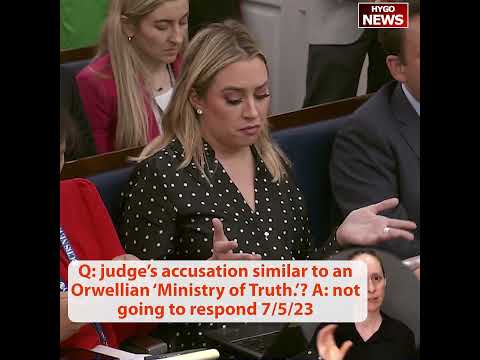
Federal Judge Compares Biden Admin to Orwellian “Ministry of Truth” — KJP Refuses to Respond
On July 5, 2023, Fox News White House correspondent Jacqui Heinrich asked Press Secretary Karine Jean-Pierre to respond to one of the most damning judicial characterizations of a presidential administration in modern history: a federal judge’s comparison of the Biden White House to an Orwellian “Ministry of Truth.” Jean-Pierre refused to address the comparison, deflecting to the Department of Justice and nearly mixing up the judge with the Attorney General in a verbal stumble that suggested she was operating on prepared talking points rather than engaging with the substance of the ruling.
The Ruling That Prompted the Question
The day before the briefing, Judge Terry Doughty of the U.S. District Court for the Western District of Louisiana issued a preliminary injunction in Missouri v. Biden, a case brought by the attorneys general of Missouri and Louisiana along with several individual plaintiffs including epidemiologists and media commentators. The ruling found that the Biden administration had engaged in a systematic campaign to pressure social media companies to suppress speech on topics the government found objectionable.
Judge Doughty’s 155-page opinion documented extensive contacts between administration officials and executives at Facebook, Twitter, YouTube, and other platforms. The evidence showed that government officials had flagged specific posts for removal, pressured platforms to change their content moderation policies, and threatened regulatory consequences for companies that did not comply with censorship requests.
The judge’s characterization was blunt and historical in its sweep. He wrote that the U.S. government “seems to have assumed a role similar to an Orwellian ‘Ministry of Truth’” and called the administration’s conduct “the most massive attack against free speech in United States history.” The reference to George Orwell’s 1984, in which a government agency called the Ministry of Truth controls information and rewrites history, was an extraordinary comparison for a sitting federal judge to make about a current administration.
Heinrich Asks the Question
Jacqui Heinrich began with a procedural question about whether the administration would appeal the injunction, then pivoted to the substance of the ruling.
“Will the administration be appealing the injunction, the ruling?” Heinrich asked.
Jean-Pierre provided a standard response: “I just said the DOJ is — is reviewing this injunction, and they’re going to look at — they’re going to evaluate their options. So, it’s for their decision to make.”
Heinrich then pressed on the judge’s most provocative language: “And then, can you just respond to the judge’s accusation that each topic suppressed by the administration was a conservative view? He had a pretty strong statement: The U.S. government ‘seems to have assumed a role similar to an Orwellian Ministry of Truth.’ Can you respond to that?”
The question contained two specific elements the White House needed to address: first, the finding that the censored topics were predominantly conservative viewpoints, and second, the “Ministry of Truth” comparison. Jean-Pierre addressed neither.
KJP’s Revealing Verbal Stumble
Jean-Pierre’s response contained a notable error: “I’m just not going to respond to the Attorney Gene- — or the judge. I’ll let the Department of Justice do that.”
The near-reference to the “Attorney General” before correcting to “the judge” suggested Jean-Pierre was operating from talking points that involved the Attorney General’s office rather than engaging with the reporter’s specific question. The stumble also raised a question about whether the White House was coordinating its response with the Department of Justice to such an extent that Jean-Pierre was conflating the two.
The substance of the refusal was more significant than the verbal slip. A federal judge had issued one of the strongest condemnations of government censorship in American legal history, comparing the administration’s behavior to a fictional totalitarian regime, and the White House press secretary’s response was simply that she would not respond. The DOJ would handle it.
What the Administration Chose Not to Defend
Jean-Pierre’s refusal to engage with either of Heinrich’s specific points — the targeting of conservative speech and the Ministry of Truth comparison — was itself an answer. In press briefings, administrations typically push back forcefully against characterizations they consider unfair or inaccurate. The White House had no trouble calling Supreme Court decisions “wrong” or labeling Republican policies “extreme.” The decision not to challenge a federal judge’s comparison of the administration to an Orwellian censorship regime suggested that the White House did not have a persuasive counter-argument.
The finding that suppressed topics were predominantly conservative views was particularly damaging. The evidence compiled in the case showed that administration officials had flagged content related to COVID-19 vaccine skepticism, the lab leak hypothesis for the virus’s origin, Hunter Biden’s laptop, mail-in voting concerns, and other topics where conservative and establishment viewpoints diverged. The pattern was difficult to explain as anything other than viewpoint-based censorship.
The White House’s standard defense — that it was merely flagging “misinformation” for private companies to evaluate independently — had been rejected by the judge, who found that the government’s communications amounted to coercion. Platforms that resisted government pressure faced implicit threats of regulatory action, antitrust enforcement, and changes to Section 230 liability protections.
The Broader Free Speech Implications
The Missouri v. Biden case, which would eventually reach the Supreme Court as Murthy v. Missouri, raised fundamental questions about the boundary between government persuasion and government censorship in the social media age. The First Amendment prohibits the government from restricting speech, but it does not clearly address situations where the government pressures private companies to restrict speech on its behalf.
Judge Doughty’s ruling drew that line aggressively, finding that the government’s contacts with social media companies constituted state action subject to First Amendment scrutiny. If the government cannot legally censor speech directly, the ruling held, it cannot achieve the same result indirectly by coercing private platforms to censor on its behalf.
The injunction barred officials from the White House, the Surgeon General’s office, the CDC, the FBI, CISA, and other agencies from communicating with social media companies for the purpose of influencing content moderation decisions. The breadth of the order reflected the breadth of the government’s censorship apparatus that the case had exposed.
The DOJ Appeal Path
The administration’s decision to route all responses through the DOJ was strategically sound from a legal perspective but politically damaging. The DOJ would indeed appeal the ruling, and the case would eventually reach the Supreme Court, where the justices would narrow the lower court’s findings on standing grounds. But the appeal process would take months, and in the meantime, the image of the White House refusing to defend itself against charges of Orwellian censorship dominated the news cycle.
Jean-Pierre’s “I’m just not going to respond” became a symbol of the administration’s posture on the censorship issue: acknowledge the ruling existed, express disagreement in the most general terms possible, and avoid engaging with any of the specific findings that made the ruling so damaging.
Key Takeaways
- Fox News correspondent Jacqui Heinrich asked KJP to respond to a federal judge’s comparison of the Biden administration to an Orwellian “Ministry of Truth” and his finding that suppressed topics were predominantly conservative views.
- KJP refused to address either point, saying “I’m just not going to respond to the judge” and deferring to the Department of Justice, while nearly calling the judge the “Attorney General” in a verbal stumble.
- Judge Doughty’s 155-page ruling in Missouri v. Biden found that the administration’s contacts with social media companies constituted “the most massive attack against free speech in United States history.”
- The White House’s refusal to challenge the judge’s specific findings — particularly the targeting of conservative viewpoints — was itself a notable non-denial that reporters recognized as significant.
- The case would eventually reach the Supreme Court as Murthy v. Missouri, but the administration’s immediate response of blanket refusal to engage left the “Ministry of Truth” characterization unchallenged in the public discourse.