 HYGO News
 Q: irrelevant! which programs reduce deficit? A: Biden policies reduce deficit
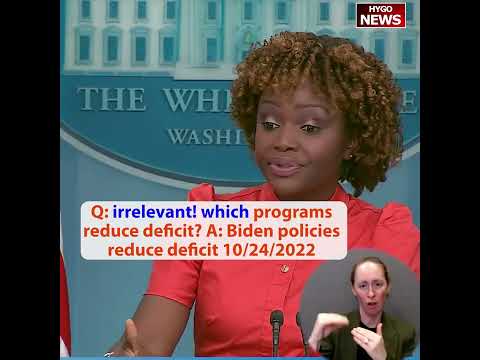
Reporter Asks KJP to Name One Biden Program That Reduced the Deficit — KJP Can’t Answer, Cuts Off the Question and Moves On
On 10/24/2022, Fox News reporter Jacqui Heinrich pressed White House Press Secretary Karine Jean-Pierre on Biden’s deficit reduction claims, calling them “sort of irrelevant.” When KJP insisted “the reduced deficit is real — $1.4 trillion,” Heinrich countered: “None of his programs have actually reduced the deficit. It just happened on its own.” KJP insisted “it is actually the policies that he has taken,” prompting Heinrich to ask the bottom-line question: “What is one thing he did that reduced the deficit? What is one program?” KJP could not name one. Instead, she said “Go ahead. Go ahead. Go ahead” — moving to the next reporter without answering.
”Sort of Irrelevant”
Heinrich challenged the premise of Biden’s most-repeated economic talking point. “Why doesn’t he lean more on some of that language than continuing to repeat this ‘we reduced the deficit’ thing that feels like, sort of, irrelevant?” Heinrich asked.
The characterization of Biden’s signature economic claim as “irrelevant” was not editorial opinion — it reflected how voters processed the message. When families were paying 13% more for groceries, gas, and rent than two years earlier, being told the federal budget deficit was smaller felt disconnected from their daily reality. Deficit reduction did not put food on tables, lower gas prices, or reduce mortgage rates.
The deficit talking point also suffered from a credibility problem: most voters didn’t believe it, and those who did understand it recognized it as largely automatic rather than the product of deliberate policy.
”The Reduced Deficit Is Real”
KJP pushed back with the administration’s standard response. “No, the ‘reduced deficit’ is real — $1.4 trillion. That’s what he talked about just last week. And that is historic as well. In one year, that’s what the President has been able to do,” KJP said. “Those are real numbers that matter as we talk about inflation, as we talk about the economy.”
The $1.4 trillion figure referred to the decline in the federal budget deficit from FY2021 to FY2022. The number was arithmetically correct — the deficit fell from approximately $2.8 trillion in FY2021 to approximately $1.4 trillion in FY2022, a reduction of roughly $1.4 trillion.
But citing the number without context was profoundly misleading. The FY2021 deficit of $2.8 trillion was inflated by pandemic-era emergency spending that was designed to be temporary — stimulus checks, enhanced unemployment benefits, PPP loans, and other one-time programs. These programs expired automatically, regardless of who was president. The deficit would have fallen by a similar amount under any president simply because the emergency spending ended.
Biden was taking credit for a mathematical inevitability — the wind-down of programs that were never meant to be permanent — and presenting it as the result of fiscal discipline.
”None of His Programs Have Actually Reduced the Deficit”
Heinrich delivered the factual challenge that KJP couldn’t rebut. “None of his programs have actually reduced the deficit,” Heinrich said. “It just happened on its own.”
The statement was accurate. Biden’s major legislative accomplishments — the $1.9 trillion American Rescue Plan, the $1.2 trillion Infrastructure Investment and Jobs Act, and the $740 billion Inflation Reduction Act — all represented new spending. The ARP added approximately $1.9 trillion to the deficit. The infrastructure bill was partially offset but still added to the deficit. The IRA’s projected $300 billion in deficit reduction over ten years was more than offset by the student loan forgiveness program’s estimated $400 billion to $1 trillion cost.
When you added up all of Biden’s legislative achievements, the net fiscal impact was deficit-increasing, not deficit-decreasing. The $1.4 trillion decline in the annual deficit occurred despite Biden’s policies, not because of them — it was the automatic wind-down of pandemic spending minus the new spending Biden signed into law.
”It Is Actually the Policies”
KJP attempted to maintain the fiction. “No, but it is actually the policies that he has taken that has helped reduce the deficit, dealing with middle-class families that you are not seeing currently — you’re not seeing currently from Republicans,” KJP said.
The response was notable for its vagueness. KJP cited “policies” without naming any. She referenced “dealing with middle-class families” without explaining how that reduced the deficit. And she pivoted to Republicans — “you’re not seeing currently from Republicans” — as a deflection from the question she couldn’t answer.
The sentence structure collapsed as KJP tried to connect deficit reduction to middle-class families to Republican alternatives, producing a response that was grammatically muddled and substantively empty.
”What Is One Thing?”
Heinrich asked the decisive follow-up. “What is one thing he did that reduced the deficit?” Heinrich asked. “What is one program?”
The question was perfectly constructed. It didn’t ask for a comprehensive list or a complex policy analysis. It asked for one thing — a single program, a single policy, a single action that Biden took that directly reduced the federal budget deficit.
KJP’s response: “Go ahead. Go ahead. Go ahead.”
She moved to the next reporter without answering. The non-answer was itself the answer — there was no program to name because the deficit reduction was not caused by any Biden program. It was caused by the automatic expiration of emergency pandemic spending.
The Deficit Talking Point’s Political Purpose
Biden’s deficit reduction claim served a specific political purpose despite its factual weakness: it allowed the president to counter Republican accusations of reckless spending. By claiming to have reduced the deficit by “$1.4 trillion — the largest deficit reduction in history,” Biden could respond to “big spender” attacks with what sounded like a powerful rebuttal.
The talking point appeared in virtually every Biden economic speech, every KJP briefing on the economy, and every Democratic campaign communication. Its ubiquity reflected not its strength but its necessity — Democrats needed something to say about fiscal responsibility, and the automatic deficit decline was the only number they had.
The problem was that the claim didn’t survive scrutiny. Every time a reporter — like Heinrich — asked the follow-up question, the claim crumbled. And the White House’s response to the crumbling was always the same: change the subject or cut off the question.
The Broader Context
The deficit, even at its reduced FY2022 level of $1.4 trillion, remained historically elevated. Before the pandemic, annual deficits were approximately $1 trillion — already high by historical standards. A $1.4 trillion deficit was not fiscal responsibility; it was a return to pre-pandemic levels of overspending that both parties had normalized.
The national debt had surpassed $31 trillion by late 2022 and was growing faster than GDP — a trajectory that CBO projections showed worsening over the coming decades due to entitlement spending, interest costs, and continued annual deficits. Claiming “historic deficit reduction” in the context of a $31 trillion debt was like celebrating a smaller credit card bill while the total balance continued to grow.
Key Takeaways
- Heinrich called Biden’s deficit reduction claims “sort of irrelevant” and asked KJP to name one Biden program that actually reduced the deficit.
- KJP could not name a single program, instead saying “go ahead” three times and moving to the next reporter.
- The $1.4 trillion deficit decline was caused by the automatic expiration of pandemic emergency spending, not by any Biden policy.
- Biden’s major legislative achievements — ARP, infrastructure, IRA, student loan forgiveness — all represented new spending that increased the deficit.
- The talking point served a political purpose but collapsed under any follow-up scrutiny, which the White House addressed by cutting off questions.
Transcript Highlights
The following is transcribed from the video audio (unverified — AI-generated from audio).
- Why doesn’t he lean more on some of that language than continuing to repeat this “we reduced the deficit” thing that feels like sort of irrelevant?
- The reduced deficit is real — $1.4 trillion. In one year, that’s what the President has been able to do.
- Those are real numbers that matter as we talk about inflation.
- It is actually the policies that he has taken that has helped reduce the deficit.
- I gotta move on because we don’t have a lot of space.
- Go ahead. Go ahead. Go ahead.
Full transcript: 138 words transcribed via Whisper AI.