 HYGO News
 Q: inflation vs student loan handout Holiday plans? A: confident, outrageous Republicans to block
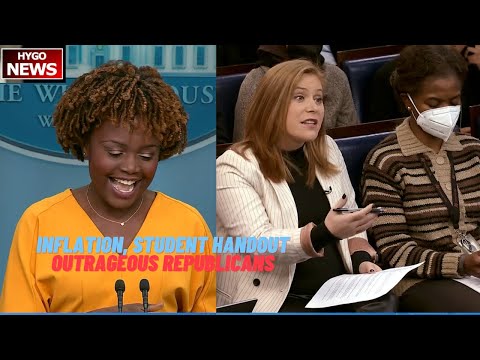
Reporter Asks If Administration Analyzed Inflationary Effects of Student Loan Forgiveness; KJP: “I Don’t Have Any Data to Share With You” — Calls Legal Challenges “Outrageous”
On 11/18/2022, a reporter pressed White House Press Secretary Karine Jean-Pierre on whether the administration had analyzed potential inflationary effects of Biden’s student loan forgiveness program — particularly given Federal Reserve Governor Christopher Waller’s comments that same week that “pay increases across the economy should slow because there’s too much money, essentially, in the economy.” KJP initially deflected, then admitted: “I don’t have any data to share with you on that particular question.” On the eve of the holiday season, with millions of borrowers uncertain about their financial futures, KJP called Republican legal challenges “outrageous, just outrageous” and said the White House was “confident in our legal authority.” The Supreme Court would strike down the program seven months later.
”Too Much Money in the Economy”
The reporter set up the inflation question carefully. “This is the same week that Fed Governor Christopher Waller had said that pay increases across the economy should slow because there’s too much money, essentially, in the economy. Are there concerns in the administration about the inflationary effects of student loan debt forgiveness?” the reporter asked.
The question linked two dots that the administration preferred to keep separate. The Federal Reserve was raising interest rates aggressively to reduce the amount of money in the economy — Waller’s comment was part of a broader Fed message about needing to cool demand to fight inflation. At the same time, the Biden administration was trying to forgive $400 billion to $1 trillion in student debt, which would effectively inject spending power back into the economy by freeing borrowers from debt service obligations.
The contradiction was obvious: the Fed was trying to reduce money in the economy to fight inflation, while the White House was trying to increase effective household spending power through debt forgiveness. These were directly opposing forces.
”Not Going to Comment”
KJP’s first attempt was a deflection. “When it comes to this particular federal official that you’re asking about, not going to comment, I’m in a situation,” KJP said.
The phrase “I’m in a situation” was a garbled attempt at some standard formulation — perhaps “I’m in no position to” or “I’m in a bind” — that collapsed into incoherence. The substance, however, was clear: KJP wouldn’t comment on Waller’s specific remarks, hiding behind the fiction that discussing a Fed governor’s public statements would violate Fed independence.
The reporter refused the deflection. “Specifically on the loans, has the administration analyzed any potential inflationary effects of student loan forgiveness?” the reporter asked, removing the Fed reference that KJP was using as an excuse.
KJP’s second attempt maintained the deflection. “Again, by making those comments, it’s kind of connected to what the federal office is,” KJP said — continuing to treat the question as if it were about Waller rather than about student loans.
The reporter’s frustration showed. “Okay, full-blown stop, nothing to do with the Fed. That’s the way you asked the question, so that’s the way I was answering the question. How has the administration analyzed any potential inflationary effects of student loan forgiveness, the plan that the administration has enacted?"
"I Don’t Have Any Data”
Cornered, KJP made the admission that defined the exchange. “It’s a good question that you’re asking, but look, the president has always — I don’t have any data to share with you on that particular question, but the president has been very clear,” KJP said.
“I don’t have any data to share with you” was an extraordinary admission. The student loan forgiveness program was one of the most expensive executive actions in American history, with cost estimates ranging from $400 billion to over $1 trillion. It was being implemented during the worst inflation in 40 years. The question of whether forgiving hundreds of billions in debt would worsen inflation was fundamental to evaluating the program’s wisdom.
The White House had no data to share on this question — either because they hadn’t analyzed it, or because they had analyzed it and didn’t want to share the findings. Either explanation was damning:
If they hadn’t analyzed it, the administration had designed and announced a policy of historic fiscal scale without examining its most obvious macroeconomic consequence.
If they had analyzed it and wouldn’t share the findings, the results were presumably unfavorable — confirming the intuition that debt forgiveness would worsen inflation.
Neither answer was compatible with sound policy process.
”Outrageous, Just Outrageous”
KJP pivoted from the inflation question to attacks on Republican legal challenges. “And it’s outrageous, just outrageous that Republican officials and special interest groups are trying to block that, are trying to make it harder,” KJP said.
“We are confident in our legal authority to carry out this program, and we won’t let these baseless lawsuits stop us either,” KJP added.
The “outrageous” characterization of legal challenges was difficult to square with reality. The challenges were being brought in federal courts by state attorneys general with arguable standing, based on constitutional arguments about the separation of powers and the limits of executive authority. Multiple federal judges — including those appointed by Democratic presidents — had found enough merit in the challenges to issue injunctions blocking the program.
Calling legitimate legal proceedings “outrageous” and “baseless” was typical Biden administration rhetoric about opponents. The characterization didn’t affect the actual legal proceedings — courts would evaluate the arguments on their merits regardless of White House complaints — but it created a political narrative framing the legal challenges as illegitimate attacks rather than normal constitutional review.
”26 Million People Already Applied”
KJP returned to her strongest talking point. “26 million people, borrowers already went to the website and filled out those applications. And so that tells you that this is a popular plan that matters to American people across the country,” KJP said.
The 26 million figure was meant to demonstrate widespread support, but it was an odd measure of popularity. Free money programs are always popular among those eligible to receive free money. Applying for a government benefit says nothing about whether the program is good policy, constitutional, or affordable. It only says that the benefit is large enough to motivate applicants.
The more relevant question — not addressed by KJP — was whether the 26 million who applied had been misled about the program’s legal viability. The White House had been telling borrowers throughout the fall that forgiveness was coming, while legal challenges were mounting and courts were beginning to block the program. The gap between administration promises and legal reality was creating false hope that millions of families were factoring into their financial planning.
”Should Americans Prepare for Relief Not Coming?”
A reporter asked the question millions of borrowers wanted answered. “Loans — should Americans at this point be prepared for the reality that the student loan forgiveness might be entirely blocked, or at the very least, should they prepare for the reality that it’s not likely they’re going to get relief by January 1st?”
KJP dodged. “So look, we are confident in our legal authority to carry out this program. Again, this is what we’re seeing here is what Republican officials are trying to do. They’re trying to block a plan that’s going to give relief to middle class Americans across the country.”
The reporter had asked for practical guidance borrowers could use for financial planning. KJP responded with political talking points about Republican opposition. Borrowers trying to figure out whether to budget for loan payments in January got no useful information from the briefing room.
The Supreme Court Question
A reporter asked about the 6-3 conservative majority on the Supreme Court. “But how confident is the White House that a Supreme Court with a 6-3 conservative majority is going to intervene on this matter?”
KJP’s response deflected from the question. “Look, what we’re saying to you is we are not going to walk away from this fight. The president is not going to walk away from this fight. We feel pretty confident in our legal authority.”
“Pretty confident” was not the same as “confident” — the hedge was telling. The White House was publicly projecting confidence while privately understanding the long odds of prevailing before a conservative-majority Supreme Court. The program would indeed be struck down in June 2023 in Biden v. Nebraska, by a 6-3 vote following the pattern KJP was being asked about.
Key Takeaways
- A reporter asked if the administration had analyzed student loan forgiveness’s inflationary effects; KJP admitted “I don’t have any data to share with you on that particular question.”
- The question came the same week Fed Governor Waller said there was “too much money in the economy” — the opposite of what student loan forgiveness would do.
- KJP called Republican legal challenges “outrageous, just outrageous” and “baseless” despite courts finding enough merit to issue injunctions.
- She cited 26 million applications as proof of popularity — a measure that conflated eligibility-based application rates with policy merit.
- The Supreme Court struck down the program in June 2023 in a 6-3 decision, following the conservative majority pattern KJP declined to address.
Transcript Highlights
The following is transcribed from the video audio (unverified — AI-generated from audio).
- Fed Governor Christopher Waller said pay increases should slow because there’s too much money in the economy.
- Are there concerns about the inflationary effects of student loan debt forgiveness?
- I don’t have any data to share with you on that particular question.
- It’s outrageous, just outrageous that Republican officials are trying to block that.
- We are confident in our legal authority to carry out this program.
- 26 million people already went to the website and filled out those applications.
Full transcript: 850 words transcribed via Whisper AI.