 HYGO News
 Q: I’m having a hard time understanding why A: Again, I will refer you to the White House Counsel
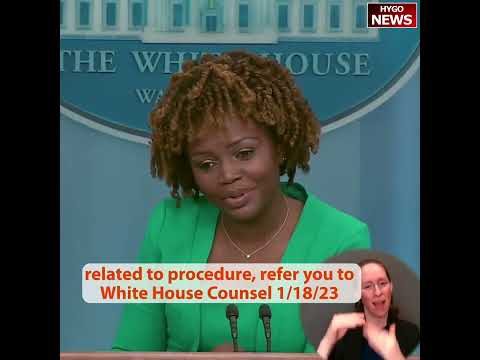
KJP Confirms Total Blackout on Biden Classified Docs Questions — Reporter Asks “Are You Not Going to Be Taking Questions About This?”
In January 2023, a reporter pressed White House Press Secretary Karine Jean-Pierre for clarity on whether she would take any questions at all about President Biden’s classified documents situation. “So just to be clear from this point on, are you not going to be taking questions about the classified documents?” the reporter asked directly. KJP’s response effectively confirmed a total blackout split between two deflection destinations: “I have been very clear over and over again. We are going to be prudent here. We’re going to be consistent. This particular matter is being looked at. There’s a legal process currently happening at the Department of Justice. And I’m going to refer you to the Department of Justice on any specifics to this particular case and anything that has to deal with what we’re doing here. I would refer you to the White House Counsel’s office.” The dual-deflection effectively meant there was no question KJP would answer herself — everything would go to either DOJ or Counsel.
”I’m Having a Hard Time Understanding Why”
The exchange began with a reporter expressing frustration. “I mean, I’m having a hard time understanding why,” the reporter said.
The statement was a response to earlier deflections on procedural questions. The reporter had been trying to ask about:
Process review — Following the classified docs incident.
Procedure questions — Not investigation-specific.
Administration review — Of its own handling.
Standard Operating Procedures — Going forward.
Biden’s satisfaction — With existing protocols.
These were process-focused questions that shouldn’t have required DOJ deflection. The reporter’s inability to understand why even these were being deflected reflected legitimate confusion about KJP’s expansive interpretation of what was off-limits.
The Garbled KJP Response
KJP’s verbal response contained stumbling. “I just said questions about we should see your wish and I just said and I just said to you The White House Counsel’s office will be able to address that question,” KJP said.
The transcript shows verbal difficulty:
“We should see your wish” — Likely mistranscription or garbled phrase.
Triple “I just said” — Repetition pattern.
Broken construction — Not flowing clearly.
Pressure response — To reporter’s push-back.
Unclear meaning — In portions.
The verbal pattern was characteristic of KJP under pressure. When reporters challenged her deflections, her responses often became more repetitive and less coherent. The “we should see your wish” phrase may have been an attempt at something like “about procedures here” that got garbled.
The SOP Question Again
The reporter repeated his SOP question. “Is President Biden satisfied with the current SOP of handling classified materials here and turning them over to National Archives?” the reporter asked.
The question was about Biden’s opinion on existing procedures:
Current protocols — What was in place.
Presidential view — Biden’s personal assessment.
Archive turnover — Specific procedure at transition.
Adequacy — Whether system was working.
Leadership statement — Biden’s position on his own processes.
This was precisely the kind of question a press secretary should be able to answer. The president’s views on his own administration’s procedures were his views to share — through his spokesperson.
”Again, I Will Refer You to the White House Counsel”
KJP’s response was literal repetition. “Again, I will refer you to the White House Counsel’s office. They are the people who would be able to answer that question about classified information,” KJP said.
The “again” acknowledged the repetition:
Third or fourth deflection — On same topic.
Same destination — Counsel’s office.
No variation — In response.
No alternative — Offered.
Template response — For this category.
The response confirmed that KJP had a fixed deflection pattern that couldn’t be adjusted based on question scope. Whether asked about the investigation, procedures, or Biden’s opinions, the answer was the same — refer to Counsel.
”So Just to Be Clear From This Point On”
The reporter then asked the definitive question. “So just to be clear from this point on, are you not going to be taking questions about the classified documents?” the reporter asked.
The question was strategically important:
Seeking explicit confirmation — Of the blackout pattern.
Going on record — About the limitation.
Documenting the position — For future coverage.
Testing the scope — Of the deflection.
Professional clarity — About what was possible.
If KJP would confirm that no questions on this topic would be answered, that became a significant story on its own — a specific press secretary admission of limitation. If she denied it, then reporters could hold her to subsequent questions.
”I Have Been Very Clear Over and Over Again”
KJP’s response started with self-justification. “I have been very clear over and over again. We are going to be prudent here. We’re going to be consistent,” KJP said.
The self-characterization was notable:
“Very clear” — Claiming clarity despite reporter confusion.
“Over and over again” — Acknowledging repetition.
“Prudent” — Framing deflection as wise.
“Consistent” — Framing repetition as principled.
Defensive tone — Responding to challenge.
The framing converted deflection into virtue. Rather than acknowledging that questions weren’t being answered, KJP presented the pattern as responsible governance — being “prudent” and “consistent.” This was a reframing strategy to legitimize what was otherwise a clear accountability gap.
”There’s a Legal Process Currently Happening”
KJP referenced the legal process. “This particular matter is being looked at. There’s a legal process currently happening at the Department of Justice,” KJP said.
The legal process framing was KJP’s anchor:
Active investigation — At DOJ.
Legal sensitivity — Requiring care.
Process respect — Not interfering.
Timing consideration — Until complete.
Administrative restraint — As principled position.
The framing had some merit. Ongoing legal processes do require some care about public statements. But the question was about scope — did this concern apply to all classified-documents-related topics, or only to investigation-specific matters? KJP was applying it broadly; reporters thought it should apply narrowly.
The Dual Deflection
KJP’s response explicitly established two deflection destinations. “I’m going to refer you to the Department of Justice on any specifics to this particular case and anything that has to deal with what we’re doing here. I would refer you to the White House Counsel’s office,” KJP said.
The dual structure:
DOJ — For specifics of the case.
Counsel — For White House internal matters.
No KJP answers — On any of it.
No alternative — Provided.
Complete deflection — On all topics.
This was effectively a comprehensive blackout. Between DOJ and Counsel, every possible angle was covered — and neither destination was actually briefing the press. The deflection covered every question while providing no pathway to answers.
The Accountability Gap
The dual deflection created a specific accountability gap:
KJP wouldn’t answer — Anything on topic.
DOJ wouldn’t brief — On active investigation.
Counsel wouldn’t brief — Not in press-facing role.
No alternative — Official sources.
Public information — Effectively cut off.
This gap was significant. The American public was being told that the White House couldn’t address significant questions about its own handling of classified documents, because those questions were being referred to institutions that wouldn’t actually address them.
The Political Calculation
The administration’s approach was a political calculation:
Minimize public exposure — During investigation.
Reduce quotable statements — That could be challenged.
Wait for investigation resolution — Before commenting.
Control message — Through silence.
Avoid daily news cycles — On the topic.
The calculation was defensible in some respects. Presidential statements on active investigations can create legal complications. Volunteering information during investigations can backfire. There were reasons for caution.
But the scope of the caution exceeded the legal need. Administrative procedures reviews, Biden’s views on SOP, basic process questions — none of these required DOJ involvement to discuss. The broader silence was a political choice, not a legal necessity.
The Media Response
Reporters’ response to the pattern was growing frustration:
Multiple reporters challenging — Different outlets pushing back.
Persistent questioning — Across briefings.
Framing stories — Around what wasn’t answered.
Coverage of the blackout — Itself.
Editorial commentary — On transparency issues.
The media’s increasing focus on the blackout pattern was creating secondary accountability. If the administration wouldn’t answer substantive questions, reporters would make the refusal itself the story. This was generating its own coverage.
The Precedent Being Set
The exchange was also about precedent. If the broad deflection standard became normalized, future administrations might use the same approach:
Any legal process — Could justify silence.
Any related matter — Could be excluded.
Broad interpretation — Would expand over time.
Accountability erosion — Across administrations.
Democratic norms weakening — Through cumulative precedent.
Each acceptance of the deflection pattern without challenge made the next such deflection easier. The political press corps’s role in resisting this was one of checking the normalization process.
The Broader Pattern
This exchange fit a pattern of reporter pushback and KJP deflection that was characterizing January 2023 briefings:
Classified documents dominance — Topic of many briefings.
Consistent deflection — From KJP.
Reporter frustration — Growing visibly.
Coverage pattern — Around the blackout.
No resolution — In sight.
The pattern was structural — not about individual exchanges but about the overall approach. Until the investigation resolved or political pressure increased, the deflection would continue.
The Legal Process Timeline
The mention of “legal process currently happening” raised questions about timeline:
DOJ investigation — Indeterminate length.
Special counsel appointment — Robert Hur announced January 12, 2023.
Report timeline — Unknown but long.
Political coverage — Continuing throughout.
Administration strategy — Silence through conclusion.
If the legal process took months or years — typical for such investigations — the deflection would extend for that entire period. This meant potentially a year or more of silence on significant questions. The accountability gap wasn’t brief; it was long-term.
Key Takeaways
- A reporter asked KJP to clarify: “Are you not going to be taking questions about the classified documents?”
- KJP’s response confirmed a total blackout with two deflection destinations: DOJ for “specifics to this particular case” and White House Counsel for “what we’re doing here.”
- The dual referral meant KJP herself would answer nothing on the topic, but neither DOJ nor Counsel was actually briefing the press regularly.
- KJP framed the deflection as being “prudent” and “consistent” — converting the accountability gap into presented virtue.
- The exchange confirmed explicit administration strategy of complete silence on classified documents questions during the ongoing legal process.
- The broad deflection scope — covering procedures, Biden’s opinions, and review processes — went well beyond legal necessity and reflected political calculation.
Transcript Highlights
The following is transcribed from the video audio (unverified — AI-generated from audio).
- I mean, I’m having a hard time understanding why I just said questions about we should see your wish and I just said and I just said to you The White House Counsel’s office will be able to address that question.
- Is President Biden satisfied with the current SOP of handling classified materials here and turning them over to National Archives?
- Again, I will refer you to the White House Counsel’s office. They are the people who would be able to answer that question about classified information.
- So just to be clear from this point on, are you not going to be taking questions about the classified documents?
- I have been very clear over and over again. We are going to be prudent here. We’re going to be consistent.
- I’m going to refer you to the Department of Justice on any specifics to this particular case and anything that has to deal with what we’re doing here. I would refer you to the White House Counsel’s office.
Full transcript: 191 words transcribed via Whisper AI.