 HYGO News
 Q: if Biden's working on the economy every day, why 100% chance of a recession? A: transition stable
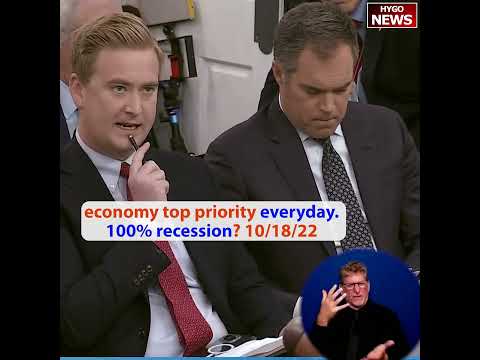
Doocy: Bloomberg Forecasts 100% Chance of Recession — How Is the Economy “Strong as Hell”? KJP: “Transition to More Stable Growth”
On 10/18/2022, Peter Doocy confronted White House Press Secretary Karine Jean-Pierre with a brutal juxtaposition: KJP had just said Biden was “working on the economy every day” for 19 months, yet Bloomberg economists were forecasting a 100% chance of recession. “So how is it that we can be barreling towards a recession and the economy is, as the president says, ‘strong as hell’?” Doocy asked. KJP responded that the economy was in a “transition” to “more stable growth, more steady growth” — rebranding potential economic contraction as part of a deliberate plan — and insisted “that is because of the work that this president has done."
"Working on the Economy Every Day” — to What End?
KJP had set up Doocy’s question herself. Earlier in the briefing, she had emphasized Biden’s daily economic focus. “He’s working on the economy every day. So that’s working on the economy every day,” KJP said — a tautological statement that invited scrutiny of the results.
Doocy seized on the framing. “So you said he’s been working on the economy every day for 19 months,” Doocy said. “Now Bloomberg economists are forecasting a 100 percent chance of a recession. So how is it that we can be barreling towards a recession and the economy is, as the president says, ‘strong as hell’?”
The question exposed the logical gap in the White House’s messaging. If Biden had genuinely made the economy his daily focus for 19 months — since roughly March 2021 — the results of that focus should be visible. Instead, the results included 8.2% inflation, two consecutive quarters of GDP contraction, a stock market down 25%, mortgage rates above 7%, and now a 100% recession probability forecast from one of the world’s most respected financial data companies.
Either Biden’s daily economic work was ineffective, or it was effective and the economy’s trajectory was where Biden wanted it. The White House could not hold both positions simultaneously, yet KJP’s briefing room strategy required maintaining exactly that contradiction.
Bloomberg’s 100% Forecast
The Bloomberg Economics recession probability model had reached 100% — a certainty forecast that was historically unusual and reflected the convergence of multiple warning indicators. The model incorporated the yield curve inversion (short-term Treasury yields exceeding long-term yields, a historically reliable recession predictor), the Federal Reserve’s aggressive tightening cycle, declining leading economic indicators, and consumer sentiment at historic lows.
While 100% probability forecasts should be viewed with appropriate skepticism — economic models are imperfect — the Bloomberg forecast reflected a broad consensus among economists that a recession was highly likely. The Wall Street Journal’s monthly survey of economists showed recession probability above 60%. The Conference Board’s leading economic index had been declining for months. Multiple major banks had issued recession warnings.
Biden’s own statement that the economy was “strong as hell” — made during a stop for ice cream on October 16, 2022 — had already drawn ridicule given the economic indicators. Doocy’s question forced the White House to reconcile the president’s ice cream shop bravado with the cold numbers.
”A Transition to More Stable Growth”
KJP’s response deployed the administration’s most creative economic euphemism. “What we are seeing right now is the job market is strong, the labor force is strong. And that is not what we see usually before a recession,” KJP said.
Then came the reframing: “It’s seeing an economy that is going through — into a transition with more stable growth, more steady growth,” KJP said. “And that is because of the work that this president has done. That is because of the economic policy that he has put forward.”
The word “transition” was doing enormous rhetorical work. GDP had contracted for two consecutive quarters — Q1 and Q2 of 2022 — meeting the traditional definition of a recession. The White House had disputed this definition, arguing that the National Bureau of Economic Research (NBER) uses a broader set of criteria. But regardless of technical definitions, the economy was decelerating sharply.
By calling this deceleration a “transition to more stable growth,” KJP was rebranding economic weakness as intentional moderation — as if the administration had deliberately engineered a slowdown from “historically strong” to “stable.” The framing required believing that the same president who was “working on the economy every day” had planned for the economy to slow dramatically, for the stock market to crash, and for recession forecasts to reach certainty — and that this was all part of the design.
”Not What We See Before a Recession”
KJP cited the strong job market as evidence against recession. “The job market is strong, the labor force is strong. And that is not what we see usually before a recession,” KJP said.
The argument had a factual basis — unemployment remained low at 3.5% — but it was also misleading. Job market data is a lagging indicator; employment typically remains strong until a recession is already underway. The labor market was the last shoe to drop, not the first indicator of economic health. Citing strong employment as proof that recession wouldn’t happen was like citing fair weather in the morning as proof it wouldn’t rain in the afternoon.
Moreover, the strong job market itself was contributing to the inflation problem. Tight labor markets pushed wages up, which increased production costs, which were passed to consumers as higher prices. The Federal Reserve’s rate hikes were explicitly designed to cool the labor market — meaning the “strong jobs” KJP cited as positive were part of the inflationary dynamic the Fed was trying to break.
The “Strong as Hell” Context
Biden’s “strong as hell” comment had come two days earlier, on October 16, during an impromptu exchange with reporters at a Portland, Oregon ice cream shop. Asked about the economy, Biden said: “Our economy is strong as hell.”
The remark was criticized for its tone-deafness. Americans were dealing with 8.2% inflation, grocery bills up 11%, and gasoline still well above pre-Biden levels. The image of the president eating ice cream while declaring the economy “strong as hell” became a symbol of the disconnect between White House messaging and consumer reality.
By the time Doocy quoted it back at KJP two days later, the phrase had already become a punchline. KJP’s task was to defend a statement that even allies acknowledged was poorly timed and poorly worded.
The Broader Messaging Problem
The exchange captured the fundamental incoherence of the administration’s economic communications in late 2022. The White House simultaneously maintained that:
- The economy was “strong as hell” (Biden, October 16)
- Biden was “working on the economy every day” because it needed fixing (KJP, October 18)
- The economy was in a “transition to more stable growth” (KJP, October 18)
- There would be no recession (the White House position throughout 2022)
- If there was economic pain, it was Putin’s fault, OPEC’s fault, or Republicans’ fault
These positions could not all be true at the same time. An economy that was “strong as hell” shouldn’t need the president working on it every day. An economy the president was working on every day shouldn’t be facing a 100% recession forecast. A “transition to stable growth” shouldn’t require denying the possibility of recession.
Key Takeaways
- Doocy asked how the economy could be “strong as hell” when Bloomberg forecast a 100% chance of recession after Biden had worked on it “every day” for 19 months.
- KJP rebranded economic deceleration as a “transition to more stable growth, more steady growth” — framing potential recession as intentional moderation.
- She cited the strong job market as evidence against recession, though employment is a lagging indicator that typically remains strong until recession is already underway.
- Biden had declared the economy “strong as hell” while eating ice cream, two days before KJP had to defend the statement against a 100% recession forecast.
- The White House simultaneously maintained the economy was strong, needed daily presidential attention, was “transitioning,” and would not enter recession — positions that contradicted each other.
Transcript Highlights
The following is transcribed from the video audio (unverified — AI-generated from audio).
- He’s been working on the economy every day for 19 months. Now Bloomberg economists are forecasting a 100% chance of a recession.
- How is it that we can be barreling towards a recession and the economy is, as the president says, strong as hell?
- The job market is strong, the labor force is strong. That is not what we see usually before a recession.
- An economy that is going through a transition with more stable growth, more steady growth.
- That is because of the work that this president has done.
- That is because of the economic policy that he has put forward.
Full transcript: 158 words transcribed via Whisper AI.