 HYGO News
 Q: how prepared to stop people from crossing border next week? A: why don't GOPs work with us?
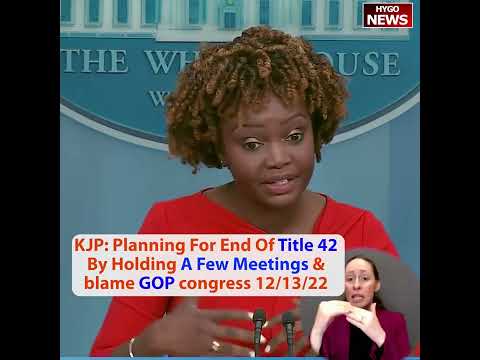
KJP on Title 42 End Next Week: Administration “Asking Congress for Resources” — Pivots to Blame Republicans Instead of Outlining Specific Actions
On 12/13/2022, a reporter asked White House Press Secretary Karine Jean-Pierre how the Biden administration was preparing for the anticipated end of Title 42 — the COVID-era public health authority that had allowed rapid expulsion of migrants at the southern border — and what Biden was prepared to do to stop increased border crossings. “How is the administration preparing for that? And what more is the President prepared to do to stop people crossing the border regularly in the United States?” the reporter asked. KJP’s response emphasized asking Congress for resources and coordinating with Western Hemisphere partners, but provided few specifics. She then pivoted to blaming Republicans: “Why don’t they work with us on this particular issue that is important to Americans across the country?” The exchange captured the administration’s pattern of responding to border questions by redirecting responsibility to Republicans rather than detailing specific administration actions.
The Title 42 Context
The question’s urgency came from an impending legal deadline. Title 42 was a public health authority that had been invoked during the COVID-19 pandemic to rapidly expel migrants at the southern border without asylum hearings. The authority had been used to expel hundreds of thousands of migrants since March 2020.
A federal court had ruled that the administration had to end Title 42 by December 21, 2022 — just over a week away when this briefing occurred. The ending of Title 42 would:
Return migrants to regular asylum processing — Meaning they couldn’t be summarily expelled.
Create processing backlogs — As numbers increased.
Test border infrastructure — With higher volumes.
Challenge administration messaging — About whether border was secure.
Raise operational questions — About capacity to handle migration.
The administration had been preparing for this moment but had provided limited public detail about specific plans.
The Specific Question
The reporter’s question had two parts:
Preparation question — How was the administration preparing for the Title 42 deadline?
Action question — What more was Biden prepared to do to stop border crossings?
Both parts sought specific information about administration plans. The first asked about preparations for the anticipated surge. The second asked about Biden’s personal engagement with the issue.
”Asking Congress for Resources”
KJP’s first response emphasized Congressional action. “So what we’re doing to need to prepare, we are asking Congress, as you all know, for the resources,” KJP said.
The “asking Congress for resources” framing was a standard administration response to border questions. The framing had several features:
Shifted responsibility — To Congress rather than executive action.
Implied insufficient resources — Suggesting Congress should do more.
Avoided specifics — What resources exactly and for what purpose.
Maintained legislative focus — Rather than regulatory or operational action.
The framing was legally plausible — Congress appropriates funds and sets immigration policy. But it was also politically convenient. By focusing on Congressional action, the administration could avoid questions about what it could do through executive action alone.
”Coordinating with Leaders Across Western Hemisphere”
KJP referenced diplomatic coordination. “We’ve been coordinating with leaders across the Western Hemisphere. As you all know, we’ve reported on meetings that we’ve had and actions that we have taken,” KJP said.
The hemispheric coordination framing had substance. Migration pressures from Central America, Venezuela, Haiti, and other countries involved regional cooperation. Administration officials had been meeting with counterparts from Mexico, Colombia, and other countries.
But the “coordinating” framing was vague:
No specific agreements cited — What coordination had produced.
No enforcement commitments — What other countries would do.
No joint operations described — What tangible cooperation existed.
No specific outcomes — Beyond general coordination.
The “as you all know, we’ve reported on meetings” referenced prior announcements but didn’t extend understanding of what specific preparations were underway for the Title 42 deadline.
”More in the Coming Days”
KJP promised future information. “We’ll certainly have more in the coming days,” KJP said.
The “more in the coming days” framing was another deflection technique. It promised information without committing to specifics. Reporters couldn’t test this promise until the “coming days” passed, and by then other questions would have priority.
The technique also managed expectations. Rather than providing specifics in the current briefing, KJP deferred them to a future announcement. This allowed the administration to control the timing and framing of any specifics that were eventually provided.
The Pivot to Republicans
KJP then pivoted to blame Republicans. “But look, you know, you’ve heard this say this before and we put the question to Congress, and what are they going to do here? Republicans are asking, you know, how are we going to secure the border?” KJP said.
The pivot shifted the conversation:
From administration actions — To Republican demands.
From specific preparations — To political conflict.
From executive responsibility — To legislative responsibility.
From Biden’s engagement — To Republican obstruction.
The pivot had a clear political purpose. By redirecting attention to Republicans, KJP could avoid providing the specifics the reporter had asked for.
”Why Don’t They Work With Us”
KJP extended the Republican-blame framing. “I’ve listed out on ways that we’ve tried to work on that. So why don’t they work with us on this particular issue that is important to Americans across the country? And we’re asking for them to join us on this issue as well,” KJP said.
The “why don’t they work with us” framing was questionable on several grounds:
Executive action was available — Administration could act through regulations and operations.
Bipartisan frameworks existed — Various bipartisan immigration deals had been proposed.
Administration hadn’t proposed specific bill — Making “working with us” ambiguous.
Political context made deal difficult — But that was partly by choice.
The framing treated Congressional gridlock as solely Republican responsibility. But negotiation requires both sides to make concessions. The administration’s own positions — maintaining asylum standards, accepting large migrant flows, not prioritizing border enforcement — were positions Republicans wouldn’t accept.
The Blame Game
The pivot to blaming Republicans was part of a broader pattern. On many policy issues, the administration used Republican obstruction as explanation for limited progress:
Voting rights — Republicans blocked legislation. Climate action — Republicans resisted ambitious policy. Immigration — Republicans blocked comprehensive reform. Budget issues — Republicans demanded spending cuts.
In some cases, this framing was accurate. Republican opposition did block various administration priorities. But the framing also deflected from administration limitations:
Executive action options — What the administration could do alone.
Regulatory possibilities — Changes within existing law.
Operational adjustments — How existing resources were used.
Leadership engagement — Presidential attention and advocacy.
Blaming Republicans couldn’t fully explain why these internal administration levers weren’t being used more effectively.
What Specific Preparations Existed
The administration did have some specific preparations for Title 42’s end:
DHS contingency planning — Various scenarios had been prepared.
Temporary housing expansion — For migrant processing.
Staffing increases — At the border.
Coordination with NGOs — For processing assistance.
Regulatory preparations — For asylum processing under regular rules.
But KJP didn’t detail these preparations in her response. The reporter’s question had asked specifically about preparations, and KJP’s response had been vague about what preparations existed.
This pattern — administrative plans existed but weren’t publicly detailed — was characteristic of Biden administration communications on border issues. The administration seemed to prefer general talking points to specific operational discussion, possibly because specifics would invite scrutiny of adequacy.
The Supreme Court Intervention
Shortly after this exchange, the Supreme Court intervened in the Title 42 case. Chief Justice John Roberts issued a temporary stay on December 19, 2022, preventing Title 42 from ending on December 21 as originally scheduled. The Court subsequently heard arguments and extended the stay indefinitely.
This judicial intervention meant Title 42 remained in effect for another five months. The December 2022 crisis the reporter had anticipated was postponed. The administration got additional time to prepare.
But the fundamental questions remained. When Title 42 would eventually end, what specific preparations would be in place? What operational adjustments would be made? How would the administration handle expected increases in crossings?
The Eventual Title 42 End
Title 42 eventually ended in May 2023. The transition included:
Various alternative policies — Replacing Title 42 with other approaches.
CBP One app — For asylum appointments.
Regional processing — In other Western Hemisphere countries.
Humanitarian parole programs — For specific populations.
Continued enforcement at ports — For unauthorized entries.
These specific policies were eventually implemented. But the December 2022 briefing had given no preview of these specific approaches. KJP’s responses had been general enough to apply to many possible preparations.
The Biden Personal Engagement Question
The reporter’s second question — what more was Biden prepared to do — had been about presidential personal engagement. KJP’s response had been about administration action generally, not about Biden specifically.
Biden’s personal engagement with border issues had been limited throughout his presidency:
Rare border visits — Just one visit (January 2023) during his term as of this exchange.
Limited public speaking — Few major speeches on immigration.
Delegated to Harris — Who had been assigned migration-related responsibilities.
Indirect engagement — Through cabinet officials and staff.
Avoided border state tours — Despite multiple trips to border states.
The limited presidential engagement was a pattern the reporter was probing. KJP’s failure to address this part of the question suggested that Biden personally wasn’t taking a dramatic new role in border response.
The Messaging Challenge
The administration’s messaging on border issues faced a fundamental challenge. It needed to simultaneously:
Acknowledge border problems — To seem responsive to concerns.
Defend current policies — As working or as best available.
Blame Republicans — For legislative gridlock.
Promise action — Without specific commitments.
Maintain progressive base — On immigration values.
These goals were in tension. Too much acknowledgment of problems would implicate administration policies. Too much defense of policies would seem tone-deaf to public concerns. Too much Republican blame would look like deflection. Too much promise of action required eventual delivery.
KJP’s responses on border topics often reflected this tension. Vague generalities, Republican blame, and procedural deflections combined to produce messaging that satisfied none of the audiences fully but didn’t damage any of them critically.
Key Takeaways
- A reporter asked KJP how the administration was preparing for Title 42’s anticipated end and what more Biden was prepared to do on the border.
- KJP cited asking Congress for resources and coordinating with Western Hemisphere leaders — but provided few specifics.
- She promised “more in the coming days” without committing to specifics.
- KJP pivoted to blaming Republicans: “Why don’t they work with us on this particular issue?”
- The response didn’t address the reporter’s question about Biden personally and what specific preparations existed for the Title 42 deadline.
- The Supreme Court eventually intervened, postponing Title 42’s end until May 2023 — giving the administration additional time but not answering the underlying questions.
Transcript Highlights
The following is transcribed from the video audio (unverified — AI-generated from audio).
- How is the administration preparing for that? And what more is the President prepared to do to stop people crossing the border regularly in the United States?
- So what we’re doing to need to prepare, we are asking Congress, as you all know, for the resources.
- We’ve been coordinating with leaders across the Western Hemisphere.
- We’ll certainly have more in the coming days.
- Republicans are asking, you know, how are we going to secure the border? I’ve listed out on ways that we’ve tried to work on that.
- So why don’t they work with us on this particular issue that is important to Americans across the country?
Full transcript: 162 words transcribed via Whisper AI.