 HYGO News
 Q: how concerned title 42? Repeated answer: Biden day 1 comprehensive immigration reform bill
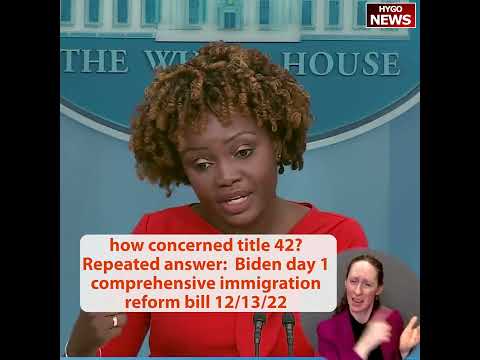
KJP on Unprecedented Border Surge Concern: Points to Secretary Mayorkas in El Paso, Recycles “Day 1” Comprehensive Reform Bill Talking Point
On 12/13/2022, a reporter asked White House Press Secretary Karine Jean-Pierre how concerned the administration was about an anticipated “unprecedented surge” of migrants once Title 42 ended. “How concerned is the administration that there will be this unprecedented surge of migrants trying to come across the border once Title 42 goes away?” the reporter asked. KJP’s response pointed to DHS Secretary Alejandro Mayorkas visiting El Paso and recycled her standard talking point about Biden having proposed a “comprehensive immigration reform bill” on his first day in office. “The first day of the President’s administration, he put forth a comprehensive immigration reform bill because he understands how important this is. We have taken action, we have given the Department of Homeland Security historic funding to deal with this very issue.” The response didn’t address the specific concern about the anticipated surge or what preparations existed for an unprecedented volume.
The “Unprecedented Surge” Concern
The reporter’s question referenced anticipated volumes. “How concerned is the administration that there will be this unprecedented surge of migrants trying to come across the border once Title 42 goes away?” the reporter asked.
The “unprecedented surge” framing was substantive. Intelligence assessments, DHS analysis, and public reporting had indicated that ending Title 42 would likely produce dramatic increases in border crossings. Estimates suggested that:
Daily crossings could double — From roughly 7,500 per day under Title 42 to 15,000+ without it.
Processing backlogs would grow — Overwhelming existing capacity.
Humanitarian challenges would increase — With larger migrant populations to care for.
Political pressure would intensify — On the administration.
Operational challenges would multiply — For Border Patrol and other agencies.
The “unprecedented” characterization was accurate. No prior migration wave had matched the anticipated post-Title 42 volumes. The administration faced a genuinely historic challenge.
”Secretary of the OECD”
KJP’s response had an odd reference. “So look, as you know, as I know you guys are all tracking, the Secretary of the OECD is in El Paso today and he’s assessing operations,” KJP said.
“Secretary of the OECD” was a clear error. The OECD is the Organization for Economic Cooperation and Development, a 38-country international economic organization. It doesn’t have a secretary who would visit El Paso to assess border operations.
KJP evidently meant “Secretary of DHS” (Department of Homeland Security) — Alejandro Mayorkas. Later in her response, she referenced “my arcus” (Mayorkas) being “down at El Paso” — confirming that Mayorkas was the intended subject.
The “OECD” error was another verbal stumble. KJP apparently mixed up abbreviations — possibly confusing DHS with OECD, or making a different mental substitution. These kinds of errors were characteristic of her briefing style under pressure.
Mayorkas’s El Paso Visit
The reference to Mayorkas in El Paso was informative. The Secretary of Homeland Security visiting El Paso just before the expected Title 42 deadline suggested:
Administration engagement — Cabinet-level attention to the situation.
Operational assessment — Secretary reviewing actual conditions.
Preparation activities — Final arrangements before deadline.
Public visibility — Secretary’s visit was a political signal.
But KJP’s reference to the visit didn’t substitute for addressing the reporter’s concern question. The Secretary visiting El Paso didn’t automatically mean the administration had adequate plans for the anticipated surge. The visit was evidence of attention but not necessarily of adequate preparation.
The “Day 1 Comprehensive Reform” Recycle
KJP then moved to a familiar talking point. “This is something, again, the first day of the President’s administration, he put forth a comprehensive immigration reform bill because he understands how important this is,” KJP said.
The “first day” comprehensive reform reference was a recurring administration talking point. On January 20, 2021, Biden had sent Congress the U.S. Citizenship Act — a comprehensive immigration reform proposal. The bill would have provided:
Pathway to citizenship for undocumented — For long-term residents.
Legal status for Dreamers — Protecting DACA recipients.
Enhanced border security — Technology investments.
Root cause investments — In Central America.
Court processing improvements — For asylum cases.
The bill had gone nowhere. Congressional Republicans hadn’t supported it. Democrats hadn’t pursued it aggressively. By late 2022, the bill was essentially dormant as active legislation.
The Recycled Talking Point Pattern
The “day 1 comprehensive reform” reference was an example of a recycled talking point. Administration officials would return to this reference whenever immigration questions arose. The purpose was:
Show administration engagement — Biden had acted on day 1.
Shift blame — Congress hadn’t passed the bill.
Appear comprehensive — Addressing the broader issue.
Avoid specifics — About current operational challenges.
Demonstrate priorities — Immigration was important from the start.
But the repeated use of the talking point highlighted its limitations. A bill that had gone nowhere for nearly two years wasn’t evidence of recent engagement. Referencing it repeatedly was a rhetorical crutch, not a substantive response.
The reporter’s question had been about current concerns about an imminent surge. Biden’s January 2021 bill didn’t address those current concerns. The answer was substantively disconnected from the question.
”Historic Funding to DHS”
KJP cited DHS funding. “We have taken action, we have given the Department of Homeland Security historic funding to deal with this very issue,” KJP said.
The “historic funding” framing was technically accurate. DHS funding had grown during Biden’s presidency. But the framing was also selective:
Funding doesn’t automatically solve capacity issues — Spending takes time to translate to operations.
Budget growth happened under prior administrations too — Not unique to Biden.
Specific preparations weren’t detailed — What the funding was being used for.
Adequacy wasn’t addressed — Whether the funding was sufficient.
The funding reference was another way to seem substantive without being specific. It pointed to financial commitment without explaining operational preparation.
”Continue to Monitor”
KJP concluded with a familiar phrase. “And so we’re going to continue to monitor this,” KJP said.
“Continue to monitor” was a standard administration phrase that meant essentially nothing. It committed to ongoing attention without committing to any specific action. The phrase appeared in administration responses on many issues:
Economic concerns — “Continuing to monitor inflation.” Foreign policy — “Continuing to monitor Russia.” Public health — “Continuing to monitor COVID.” Climate events — “Continuing to monitor storms.”
The phrase’s utility was that it was always true (administrations do monitor issues) and always forward-looking (promising attention). It didn’t commit to any specific outcome or action.
On an imminent surge of migrants, “continuing to monitor” was particularly inadequate. Monitoring was necessary but insufficient. Preparation for the anticipated events required specific actions, not just observation.
The Pattern Consistency
KJP’s response to this question showed the consistent pattern of administration border messaging:
Cabinet activity reference — Mayorkas in El Paso.
Recycled talking point — Comprehensive reform bill from day 1.
Funding emphasis — Historic DHS funding.
Monitoring commitment — Continuing to watch.
No specific preparation details — About the anticipated surge.
This pattern produced briefings that satisfied minimum requirements for engagement without producing actual information. Reporters got responses. The administration got to claim it had addressed the questions. But substantive understanding didn’t increase.
The Real Preparation Activity
Behind the vague public messaging, actual preparations were underway:
DHS contingency planning — Multiple scenarios being developed.
Regulatory preparations — For processing under non-Title-42 rules.
Regional diplomacy — With Mexico and Central America.
Capacity expansion — For processing centers.
Agency coordination — Between CBP, ICE, USCIS, and others.
These preparations were real and substantial. But they weren’t described in public briefings in detail. The administration seemed to prefer:
Minimal preparation disclosure — Reducing scrutiny of adequacy.
Flexible operational options — Preserving ability to adjust.
Lower public expectations — Avoiding commitments that might fail.
Political messaging control — Framing specific to each communication.
These preferences meant that public briefings provided little actual information about the administration’s preparation.
The Supreme Court Rescue
The anticipated Title 42 surge didn’t happen on December 21, 2022, because the Supreme Court intervened. Chief Justice Roberts issued a stay preventing Title 42 from ending on that date. The Court subsequently extended the stay indefinitely.
This judicial intervention gave the administration additional time. But it also meant that the specific preparations for December 21 were never tested. The administration could claim it had been ready without having to prove it.
When Title 42 eventually ended in May 2023, different circumstances prevailed:
Different policies in place — Alternative enforcement mechanisms.
Different volumes — After additional economic and political changes.
Different political context — Approaching 2024 election cycle.
Different administrative approach — With additional preparation time.
Whether the administration would have been prepared for a December 2022 end of Title 42 was never determined. KJP’s vague December 2022 responses weren’t tested against the anticipated surge that didn’t happen on schedule.
The Messaging vs. Reality
The gap between public messaging and operational reality was characteristic of administration border communications. The administration had:
Genuine internal preparations — Various contingency plans.
Limited public disclosure — Of specific plans.
Political constraints — On what could be said publicly.
Operational flexibility needs — That discouraged specific commitments.
Strategic messaging priorities — About Republicans, comprehensive reform, etc.
These factors combined to produce public messaging that was substantively disconnected from operational reality. Reporters asking about preparation concerns received talking points about past legislation. Reporters asking about current operations received generic references to cabinet activity. The information value of briefings was low even when substantive preparation was occurring.
Key Takeaways
- A reporter asked KJP how concerned the administration was about an “unprecedented surge” of migrants once Title 42 ended.
- KJP’s response pointed to DHS Secretary Mayorkas visiting El Paso (mistakenly called “Secretary of the OECD”).
- She recycled her standard talking point about Biden’s day-1 comprehensive immigration reform bill.
- KJP cited “historic funding” to DHS and committed to “continue to monitor.”
- The response didn’t address the specific concern about the anticipated surge or detail what preparations existed for an unprecedented volume.
- The Supreme Court’s intervention delayed Title 42’s end to May 2023, meaning the specific December 21 preparations were never tested.
Transcript Highlights
The following is transcribed from the video audio (unverified — AI-generated from audio).
- How concerned is the administration that there will be this unprecedented surge of migrants trying to come across the border once Title 42 goes away?
- The Secretary of the OECD is in El Paso today and he’s assessing operations.
- The first day of the President’s administration, he put forth a comprehensive immigration reform bill because he understands how important this is.
- We have taken action, we have given the Department of Homeland Security historic funding to deal with this very issue.
- And so we’re going to continue to monitor this.
- My arcus was down at El Paso to talk.
Full transcript: 121 words transcribed via Whisper AI.