 HYGO News
 Q: gas prices going up, now do you deplete Reserve more or refill it?
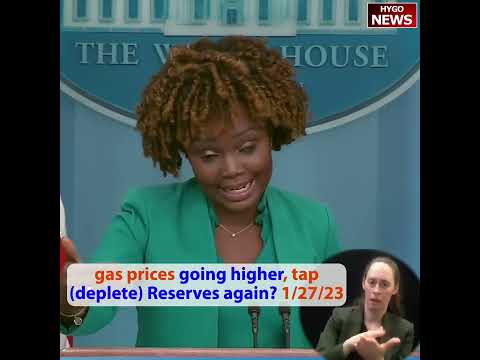
Reporter on $4 Gas: Will Biden Tap SPR Again? KJP: Not Refilling Now, Oil Climbing to $110
In late January 2023, a reporter asked White House Press Secretary Karine Jean-Pierre about potential Biden actions on Strategic Petroleum Reserve as gas prices were rising again. “Gas prices could hit $4 in the next couple of months, the national average, according to a lot of the experts like Gas Buddy. How likely is it that the president taps into the Strategic Petroleum Reserve again this year to try to lower price?” the reporter asked. KJP cited current price status: “Price of gas is still down about $1.50 since June peak. In contrast to what the House Republicans want to do, we have that SPR bill that they put forward in trying to stop the president for doing everything that he can to lower cost.” On refill: “We’re not refilling it, especially now that oil prices are climbing again, could get up to $110 a barrel.” When asked about timeline, KJP deflected: “I would refer you to the Department of Energy for any specifics.”
The $4 Projection
$4 gasoline projection:
Gas Buddy expert — Cited.
National average — Possible.
Two months — Timeframe.
Rising trend — Context.
Voter concern — Growing.
Gas Buddy’s projection of potential $4 gasoline was widely covered. This was concerning trend for administration messaging that had touted declining prices.
”Down About $1.50 Since June Peak”
KJP’s defensive statistic. “Price of gas is still down about $1.50 since June peak,” KJP said.
The defense:
June peak — Reference point.
$1.50 decline — From peak.
Favorable framing — Chosen.
Selective period — Used.
Positive aspect — Emphasized.
Gas prices had indeed declined from summer 2022 peak. But they were rising again from January lows. The “down from peak” framing ignored recent upward trend.
The Current Trend
Current trend:
Rising — Again.
Winter driving — Reduced typically.
Production issues — Some.
Global tensions — Various.
Seasonal refining — Transitions.
Multiple factors were driving gas prices up again. Even with production at record levels, prices were rising. The administration’s favorable framing faced contradictory trend.
”In Contrast to What the House Republicans Want”
KJP’s attack pivot. “In contrast to what the House Republicans want to do, we have that SPR bill that they put forward in trying to stop the president for doing everything that he can to lower cost,” KJP said.
The pivot:
GOP attack — Standard.
SPR bill — Characterized.
“Stop president” — Framing.
“Lower cost” — Biden’s goal.
Political confrontation — Invoked.
Rather than answering about likelihood of further SPR tapping, KJP pivoted to attacking GOP SPR restriction bill. This characterized the GOP as opposing cost reduction.
The GOP Bill Characterization
GOP bill:
Not preventing tapping — Exactly.
Required plan — For refill.
Accountability — Element.
Ban exports to China — Separate bill.
Reasonable — Arguably.
Characterizing GOP bills as “trying to stop the president from lowering cost” was misleading. The bills required planning rather than preventing tapping. This was political spin.
”Doing Everything He Can”
“Everything he can” framing:
Maximum effort — Claimed.
SPR tapping — Tool.
Other tools — Limited.
Constraint acknowledgment — Partial.
Political messaging — Strong.
Claiming Biden was “doing everything he can” was standard framing. Whether he had actually exhausted all options was debatable. Some had argued domestic production support was underutilized tool.
”We’re Not Refilling It”
KJP’s direct statement. “We’re not refilling it, especially now that oil prices are climbing again, could get up to $110 a barrel,” KJP said.
The statement:
Not refilling — Current status.
Oil rising — Reason.
$110 forecast — Cited.
Price sensitivity — Factor.
Delay justified — By market.
The not-refilling position was practical given rising prices. Administration wanted to buy low. But waiting indefinitely for low prices might mean never refilling if prices stayed high.
The Refill Timing Challenge
Refill timing:
Buy low — Ideal.
Market high — Current.
Long-term need — Real.
Political pressure — To refill.
Decision tension — Genuine.
The refill timing was genuinely challenging. Buying at high prices would waste taxpayer money. Waiting too long left reserves low during potential emergencies.
”Could Get Up to $110 a Barrel”
Oil price projection:
$110 barrel — Possible.
Current — ~$80.
Rising trend — Acknowledged.
Market conditions — Deteriorating.
Refill impossible — At high prices.
The projection of $110 oil was significant. Refill strategy made sense at lower prices but became impractical at higher ones. This admitted market constraint on policy.
”When Do You See the Timeline”
Timeline question:
Specific — Timeline requested.
Commitment sought — From KJP.
Accountability — Through dates.
Planning — Documented or not.
Political weight — Of answer.
The timeline question required specific response. Without dates, refill was abstract promise. Having timeline would create accountability.
”I Don’t Have Anything Updated”
KJP’s deflection. “So we had laid out the plan of how that was going to work. I don’t have anything updated on that,” KJP said.
The deflection:
Previous plan — Existed.
No update — Available.
DOE referral — Standard.
Specifics avoided — Of timeline.
Accountability gap — Created.
By saying there was “no update,” KJP was avoiding specific timeline. This allowed administration flexibility but created accountability gap.
The DOE Referral
DOE referral:
Standard deflection — For energy specifics.
Not briefing — Press regularly.
Information limit — For reporters.
KJP escape — Available.
Pattern — Repeated.
Referring reporters to DOE was standard deflection on energy specifics. DOE didn’t brief press regularly. The referral effectively prevented follow-up.
The SPR Drawdown History
SPR drawdown:
180 million barrels — Biden’s release.
Historic scale — Yes.
6-month release — Extended.
Price effect — Debated.
Strategic impact — Significant.
Biden’s 180 million barrel release had been historic drawdown. Whether it had meaningfully affected prices was debated. Strategically it had reduced reserves significantly.
The Refill Commitment
Refill commitment:
Announced earlier — 2022.
$70 barrel target — Originally.
Prices rose — Before refill.
Delayed — Indefinitely.
Political vulnerability — Real.
Biden had announced refill commitment at $70/barrel. When prices rose above that, refill was delayed. The commitment wasn’t being implemented. This was political vulnerability.
The Political Stakes
Political stakes:
Gas prices — Voter concern.
SPR status — National security.
2024 approaching — Campaign relevance.
Narrative battle — Ongoing.
Stakes — Real.
The political stakes around SPR and gas prices were high. 2024 campaign would feature energy policy debates. Current administration vulnerability was real.
The Republican Messaging
Republican messaging:
Drawdown criticized — Extensively.
China sales — Attack point.
Refill failure — Emphasized.
Energy policy — Broader critique.
Concerns — Multiple.
Republicans had multiple attack lines on SPR. Scale of drawdown, China sales, refill failure, broader energy policy. Each provided ammunition.
The Strategic Reserve Purpose
Strategic Reserve purpose:
Emergency — Original.
Not price management — Traditional.
Biden’s novel use — Controversial.
Precedent set — Concerning.
Future administrations — Will use?
Biden’s precedent of using SPR for price management rather than just emergencies was controversial. Future administrations would be tempted to use it similarly.
The Energy Security Implications
Energy security:
Reserve at historic lows — Yes.
Emergency capacity — Reduced.
Strategic position — Weakened.
Ally confidence — Affected.
Deterrence — Reduced.
The strategic implications of having SPR at historic lows were real. If major supply disruption occurred, emergency capacity would be limited. This was legitimate concern.
The Market Dynamics
Market dynamics:
Supply factors — Multiple.
Demand factors — Complex.
Refining capacity — Limited.
Transportation — Constraints.
Global factors — Substantial.
Gas prices reflected complex market dynamics beyond administration control. Even with domestic production at record levels, global factors drove prices.
The Production Reality
Production reality:
Near record — U.S. levels.
Growth slowed — Somewhat.
Capital discipline — Industry.
Investor pressure — Shareholder returns.
Policy factor — Debated.
U.S. oil production was at near-record levels despite administration rhetoric. Industry had shifted to capital discipline returning cash to shareholders rather than maximum growth.
The OPEC+ Role
OPEC+ role:
Production decisions — Significant.
Saudi leadership — Key.
Russia partnership — Continuing.
U.S. leverage — Limited.
Diplomatic dimension — Important.
OPEC+ production decisions significantly affected prices. Saudi Arabia’s leadership and Russia’s role shaped decisions. U.S. influence was limited despite diplomatic efforts.
The China Demand Factor
China demand:
Recovery from COVID — Ongoing.
Oil imports — Growing.
Market impact — Significant.
Price effect — Upward.
Global factor — Major.
China’s emergence from COVID restrictions was driving oil demand higher. This was major factor in price trends. Administration had limited influence on this.
The Russia Factor
Russia factor:
War continuing — Impact.
Sanctions — Various.
Price caps — Implemented.
Production — Complex.
Long-term disruption — Real.
Russia’s invasion of Ukraine continued affecting global energy markets. Western sanctions and price caps had complex effects. The disruption was multi-year phenomenon.
The Administration Position Defense
Administration defense:
Complex market — Acknowledged.
Doing what they can — Claimed.
Consumer focus — Emphasized.
Republican attacks — Countered.
2024 narrative — Prepared.
Administration was positioning on energy issues for 2024 campaign. Defending drawdown decisions while acknowledging complexity. The political narrative was being developed.
The Political Vulnerability
Political vulnerability:
Specific numbers — Attack material.
Reserves low — Fact.
Refill stalled — Fact.
Gas rising — Fact.
Accumulating — Over time.
The political vulnerability was real and growing. Specific facts worked against administration narrative. Republicans had substantive ammunition.
The Energy Policy Complexity
Policy complexity:
Short-term — Gas prices.
Long-term — Transition.
Security — Reserves.
Climate — Emissions.
Balance difficult — Genuinely.
Energy policy required balancing multiple concerns. Short-term price management versus long-term transition. Security reserves versus climate goals. The balancing was genuinely complex.
The Messaging Discipline
Messaging discipline:
Favorable stats — Emphasized.
Negatives — Minimized.
GOP attacks — Deflected.
Future commitments — Vague.
Consistency — Maintained.
Administration messaging discipline was apparent. Specific favorable statistics deployed. Negatives minimized through framing. GOP attacks deflected. Future commitments kept vague for flexibility.
The 2024 Campaign Preview
2024 preview:
Energy as issue — Major.
Gas prices — Specific.
SPR status — Referenced.
Administration record — Tested.
Messaging battle — Intensifying.
The 2024 campaign energy battles would feature many of these issues. Current administration positioning was setting ground for campaign. Both sides were preparing.
Key Takeaways
- A reporter asked KJP about $4 gasoline projection and potential further SPR tapping.
- KJP cited favorable stat: “Price of gas is still down about $1.50 since June peak.”
- She pivoted to attack GOP: “In contrast to what the House Republicans want to do… trying to stop the president for doing everything that he can to lower cost.”
- On refill: “We’re not refilling it, especially now that oil prices are climbing again, could get up to $110 a barrel.”
- When asked about refill timeline, KJP deflected: “I don’t have anything updated on that. I would refer you to the Department of Energy for any specifics.”
- The exchange highlighted administration’s challenge — SPR depleted, refill stalled, gas prices rising, while facing GOP attack legislation.
Transcript Highlights
The following is transcribed from the video audio (unverified — AI-generated from audio).
- Gas prices could hit $4 in the next couple of months, the national average, according to a lot of the experts like Gas Buddy.
- How likely is it that the president taps into the Strategic Petroleum Reserve again this year to try to lower price?
- Price of gas is still down about $1.50 since June peak.
- In contrast to what the House Republicans want to do, we have that SPR bill that they put forward in trying to stop the president for doing everything that he can to lower cost.
- We’re not refilling it, especially now that oil prices are climbing again, could get up to $110 a barrel.
- So we had laid out the plan of how that was going to work. I don’t have anything updated on that. I would refer you to the Department of Energy for any specifics.
Full transcript: 165 words transcribed via Whisper AI.