 HYGO News
 Q: FTC has found no price gouging why President still continues? WH: we see their profit
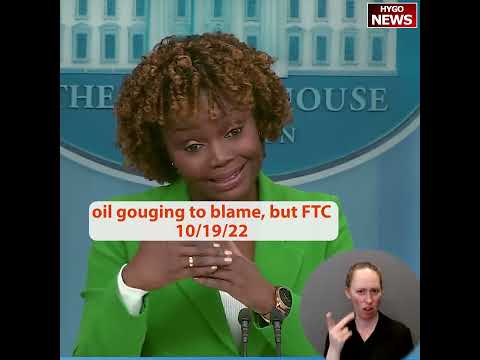
FTC Found No Price Gouging by Oil Companies — Reporter Asks Why Biden “Still Continues That Narrative”; KJP: “We’re Seeing It From the Chart”
On 10/19/2022, a reporter confronted White House Press Secretary Karine Jean-Pierre with a fact that undercut one of Biden’s central energy talking points: “The FTC has so far found no signs of wrongdoing for price gouging within oil companies. So I’m wondering why the President still continues that narrative.” KJP’s response — “because we’re seeing it from the chart” — effectively admitted the administration was substituting its own chart-reading for the conclusions of the federal agency it had asked to investigate. She pointed to a “60-cent gap” between oil company profits and pump prices as proof of gouging, despite the FTC finding no evidence of the wrongdoing Biden repeatedly alleged.
”The FTC Has Found No Signs of Wrongdoing”
The reporter’s question was built on the administration’s own investigative record. Biden had repeatedly accused oil companies of price gouging throughout 2022, calling their profits “outrageous” and “war profiteering.” In June, Biden had written a letter to major oil companies accusing them of exploiting consumers and demanding they increase refining capacity. He had also directed the FTC to investigate whether illegal activity was driving gas prices higher.
But the FTC’s investigation had produced no findings of illegal price gouging. The commission’s reports found that gas prices were driven by global crude oil costs, refining capacity constraints, and supply-demand dynamics — not by coordinated corporate malfeasance. The market was functioning as markets function during supply disruptions: prices rose when supply tightened and fell when supply loosened.
“So I’m wondering why the President still continues that narrative,” the reporter asked — pointing out that Biden’s own investigators had failed to substantiate his claims.
”Because We’re Seeing It From the Chart”
KJP’s response was remarkable for its candor. Rather than citing any legal finding, economic analysis, or regulatory conclusion, she pointed to a chart. “Because we’re seeing it from the chart,” KJP said.
The statement revealed the administration’s evidence base: not FTC investigations, not economic analyses, not market studies — a chart showing the gap between crude oil prices and retail gas prices. The administration was eyeballing a price spread and declaring it proof of gouging, regardless of what the actual regulatory investigation found.
“And oil companies were able to do it before, as I just stated to Peter,” KJP continued. “We’re seeing a 60-cent gap between where their profit are and what people are paying at the pump. And so they can bring it down. They’ve done it before.”
The “60-cent gap” argument was the administration’s visual shorthand for price gouging: the spread between the wholesale price of refined gasoline and the price consumers paid at the pump was wider than historical averages. The White House interpreted this as proof that oil companies were overcharging. Industry analysts offered a different explanation: refining capacity had been reduced during the pandemic (several refineries closed permanently), and the remaining capacity was operating at near-maximum utilization, which naturally widened the margin between crude and retail prices.
The FTC’s Actual Findings
The FTC had published multiple reports on gasoline pricing by October 2022, none of which found evidence of illegal price gouging. The commission’s analysis consistently concluded that gas prices tracked global crude oil prices with expected delays and regional variations.
In a December 2021 report, the FTC found that gasoline price increases in 2021 were “largely explained by the confluence of rising crude oil prices” and supply-demand imbalances. The commission noted that retail margins were not unusually high when accounting for increased costs across the supply chain.
In subsequent reports, the FTC identified instances where retail prices were slow to decline when wholesale costs fell — a phenomenon known as “rockets and feathers” — but this was a longstanding market pattern observed for decades, not evidence of new or illegal price manipulation.
Biden had asked the FTC to investigate specifically to create the impression that corporate greed was driving inflation — a politically useful narrative that shifted blame from government policy to private companies. When the investigation failed to produce the desired conclusions, the administration continued the accusation anyway, substituting chart-reading for evidence.
”Their Profits Is Being Afforded and Given To”
KJP’s explanation deteriorated further as she tried to articulate the policy position. “And so the President wants to make sure that the profits that oil companies are making is also being — you know, their profits is — is being afforded and given to — to the American people,” KJP said, the sentence trailing off into incoherence.
The incomplete thought appeared to be heading toward an argument about redistributing oil company profits to consumers — a concept that, if fully articulated, would have sounded like a description of windfall profit taxes, which Biden had threatened but never formally proposed to Congress. The fact that KJP couldn’t complete the sentence suggested the underlying policy idea was half-formed at best.
The “Greedflation” Strategy
Biden’s persistent accusations of oil company price gouging were part of a broader “greedflation” narrative that the administration deployed across multiple sectors throughout 2022. The strategy attributed inflation not to government spending, Federal Reserve policy, or supply constraints, but to corporate greed — specifically the decision by companies to raise prices beyond what input costs justified.
The narrative served a critical political purpose: it shifted blame for inflation from the government (which voters could punish at the ballot box) to corporations (which voters could not). If inflation was caused by greedy oil companies, meat packers, and shipping conglomerates, then the solution was government action against those companies — not a change in the government’s own policies.
The problem was that virtually no credible economist endorsed the “greedflation” theory as a primary explanation for broad-based inflation. Profit margins naturally expanded during periods of high demand and constrained supply — this was how markets allocated scarce resources, not evidence of coordinated gouging. And the FTC — the administration’s own investigative arm — had confirmed this reality.
The Political Utility of Blaming Oil Companies
Despite the lack of evidence, the price gouging narrative persisted because it served multiple political functions simultaneously. It provided a villain for voters frustrated by high gas prices. It justified potential windfall profit taxes that could fund Democratic spending priorities. It created rhetorical cover for the administration’s anti-fossil-fuel policies. And it allowed Biden to claim he was “fighting for consumers” against powerful corporate interests — a populist posture that polled well even if the underlying claims were unsupported.
The strategy required ignoring the FTC’s findings, which is precisely what KJP did when the reporter asked about them. “We’re seeing it from the chart” was an admission that the administration’s evidence was visual impression rather than investigative conclusion.
Key Takeaways
- The FTC found no evidence of price gouging by oil companies despite Biden repeatedly accusing them of war profiteering and exploitation.
- KJP’s defense — “because we’re seeing it from the chart” — admitted the administration was substituting chart interpretation for the FTC’s actual investigative conclusions.
- She cited a “60-cent gap” between profits and pump prices, which industry analysts attributed to reduced refining capacity, not corporate manipulation.
- KJP’s attempt to explain the policy goal trailed off into incoherence: “their profits is being afforded and given to — to the American people.”
- The price gouging narrative served political purposes — blame-shifting and populist positioning — but was unsupported by the administration’s own regulatory findings.
Transcript Highlights
The following is transcribed from the video audio (unverified — AI-generated from audio).
- The FTC has so far found no signs of wrongdoing for price gouging within oil companies. Why does the President still continue that narrative?
- Because we’re seeing it from the chart. And oil companies were able to do it before.
- We’re seeing a 60-cent gap between where their profits are and what people are paying at the pump.
- They can bring it down. They’ve done it before.
- The President wants to make sure that the profits oil companies are making is also being — their profits is being afforded and given to the American people.
- And so they can bring it down.
Full transcript: 108 words transcribed via Whisper AI.