 HYGO News
 Q: free & open press important democracy? A: disagree with your premise
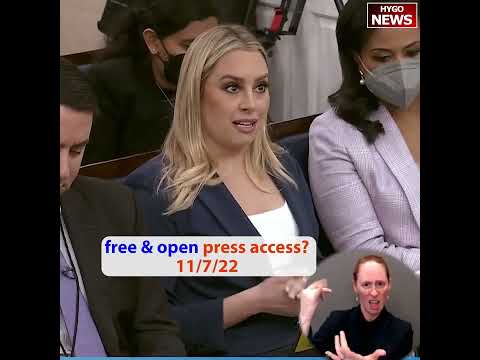
Reporter: If Democracy Is on the Ballot, Shouldn’t Biden Hold a Press Conference? KJP: “I Disagree With Your Premise” — Another Reporter: “The Question Was About Press Access, Not Democracy”
On 11/7/2022, the day before the midterm elections, Fox News reporter Jacqui Heinrich used Biden’s own “democracy is on the ballot” rhetoric against the White House’s press avoidance strategy. Heinrich argued that Biden’s warnings about threats to democracy made it “that much more important that the President avail himself to the free and open press that he has lauded as indispensable to the functioning of democracy.” KJP responded by saying she “disagreed with your premise” and talking about Biden’s commitment to democracy — completely missing the point. Another reporter interjected with the correction heard around the briefing room: “The question was about press access, not democracy.” KJP ignored the correction and moved on.
The Democracy-Press Freedom Paradox
Heinrich’s question was brilliantly constructed. She took Biden’s own argument — that democracy was under threat and voters needed to protect it — and connected it to the administration’s refusal to hold press conferences. “The president’s own warning that democracy is on the ballot, plus this potential for unrest, make it that much more important that the President avail himself to the free and open press that he has lauded as indispensable to the functioning of democracy,” Heinrich said.
The logic was airtight. Biden had spent months warning that American democracy was in peril. He had delivered a prime-time address at Independence Hall calling “MAGA Republicans” a threat to the republic. He had described the midterms as the most consequential election of his lifetime. He had called a free press “indispensable” to democratic governance.
Yet the president who warned about democratic erosion hadn’t held a formal White House press conference since January — a 10-month gap that was itself a departure from democratic norms of presidential accountability. If democracy required a free and open press, as Biden said, then a president who avoided sustained press questioning was undermining the very institution he claimed to defend.
Heinrich’s question forced KJP to reconcile two incompatible positions: Biden’s rhetoric about press freedom as essential to democracy and Biden’s practice of avoiding the press. The reconciliation was impossible, which explained KJP’s response.
”I Disagree With Your Premise”
KJP’s response was one of her most revealing non-answers. “The President has been very clear about where he stands when it comes to democracy. You’ve heard him talk about democracy over and over again,” KJP said. “So I disagree with your premise as if it is something that is not important to him. He’s made this an important issue.”
The response answered a question that wasn’t asked. Heinrich didn’t ask whether democracy was important to Biden — she asked whether Biden’s commitment to democracy should extend to holding press conferences. KJP treated the question as an attack on Biden’s democratic credentials rather than what it actually was: a request for the president to practice the press freedom he preached.
The “I disagree with your premise” formulation was a KJP staple — a way of rejecting a question without engaging with its substance. But in this case, the premise was Biden’s own argument, not the reporter’s. Biden said free press was essential to democracy. The reporter said therefore the president should hold press conferences. KJP disagreed — effectively disagreeing with the logical extension of Biden’s own position.
”Press Access, Not Democracy”
The exchange’s defining moment came when another reporter interjected with a correction that cut through KJP’s deflection. “The question was about press access, not democracy,” the reporter said.
The correction was devastating because it was true and concise. Heinrich had asked about press access. KJP had answered about democracy. The two were related — that was Heinrich’s entire point — but KJP had pivoted to the easier topic (Biden’s commitment to democracy) while ignoring the harder one (Biden’s avoidance of press conferences).
The interjection exposed a recurring KJP technique: reframing uncomfortable questions into questions she could answer. Reporter asks about press access → KJP answers about democracy. Reporter asks about inflation → KJP answers about the IRA. Reporter asks about Biden’s health → KJP answers about Biden’s schedule. The pattern was so consistent that the press corps had begun calling it out in real time.
KJP did not respond to the correction. She did not acknowledge that the question had been about press access. She moved on to the next reporter — the standard escape maneuver when she was caught deflecting.
”Consider This Our Request”
Heinrich concluded with a direct plea. “Consider that our request to have a press conference the day after the midterms,” Heinrich said — making the formal ask on behalf of the press pool.
The request highlighted the absurdity of the situation: the White House press corps was formally requesting that the president of the United States answer their questions. In a functioning democratic system with a transparent executive, this should not have required a formal request. Press conferences were supposed to be a regular feature of presidential communication, not a favor to be requested and potentially denied.
Biden had held fewer solo press conferences than any modern president at the equivalent point in their term. The scarcity had been noted by press freedom organizations, media critics, and even sympathetic commentators who argued Biden’s avoidance of sustained questioning undermined public accountability.
The Democracy Messaging Contradiction
Biden’s midterm closing argument was built on the premise that American democracy was uniquely threatened and that voters needed to act to protect it. The Independence Hall speech, the repeated warnings about “MAGA Republicans,” and the “democracy is on the ballot” framing all positioned Biden as democracy’s defender.
But the administration’s relationship with the press — which Biden called “indispensable” to democracy — told a different story. The White House routinely:
- Limited press conferences to the bare minimum
- Pre-selected reporters for questions at many events
- Cut off briefings when questions became uncomfortable
- Characterized legitimate questions as “bizarre,” “ridiculous,” or based on false premises
- Had Biden’s aides physically remove reporters from events
- Used the Hatch Act as a shield against political questions
- Refused to provide timelines, specific policy details, or accountability metrics
The gap between Biden’s pro-democracy rhetoric and his anti-accountability practices was the contradiction Heinrich’s question identified — and the correction “the question was about press access, not democracy” made impossible to ignore.
The Midterm Eve Context
The exchange occurred on November 7, 2022 — the final briefing before Election Day. KJP’s inability to commit to a post-midterm press conference on the last day before the election suggested the White House intended to manage Biden’s exposure regardless of the outcome. Whether Democrats won or lost, the strategy of limiting Biden’s unscripted public appearances would continue.
Biden did hold a post-midterm press conference on November 9, 2022 — a rare event that produced its own memorable moments, including Biden calling on reporters from a pre-approved list and saying “I’m told there will be four questioners.” The press conference was notable more for its rarity than for its substance, and it did not establish a pattern of regular presidential press availability.
Key Takeaways
- Heinrich argued that Biden’s “democracy is on the ballot” rhetoric made it “that much more important” for him to hold press conferences — using Biden’s own logic against the administration’s press avoidance.
- KJP said “I disagree with your premise” and talked about Biden’s commitment to democracy — answering a question that wasn’t asked.
- Another reporter interjected: “The question was about press access, not democracy” — exposing KJP’s deflection in real time.
- Heinrich formally requested “a press conference the day after the midterms” — highlighting the absurdity of the press pool having to formally ask the president to answer questions.
- Biden hadn’t held a White House press conference since January — a 10-month gap unprecedented for modern presidents.
Transcript Highlights
The following is transcribed from the video audio (unverified — AI-generated from audio).
- The president’s own warning that democracy is on the ballot makes it that much more important that he avail himself to the free and open press.
- The president has been very clear about where he stands when it comes to democracy.
- I disagree with your premise as if it is something that is not important to him.
- Press access, not democracy. — I just wanted to follow up.
- Consider that our request to have a press conference the day after the midterms.
- He has made this an important issue. I’m not going to get ahead of it.
Full transcript: 128 words transcribed via Whisper AI.